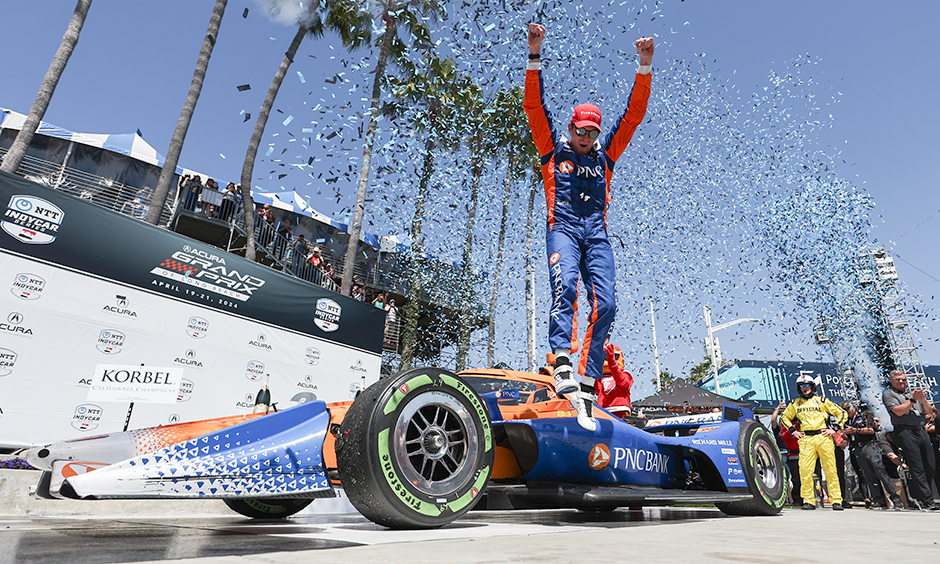
After a couple of duds, IndyCar returned to Long Beach to deliver a thriller. Strategy determined the day, but only one driver could make the winning strategy work. Six-time champion Scott Dixon reminded us that when fuel saving is required, there’s no other driver to back.
The race opened with some frantic, exciting laps, as the drivers jostled, given the importance of gaining early track position in a race where tyre saving could prove key. Felix Rosenqvist, who took a sensational pole on Saturday, once again did not have the race pace, losing several places to put himself out of the contention for the win. Will Power built a healthy lead over the field in the first stint, at this point looking like a shoo-in for victory lane. Yet fate had other plans, instigated by Christian Rasmussen’s crash causing an early caution period.
In response to the caution, amongst other drivers, Will Power and Scott Dixon jumped into pit lane, whilst Power’s teammate, Josef Newgarden stayed out. Those who pitted had to enter extreme fuel saving mode, making winning the race far harder for Will Power. A few laps later Dixon opportunistically overtook Power, ending Power’s chances and placing himself in the hot seat of leading the alternate strategy. And whilst Power lost out through this strategy, Dixon somehow won. Dixon’s team Chip Ganassi, Power’s Team Penske and even Scott Dixon himself were convinced that it would be impossible to save enough fuel at winning pace, yet not even physics could prevent this sensation.
Yet before winning the race, Scott Dixon still had to handle a fast-charging and determined Josef Newgarden, who caught Dixon easily. Nothing but perfection would be able to prevent Penske from taking victory at this point, yet Scott took every line correctly, keeping Josef in his dirty air, preventing what should have been an easy pass from even looking possible. Dixon was about to take one of the most unlikely wins in recent IndyCar history. As for his rival at Team Penske, he still had a little more to lose.
A few laps before the end the Dixon-Newgarden battle evolved into a four car battle for the win. Newgarden’s closing speed combined with a slight misjudgment from Colton Herta behind meant that Josef was hit from behind. Unfortunately for Penske, what looked like slight contact put Newgarden’s car into anti-stall, causing them to not only lose the win, but the podium. No penalty was given to Herta, in what on balance seemed a fair decision. In comparison to Pato O’Ward completely out breaking himself and slamming into his teammate at the race’s start, or Lance Stroll’s antics behind the safety car in F1, Herta’s mistake was slight and did not result in major contact. The IndyCar stewards recognized that this resembled the contact that can occur in wheel-to-wheel combat, to Penske’s disappointment. Though whilst disappointing rival teams, for motorsports to remain fun I believe there should be leniency given for some slight contact to encourage aggressive and competitive racing. Herta displayed maturity after the race though, immediately taking responsibility for his slight mistake. In comparison to Lance Stroll’s inability to take any responsibility for his actions, I’m glad that one driver this weekend was able to demonstrate how to maturely respond to one’s errors.
So, we had a bold fuel strategy leading to an unexpected winner and four-car battle for the race lead. These are the races IndyCar is known for, a chess-like strategy that leaves the audience guessing who will take victory until the final laps. It’s taken six weeks longer than it should have to say this, but IndyCar is back.
 Ryan's Lil' F1 Blog