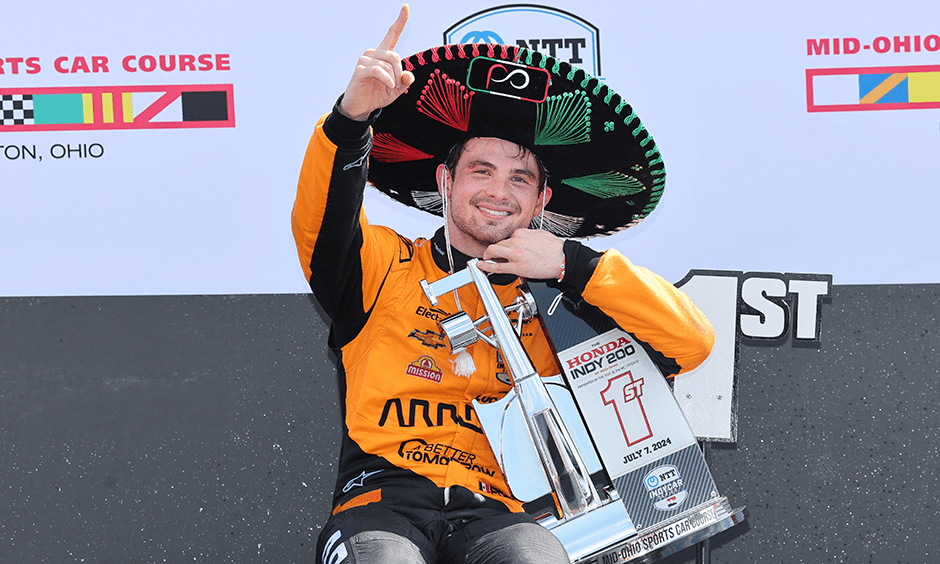
IndyCar’s Mid-Ohio race saw the debut of the hybrid system. Introducing a new technology mid-season is quite the risk for IndyCar to take. On one hand, I do admire the confidence it shows in the technology. On the other, it may derail the season if things go wrong. Mid-Ohio was not a complete disaster for the hybrids but was also not the unmitigated success that the commentary team tried to spin it as either. Whilst there were not a flurry of hybrid related retirements, one happened on the warm up lap. And it was Scott Dixon who was the victim of this bad luck, who to this point has been one of the contenders for the championship. His chances were already fading before this race and his luck may have put the nail into the coffin. This is the primary concern people have with the hybrids, that they’ll mess up the championship fight. To see that fear realized before the race even started was concerning.
The race itself was a relatively dull affair with not many on track battles. Alex Palou once again started on pole and took an early lead, that reached around six seconds over Pato O’Ward by the first stops. The star of the weekend was David Malukas. Having been dropped by McLaren earlier in the year after breaking his wrists during the pre-season, Malukas was bought back into the sport by Meyer Shank Racing. Despite still suffering the effects of his broken wrists, Malukas was able to qualify in third place in only his second race back. A podium was on the cards, and he ran in third during the first stint. However, another persistent problem with the hybrids affected Malukas, his car stalling after his pit stop. This lost Malukas a lot of time that he was not able to recover, finishing the race in twelfth. At this point I was evidently quite angry, as two of my favorite drivers had their races ruined by the new technology. Whilst it will obviously affect different drivers in future races, if the hybrids’ aim was to instantly alienate me, they succeeded.
Due to the lack of action across the field, most of the coverage was focused on the battle for the win between Palou and O’Ward, which in fairness, did remain tense for the race’s distance. Whilst Palou had built up a healthy lead by the first stops, on the softer red tyres O’Ward proved the better driver. Throughout the second stint he slowly closed up to Palou, to be within a second by the time they made their second stops. O’Ward stopped first and successfully undercut Palou, who himself lost around a second with a mini stall leaving the pits. Whilst Palou was quicker on the harder black tyres, he was unable to find a way past O’Ward, even when they were in traffic. Therefore, O’Ward took his second win of the season and his first on-track victory in nearly two years, as his St. Petersburg win was awarded due to Josef Newgarden’s disqualification. It was a deserved win and reminded fans that O’Ward has what it takes to win races and fight for championships if his consistency improves.
Other than the battle at the front, there was little excitement in the field. The only other thing worth saying about the hybrid system is that the on-screen graphics need to be changed. Red and green lights were appearing on the timing screen beside every driver’s name when they were using or recharging their highlights. This was distracting enough for me; it would be a nightmare for fans with sensory issues. The graphics team needs to fix that immediately, as the sport should be accessible for all fans. Thankfully, this problem was not evident in the double header at Iowa, though it proved the least of that weekend’s problems.
 Ryan's Lil' F1 Blog