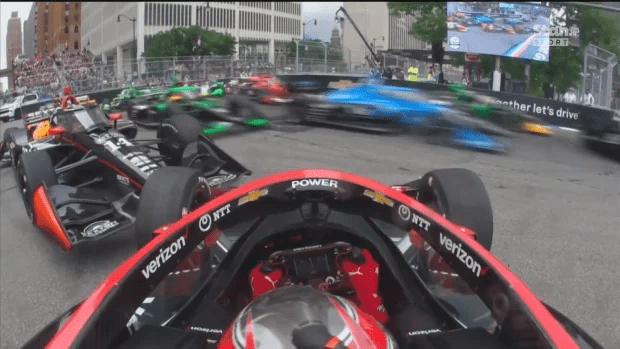
Whoever’s idea it was to follow up the excitement of the Indy500 with a race at a terrible street track in downtown Detroit needs to reflect on what they’ve done. Anyone who had watched the 500 and wanted to see what else IndyCar has to offer may not watch another race. With a track that is essentially a worse version of Baku, itself one of F1’s worst tracks, I expected the race to either be boring or chaotic to the point of frustration. Having now seen the second option play out, I really wish that this race was boring.
It’s unfortunate how the race unfolded, because the opening stint left some hope that it had some potential. This was because the teams mistakenly presumed that the softer green tyres would be preferrable. When Alex Palou, who had started the race in second on the greens, had to pit after dropping through the field like a boulder, it became apparent the harder black tyres were better. Realizing this, many teams prepared to adapt their strategies for a race that could have developed into an interesting tyre war. Instead, it began to rain.
Under a caution period, the track began to resemble a duck pond. At this point, many drivers, including the leading Colton Herta, pit for wet weather tyres. Then it stopped raining, whilst the safety car was still out. As the track dried up, every driver who had pitted regretted their choice, realizing they had handed a valuable win to Scott Dixon. Dixon managing to pull off one of his famous fuel saving strategies to take the win was the only saving grace from here on out. And even then, a Dixon master class is less impressive when nearly half the race was run under caution periods, due to events spiralling into some sort of demolition derby.
The aforementioned derby was not entertaining. Nearly every driver forgot what a braking point was and slammed into the sides of their competitors. Colton Herta was the only exception to this, preferring to miss his braking point so much that he slammed directly into the tyres at the end of the escape road. After having dominated the early stages of the race, Colton made another unforced error when he found himself lower down the field. His move was both emblematic of his championship challenge collapsing and a general lack of adherence to expected driving standards. It was not a great showing for the sensibilities of IndyCar’s drivers and destroyed whatever entertainment could have been salvaged out of the weekend.
Whilst personally dissatisfied at some of the racing standards on display, one thing from the Detroit weekend’s aftermath stuck out. You do not, under any circumstances, send abuse and death threats to anyone, for any reason, ever. This has been the warrant of a subsection of Augustin Canapino fans, who act like football ultras to anyone who crosses Augustin’s path. Theo Pourchaire was the target of abuse this time around, all for contact that was relatively minor compared to some of the incidents that took place during the race.[1] The abuse itself is already problematic, but Canapino’s response beggared belief, as he focused on how his fans were not responsible and questioned if Theo received death threats due to not having personally seen them.[2] This led to Augustin not racing at Road America and his team’s partnership with McLaren being terminated. Yet, Augustin’s response was not even the worst element of the whole debacle. That came from the team owner, Ricardo Juncos, who was heard calling Theo a ‘son of 1,000 wh***s.[3]’ It would be one thing for a driver, in the heat of the moment, to use inappropriate language towards a competitor. When the team owner is doing it, that speaks to a broader workplace cultural problem. And not only did Ricardo Juncos use inappropriate language, he used deeply misogynistic language, language that would not even come into my head to describe my worst enemy. All this, for minor contact. Juncos Hollinger need to do better.
[1] https://x.com/TPourchaire/status/1797751884700127467
[2] https://x.com/AgustinCanapino/status/1797956262573043725
[3] https://www.planetf1.com/news/theo-pourchaire-hate-death-threats-indycar
 Ryan's Lil' F1 Blog