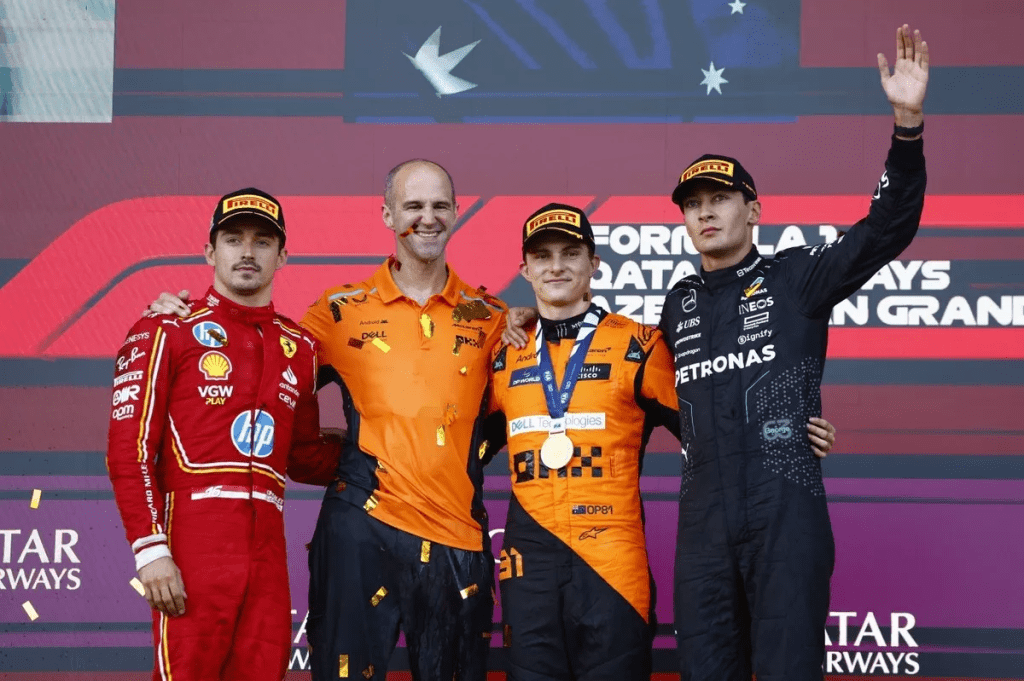
Oscar did what his teammate has yet to do at Azerbaijan, win a race whilst not having the fastest car. After executing a fantastic overtake on Charles Leclerc for the lead, Piastri defended for dozens of laps against a Ferrari that was fundamentally faster on the streets of Baku. He described the race as the most stressful afternoon of his life, yet proved that for some characters, extreme stress brings out the best of them.
2. Fernando Alonso-
Fernando dominated the midfield in Azerbaijan, taking advantage of the retiring cars in front of him to finish in sixth and bag eight points for the team. Whilst that Aston has been firmly in the midfield after the first few races of the year, Fernando has turned his season around recently, returning to the form that saw him dominate Lance Stroll that appeared lost earlier in the year.
3. Alexander Albon-
Whilst largely finishing ahead of his teammate due to being on a preferred strategy, Albon was still able to show fantastic pace throughout the race, even keeping cars like Verstappen’s Red Bull and Norris’ McLaren behind him on old hard tyres.
4. Franco Colapinto-
Franco Colapinto has been one of the biggest good surprises in F1 for a long time and has fully justified Williams’ decision to drop Logan Sargeant. In only his second F1 race, in the upgraded Williams, Franco has already scored four points, three more than Sargeant could manage in a year and a half.
5. Sergio Perez-
As I said in my review, it was a real shame that Sergio Perez didn’t score in Azerbaijan after a collision that was not his fault. For the first time this year, he comprehensively outperformed Max Verstappen and was on his way to a first podium since twelve races previously in China.
The Azerbaijan Grand Prix was another thriller. Oscar Piastri, Charles Leclerc and Sergio Perez all fought valiantly for the win, with the three cars seldom separated by more than a second. Whilst the Australian crossed the line in first, all three drivers had a genuine shot at victory if the race had played out slightly differently. And for one of the drivers, not getting into the race lead kickstarted a chain of events that led to his retirement. And in all this, Verstappen was nowhere, being thoroughly outclassed by his teammate for the first time in forever.
On Saturday during qualifying, Charles Leclerc was mighty. He kept his foot on the throttle in corners where every other driver lifted and snatched pole by over three tenths of a second, a mighty gap when the top teams are so close. And Charles initially looked to have the race in the bag during the first stint, as he briskly pulled a six second gap to Oscar Piastri in second. In the first stint of the race, I was incredibly excited to see Charles take a dominant win and thought the fight for second would prove more dramatic than the fight for fist. The aforementioned fight for second was ignited on lap thirteen, as Red Bull brought in Sergio Perez in an attempt to undercut Piastri.
Whilst the undercut was powerful in Baku McLaren were able to efficiently play the team game to survive. After pitting, Perez found himself behind Lando Norris, who was running a long stint on the hard tyres after starting the race in fifteenth. At this point, McLaren requested that Lando slow down Perez in the tight and twisty middle sector, where it is impossible to overtake. Lando responded to this request and held Perez up, which when combined with Piastri’s pit stop being about half a second faster than Perez’s, meant that when Piastri came out of his pit box two laps after Perez, he retained second place. Given the subsequent events of the race and Red Bull’s superior top speed, it appears likely that if Perez had got past Piastri, he would have won the race. Whilst it was not to be for Perez on this occasion, it is worth praising his performance in Baku. Sergio has come under rightful criticism during his time at Red Bull for being consistently slower than Max and came very close earlier this season to being fired. Yet, in recent races he has begun to turn his season around, showing that there are circumstances where he can deliver a solid performance. Perez may have saved his seat for next season last weekend, an achievement I would make no effort to downplay.
After Leclerc pitted, his Ferrari proved to have issues with warming up the hard tyres. Whilst these issues were minor and the Ferrari still appeared to be the fastest car in the race, Oscar Piastri snatched his opportunity to take the lead, catching Leclerc napping to make a fantastic overtake on the inside of turn one. For the rest of the race, Leclerc harangued Oscar, but Piastri defended his lead perfectly, ensuring that Charles would never get the chance to take the inside line where it is easier to overtake. For both his overtaking and defending, Piastri deserves plaudits. He delivered an Oscar-worthy performance last weekend and has established himself as a top F1 driver. Oscar Piastri thoroughly deserved that win, even if I wish Leclerc had won it.
Whilst Charles tried his best to get past Piastri, the extent of time he spent pushing in dirty air had only one inevitable consequence. Thus, near the end of the race, Charles’ tyres began to fall off a cliff. Sergio Perez attempted to take advantage of this and looked to have a solid overtake lined up, but Charles was incredibly late to brake to ensure that Perez wouldn’t get past. This put Perez out of shape, allowing him to be overtaken by the fast-charging Carlos Sainz, who had slowly dragged his way into the battle for the podium places. Yet, as Perez attempted to come back on Sainz after turn two, Sainz failed to take of note of Perez and took the normal racing line. He promptly crashed into the side of Perez, taking them both out of the race and promoting George Russell into third. As Sainz made no erratic movements, the stewards deemed it to be a racing incident and did not penalize Carlos. Yet, even so, it showed an incredible lack of awareness by Carlos. Additionally, it made me feel awful for Sergio Perez. After his best weekend of the year, he had it all taken away from him on the penultimate lap. It was a real shame to see, and I really hope Sergio can bounce back in Singapore, another track that he has won at before.
In conclusion, it was another great race. The person I wanted to win didn’t and I felt so sorry for Sergio Perez, but still, it was full of great moments. A three-way fight for the win; Verstappen’s pace being non-existent; Norris charging from fifteenth to fourth; a double Williams points haul and even a lovely little tenth for Ollie Bearman. In reflection, a lot of good did happen in this race.
Wow. Silverstone really delivered an all-time classic. It’s always one of the best races of the year, but along with Canada, this race may go down as one of the best of the decade. We witnessed a fantastic battle for the win, involving five drivers and three teams. Many drivers looked like they had the opportunity, but it was Lewis Hamilton to take the checkered flag first. Whilst ending a two-and-a-half-year win drought with a home win in front of adoring fans was a great story to witness, a great story does not always translate into a great race. Yet, the race was worthy of the story it accompanied, as constantly changing climatic conditions ensured that fun and unpredictability was aplenty.
Saturday’s qualifying proved that the Mercedes thrives in colder conditions, as the team took a dominant 1-2. This was converted at the beginning of the race, as both Mercedes opened a gap to Verstappen in third. The McLaren also proved a stronger car than the Red Bull, with both McLarens using superior tyre wear to overtake Verstappen during the opening stint. But it was in the rain that the McLaren showed its true strength. In slippery conditions, the McLaren was by far the best car, with Norris and Piastri quickly overtaking both Mercedes to establish a McLaren 1-2. It was at this point that McLaren had an opportunity to take an emphatic victory. But as they have shown over this year, McLaren are experts in bottling wins.
The first mistake McLaren made came when it was time to switch to the intermediate tyres. Whilst Mercedes made the right call to bring both of their cars in on the same lap, McLaren decided to leave Oscar Piastri out for an extra lap, to avoid him being held up in the pit box behind Lando. This was an awful decision, as Piastri lost close to a whole pit stop in the subsequent lap. This destroyed Piastri’s chance of winning the race, something heavily disappointing for a driver who had appeared to be the fastest on track. Still, McLaren had Norris in the lead during the wet section of the race, who still had a great chance of winning. Though McLaren still had other ideas.
When Hamilton made the jump onto the dry tyres first, McLaren were slightly compromised. They had been effectively undercut and were guaranteed to come out of the pit lane behind Lewis. However, the team had an advantage available to them, an extra set of medium tyres. Whilst Hamilton only had softs, the mediums were evidently the best tyres for the final stint. All McLaren needed to do was pit Norris onto mediums, like they did with Piastri, and they would have won the race. They didn’t. They instead, asked Norris if he wanted to cover Hamilton with softs or Verstappen with mediums. As he had limited information and Hamilton was ahead of him, Norris chose the soft tyres. However, it should never have been his choice. Everyone knew that having a set of mediums was an advantage, including the commentators, though seemingly excluding McLaren. Thus, Norris went onto awful tyres that he couldn’t manage and instead of taking a dominant win, he fell behind Verstappen and finished third. The Norris title campaign has proven to be a joke, though one that is at least fun to watch.
The rest of the final stint consisted of Hamilton managing his soft tyres perfectly. Whilst Verstappen had superior pace, Hamilton stopped him from catching and took an amazing victory. The emotions ran high after the race, with Hamilton crying during the interview. It was amazing to watch, he had driven perfectly all weekend and deserved it. Whilst the primary reason for his victory was because McLaren’s strategy was awful, it was nevertheless amazing to watch. Unpredictable races where multiple teams fight for the win are the best type that Formula One has to offer and I hope we see more of them during the year.
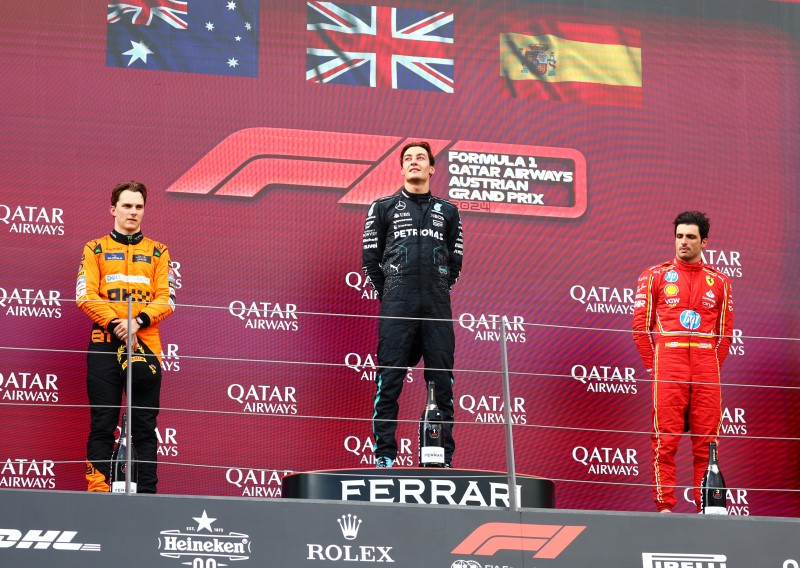
The Red Bull Ring is always a fun track. With a simple layout and three DRS zones, the track encourages overtaking and battling throughout many laps. The Grand Prix this year was a good watch, providing entertaining battles and late race drama. Whilst the race felt like it was lacking a cohesive narrative and felt more like a series of disconnected events, the events in themselves were fun. Not fun for a Leclerc fan, but the action towards the end of the race distracted from that particular disappointment.
Before the drama at the race’s conclusion, there were limited moments of intrigue throughout the first two stints. In particular, there were some exciting teammate rivalries to ruminate on. The first example came when the Haas cars made their first stops, with Magnussen and Hulkenberg proceeding to pass and repass each other as their respective engineers begged for them to work together to save tyres. It took a few minutes of convincing and some colourful language from Magnussen to get there, but eventually the Haas boys calmed down and recorded their best finish of the season. The Alpine boys were not so quick to settle, as they engaged in yet another vicious battle. Whilst it was a tremendously foolish idea to ever make Ocon and Gasly teammates, it provides fans with the entertainment of watching two people who absolutely despise each other fight. As always, the way they raced each other demonstrated their feelings, as they were fighting through for multiple laps, whilst pushing each other off the track at every opportunity. Eventually Gasly passed Ocon, but the fighting likely lost both drivers time and tyres. However, the fact that at any track these drivers never stop fighting makes up for the lack of sensibility with a flurry of entertainment.
Whilst the first two thirds of the race were not boring, it was during the final third that the main spectacle came to pass. Red Bull had already made a mistake during practice, using too many medium tyres when these would prove the strongest in the race. Thus, they had to put Verstappen on an old set of mediums for his final stint. Combined with a slow pit stop and a lock up, this put Lando Norris right on Verstappen’s tail. For a number of laps, Norris tried to hustle his way past, in a battle that was as thrilling as it was silly. Both drivers didn’t show their best qualities during this duel. On Norris’ behalf, his hastiness to overtake Max led him to commit to some silly divebombs and opportunistic overtakes. This showed a lack of solid race craft during high pressure moments from Lando. On Verstappen’s behalf, he demonstrated his willingness to be too aggressive when he feels he can get away with breaking the rules. Virtually every time Norris attempted to overtake, Max would move in the braking zone to push Lando into backing out. The stewards repeatedly failed to intervene to stop Verstappen’s illegal tactics, despite the rule breaking being obvious to anyone watching the race. With Norris and Verstappen both getting increasingly angry at each other’s driving, there was only one way this battle could end.
Thus, on lap 64, as Norris tried to overtake, Max moved under braking again. But Norris didn’t back down and they collided in a dramatic fashion. This gave both of them punctures and was a fantastic example of why the stewards should punish illegal tactics before those tactics lead to the inevitable. One would have thought that the stewards would have learnt their lesson from the events of 2021, but instead they let history repeat itself. Whilst I often criticize Lando Norris, in this moment I have to praise his resolve. He showed Verstappen that he wasn’t prepared to be pushed around. Whilst Norris lost out more from the collision, as he had to retire whilst Verstappen finished fifth, this is still good if Norris wants to be in regular battle with Verstappen. Norris needs to carry the aggression forward throughout the season, as you can only beat Verstappen by meeting his aggression.
The collision between the leaders led to the biggest surprise of the afternoon, George Russell winning. This was the first Mercedes victory since Russell’s win in Brazil 2022 and whilst it fell into his hands, it was nevertheless well deserved. George has been fantastic this year, regularly outqualifying his teammate and proving that he can become Mercedes’ team leader. He drove a perfect weekend, making no mistakes where others faltered. I said that he needed to win another race during my Canada review, to prove his critics wrong. George delivered in the best way possible and I’m sure the Mercedes factory enjoyed their champagne Monday.
Max proved once again that he doesn’t need the fastest car to win. He maximized the opportunity the start gave him, passing Russell with ease and building a first stint lead that Norris was unable to overturn. Races like these remind all fans of the quality of Max Verstappen.
2. Lewis Hamilton-
Whilst this season has largely been a challenge for Lewis, he had a good performance in Barcelona, qualifying ahead of his teammates and the Ferraris. Whilst not having the start Russell had, Lewis was able to perfectly execute his superior strategy to take the third step on the podium.
3. George Russell-
Whilst not being on the preferred strategy, George showed his talents throughout the race, with a fantastic start to take the lead from fourth and great defending later on from Norris’ quicker tyres. Whilst he didn’t quite make the podium, Russell achieved the maximum result he could with his strategy.
4. Charles Leclerc-
Whilst having to handle an aggressive Sainz early on, Leclerc played the patient game, following Norris’ strategy to have quicker tyres throughout the second and third stints. During these stints, his race pace was apparent, almost equal to Verstappen and Norris. Whilst running out of time to catch Russell, Leclerc proved the more talented Ferrari driver of the weekend.
5. Pierre Gasly-
Gasly had a fantastic weekend in Spain, outqualifying and nearly beating the Red Bull of Perez. With Alpine starting to creep up the midfield, Gasly is beginning to appear like the Alpine driver in form at the point where points are finally on offer. However, with both drivers appearing close, I would not be surprised to see more collisions throughout the year.
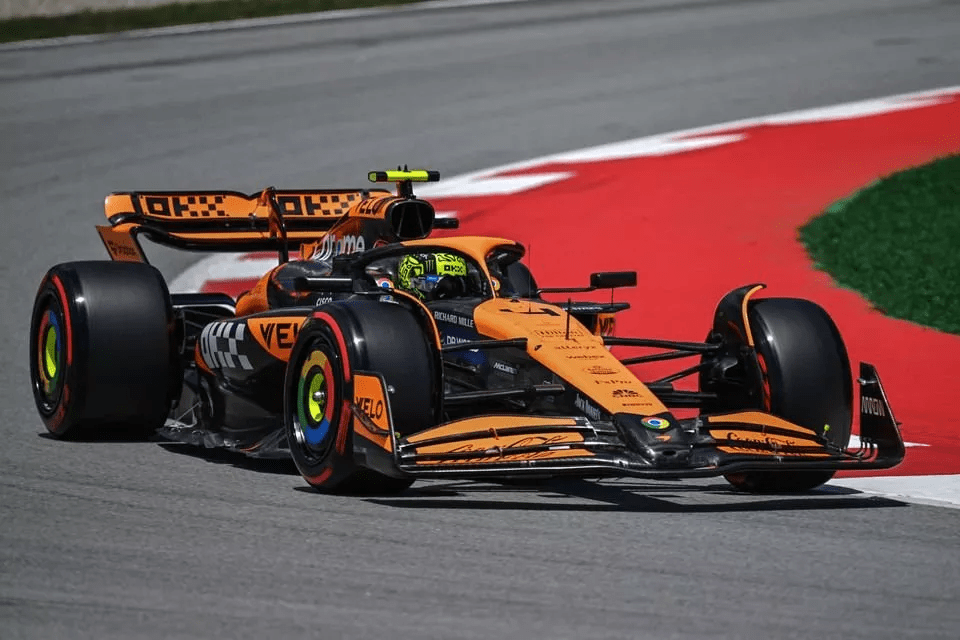
Whilst hardly a thriller, this year’s Formula One race in Barcelona gave us an interesting strategic battle between Max Verstappen and Lando Norris. Norris and McLaren demonstrated the many ways to lose a race with the fastest car, whilst varying tyre choices across the field kept the race intriguing.
It looked promising on Saturday for Lando to take his second win, after he achieved his first pole position since 2021. Whilst the Red Bull was close in qualifying trim, the McLaren would prove to be faster during the race. However, the race start can be vital at Barcelona and Lando failed to capitalize. Whilst he was busy pushing Verstappen onto the grass, George Russell utilized the outside line to sweep past the pair of them. Stuck in the middle of the situation, Lando was squeezed from first into third. Verstappen then swiftly utilized his Red Bull’s superior top speed to overtake Russell’s Mercedes on lap three. Lando, on the other hand, did not have the top speed advantage to overtake a Mercedes on equal tyres, so found himself stuck behind the slower Russell for the entire first stint. This allowed Verstappen to build a healthy lead over Norris by the end of the stint and forced McLaren onto an alternative strategy to have any hope of catching the Red Bull.
In response to being stuck in the George Russell train, McLaren decided to pit Norris much later than the other front runners, to give him a tyre advantage over Verstappen. However, whilst Norris was significantly faster than Verstappen, he was forced to pass Carlos Sainz, Lewis Hamilton and George Russell on track. All the time Norris spent following and passing other cars would be a detriment upon his advantage. Whilst Sainz and Hamilton proved easy pickings for Lando, George showed his prowess by forcing Lando into a duel. Whilst Lando eventually won the battle, he lost vital time to Verstappen through this sequence. To avoid the necessity of passing slower cars again, McLaren pitted Lando for his third stint slightly earlier than they would have desired. So, he had less of an advantage over Verstappen and whilst he closed up, Lando ran out of time to catch Max, finishing two seconds behind. With a better start, quicker stops, more decisive passes and an uncompromised strategy, McLaren could have won this race. In contrast, bottling all these things left Norris unhappy with second place.
Further down the field the uncertainty in tyre strategies proved to the detriment of some drivers. Whilst Russell and Sainz took the early leads in their respective inter-team battles, they were both put onto the hard tyres for the last stint. With their teammates proving faster on new soft tyres, both drivers were forced to cede position. By the end of the race, both were also not far from losing positions to Leclerc and Piastri respectively. This showed the uncertainty that a hot day on an abrasive circuit can bring, as teams become less sure what tyres to put their drivers on. It was unlikely that Mercedes and Ferrari intended to put their leading drivers on a compromised strategy, but it would certainly prove to the disappointment of Russell and Sainz. But sometimes, strategy is key and strategy in Spain won Lewis Hamilton his first podium of the year, bringing some happiness to a season that he has so far found lacking.
In conclusion, Spain was interesting throughout, if not outstanding. When a race circuit is slightly more difficult to overtake, it pays to have differing tyre strategies. Barcelona is not a bad circuit by any means and there were some amazing turn one overtakes by Russell, Norris and Hamilton throughout the race. But, seeing this race makes me want tyres with higher degradation, to throw more strategic upsets into the mix.
Along with Imola, this race has to go down as one of Verstappen’s greatest victories. In the trickiest of conditions, no driver was perfect, but Verstappen made the least mistakes, in a car that seldom appeared the fastest.
2. George Russell-
George may have made a few mistakes throughout the race, but it was still a fabulous performance. In a track that his teammate has often excelled at, George once again proved that he is currently the fastest and most reliable Mercedes driver, to duly deliver his team their first podium of the year.
3. Alexander Albon-
Whilst a late spin from Sainz took Albon out of the race, he reminded everyone the fighter he is with his performance throughout the race. In particular, his double overtake on Ricciardo and Ocon, where he slipped through the tiniest gap in the middle of the two cars, was sublime.
4. Daniel Ricciardo-
After justified criticism from Jacques Villeneuve, Daniel decided to show up this week, qualifying in fifth and finishing the race in eighth, despite a jump start penalty. It was a solid performance and if Daniel can keep these up, he will justify why he should stay in Formula One.
5. Alpine-
I’m breaking my rules again and giving half a point to each of the Alpine drivers. Esteban Ocon drove from the back of the grid into the points, which is always worth a shout out and Pierre Gasly also delivered a points finish. Despite a post-race controversy about a controversial driver swap at the end of the race, both drivers showed their talents still shine through in a bad car.
Thrilling conditions often bespoke a thrilling race. Which is exactly what Formula One provided in Canada. Featuring a three-way battle for the win, incidents aplenty and Alex Albon making the overtake of the year, Canada delivered a wet-to-dry classic that fans will be talking about for years to come.
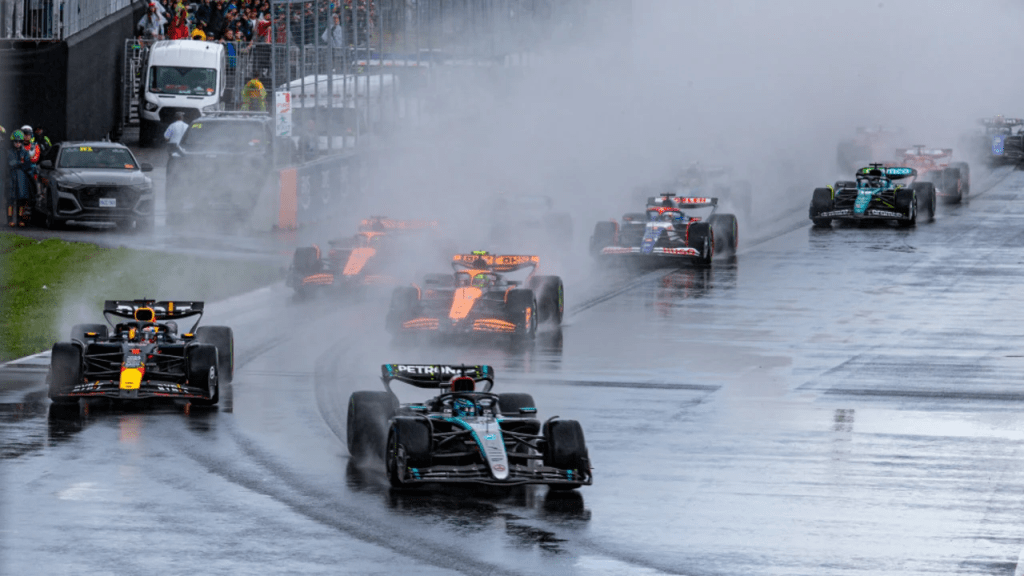
After an equally thrilling qualifying, which saw George Russell and Max Verstappen set the exact same pole time, conditions at the start of the race were incredibly wet. As all the runners on the intermediate tyres struggled for grip, one team made moves across the field. As Haas had elected to start on the wet tyres, they were instantly the fastest cars on the circuit. My favourite chaos merchant Kevin Magnussen made fine use of his extra grip, moving from fourteenth to fourth in the space of a few laps. It seemed like Haas had made a fantastic gamble, but within a few laps, as the track started to dry, conditions moved towards the intermediate runners. It was at this point that Haas needed to bring Kevin in for a pit stop. They did this, albeit forgetting to bring the tyres. So, Kevin’s work was all for nought, as he fell down the field, throwing away a chance of points. It was a shame to see Kevin’s performance yield no rewards, as he reminded everyone that when he’s not courting controversy, he’s a damn good racer.
As all the midfield chaos was occurring, George Russell was leading with Verstappen hot on his tail. The Mercedes showed a surprising flash of pace this weekend, likely bolstered by their upgrades and the colder conditions in Canada. After not being close to the podium all season, Russell was a legitimate contender for the win. It was a great turnaround, though as the two frontrunners fought, the McLaren’s of Norris and Piastri were getting closer and closer. McLaren had set their car up to prioritise tyre wear and this began to pay off, as Norris overtook both Verstappen and Russell to lead the race. He then began to pull away from the field and it began to appear like Lando’s second win was on the horizon. Then Logan Sargeant crashed and bought out the safety car. From here, things began to fall apart for Lando.
When the safety car was called, McLaren had just enough time to bring in Lando for a pit stop.[1] Unfortunately for them, they missed their opportunity, continuing an under-scrutinized trend of McLaren making poor strategic decisions at vital moments. As all the other front runners pitted, Norris had to complete another lap behind the safety car, resulting in him falling from first to third when he finally did pit. Norris would never regain the opportunity to win the race from this point onwards, despite attempting an overcut when switching to dry tyres. Whilst finishing second, this result was not was Norris was hoping for. Combined with the near miss at Imola, Norris has missed out on possible victories in two of the last three races. For a team that finally seems to have a championship contending car, McLaren have to take these opportunities.
As the race reached its dry zenith, it was the Mercedes of George Russell that looked to have the pace to challenge for Verstappen for the win. Yet, a series of small, costly errors throughout the race consistently put Russell into fights with other frontrunners that he could have avoided. This is a consistent trend many have noticed about George Russell. He is a fantastic driver, with supreme qualifying abilities and great race pace, but he makes mistakes at the exact wrong moments. At minimum, he could have finished second with his pace towards the end of the race, but instead had to settle for third. It was still a fantastic performance throughout the weekend for George, but he’s got to have to turn this narrative around soon. If Mercedes’ upgrade path is as fruitful as some are predicting, perhaps that opportunity could arise in Spain. If it does, George has to take it.
With such a fantastic race, the only thing that could possibly make me upset would be if Ferrari were to have an absolute howler. If, for example, they were to both qualify outside the top-10, then have race-ending engine issues on my favourite driver’s car, I would be upset. I would be even more upset if Ferrari’s other driver then proceeded to spin out of the race, in the process hitting my second favourite driver, who up to that point was having a brilliant race. For the sake of praising one of the best Formula One races of the last few years, I am going to choose to no longer ruminate on the fact that these exact events occurred.
So, despite certain events, this race had everything. Three teams fighting for the win, battles across the field, strategy gambles and Max Verstappen delivering a masterclass performance to remind everyone that even without a dominant car, he is a dominant driver. I won’t be forgetting this one anytime soon.
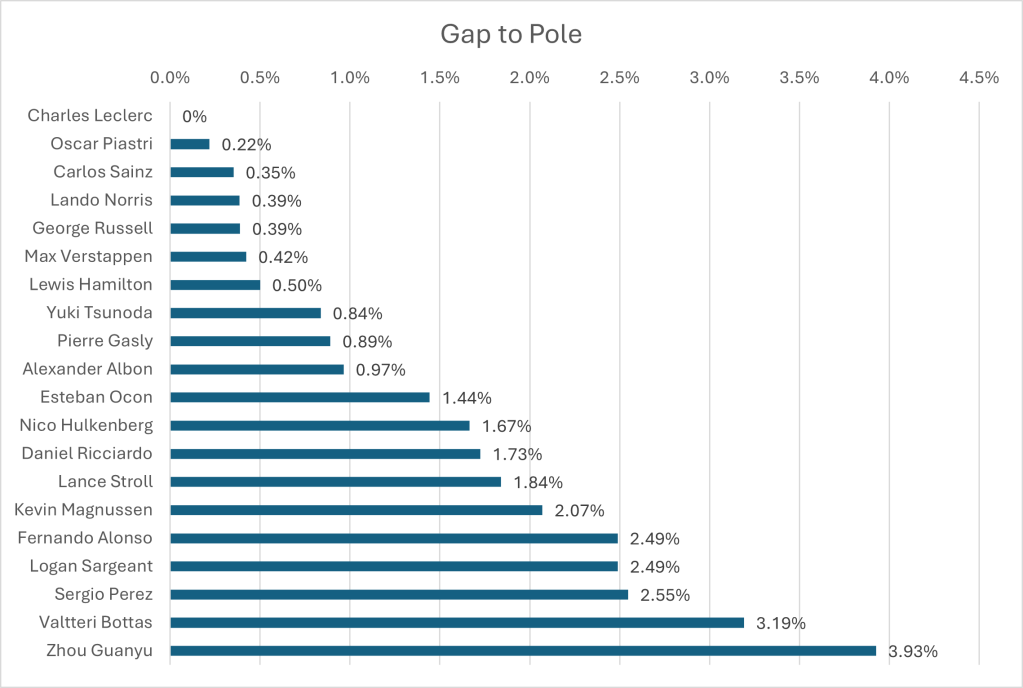
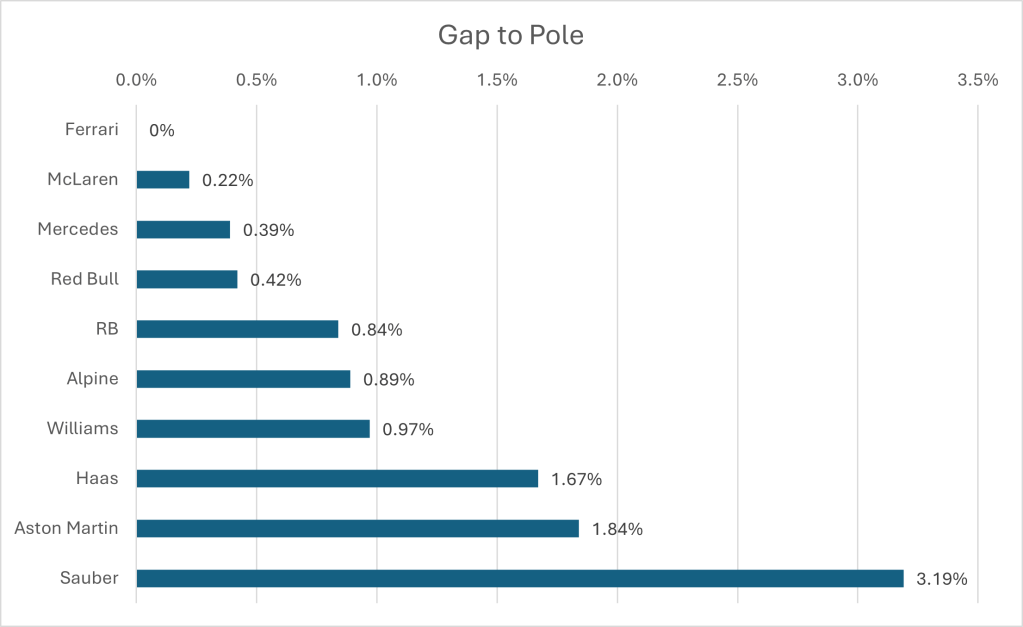
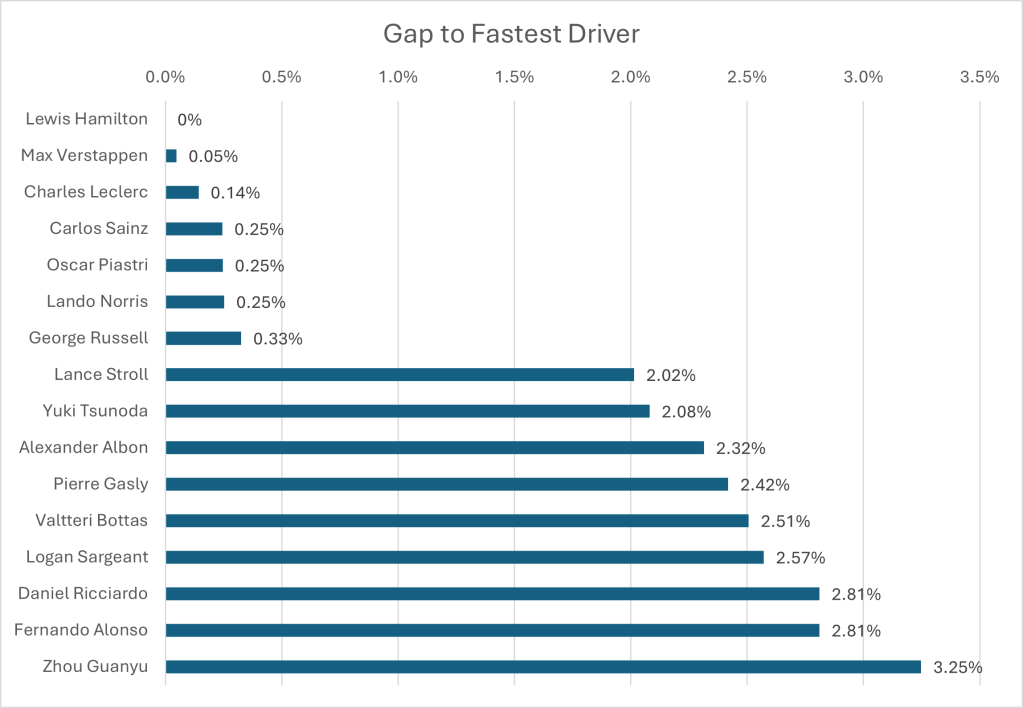
I have collated the fastest laps by each driver in qualifying, to show the average gap to the fastest driver. Whilst this extends the gap between drivers who made it to the top ten and those below, I’ve ruled using the overall fastest times a better grounding point for the true limit of the top cars, as the cars most likely to compete for points are my primary focus in these analyses.
Qualifying Pace-
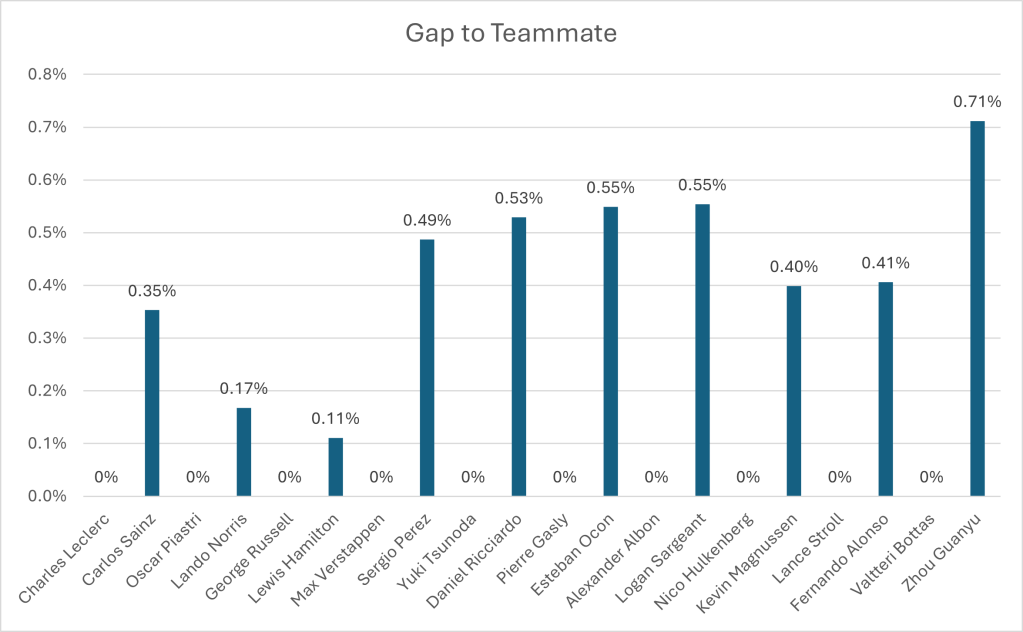
Additionally, I have collected the data for the gaps between teammates. I did this by using their lap times set in the same qualifying session. I generally compare the last session both drivers competed in, however if the fastest driver drove their fastest time in an earlier session, I count these times instead.
Race Pace-
I have calculated the average pace of the drivers, removing race starts, laps in the pit lane and extra formation laps as these are all too slow to be representative. I have only included drivers that completed at least 75% of the laps to not skew the season averages against drivers that never got the chance to run their cars on low fuel, which excludes Esteban Ocon, Sergio Perez and both Haas drivers in Monaco.
As different drivers have a varying number of race stints, this skews the overall pace. Generally, if a driver makes more stops, their pace will be faster on average. This will be considered in my final thoughts and analysis. Additionally, the average pace per stint and number of stints are recorded at the bottom of this article, for those interested in viewing more precise estimates of pace relative to other drivers on the same stint.[1]
Analysis:
This race is not particularly representative of the pace of each team, as every driver was driving as slowly as possible for most of the race, to save their tyres on a track where overtaking is almost impossible.
Consequently, the Haas team benefited in the season long average by being out of the race after the first lap. As there are only 22 races, this should have little effect on the season long average, but is worth noting.
As they were the only drivers at the front to make a pit stop, Hamilton and Verstappen set the fastest average pace during the race. However, this does not represent the general pace the cars showed on similar stints, where the Ferrari and McLaren cars were faster.
There were a number of laps where I could not tell if cars had strategically reduced their pace or were being lapped. As I could not tell, I did not remove these laps.
Further Resources-
Qualifying Pace:
Driver
Fastest Qualifying Time
Charles Leclerc
70.27 (0%)
Oscar Piastri
70.424 (+0.219%)
Carlos Sainz
70.518 (+0.353%)
Lando Norris
70.542 (+0.387%)
George Russell
70.543 (+0.389%)
Max Verstappen
70.567 (+0.423%)
Lewis Hamilton
70.621 (+0.500%)
Yuki Tsunoda
70.858 (+0.837%)
Pierre Gasly
70.896 (+0.891%)
Alexander Albon
70.948 (+0.965%)
Esteban Ocon
71.285 (+1.444%)
Nico Hulkenberg
71.44 (+1.665%)
Daniel Ricciardo
71.482 (+1.725%)
Lance Stroll
71.563 (+1.840%)
Kevin Magnussen
71.725 (+2.071%)
Fernando Alonso
72.019 (+2.489%)
Logan Sargeant
72.02 (+2.490%)
Sergio Perez
72.06 (+2.547%)
Valtteri Bottas
72.512 (+3.191%)
Zhou Guanyu
73.028 (+3.925%)
Average Race Pace:
Driver
Pace
Lewis Hamilton
78.245 (0%)
Max Verstappen
78.283 (+0.048%)
Charles Leclerc
78.357 (+0.143%)
Carlos Sainz
78.437 (+0.245%)
Oscar Piastri
78.438 (+0.247%)
Lando Norris
78.443 (+0.253%)
George Russell
78.5 (+0.326%)
Lance Stroll
79.821 (+2.015%)
Yuki Tsunoda
79.873 (+2.081%)
Alexander Albon
80.056 (+2.315%)
Pierre Gasly
80.138 (+2.419%)
Valtteri Bottas
80.206 (+2.507%)
Logan Sargeant
80.257 (+2.572%)
Daniel Ricciardo
80.444 (+2.811%)
Fernando Alonso
80.445 (+2.811%)
Zhou Guanyu
80.786 (+3.248%)
All Stints:
Best Stints
Pace
Hamilton 3rd (26L/UH)
75.673
Verstappen 3rd (25L/UH)
75.681
Sargeant 3rd (18L/UH)
77.127
Zhou 3rd (5L/NS)
77.636
Leclerc 2nd (75L/NH)
78.357
Sainz 2nd (75L/NH)
78.437
Piastri 2nd (75L/UH)
78.438
Norris 2nd (75L/UH)
78.443
Stroll 4th (27L/NS)
78.458
Russell 2nd (75L/NM)
78.5
Verstappen 2nd (48L/NM)
79.638
Hamilton 2nd (47L/NM)
79.668
Bottas 3rd (60L/UH)
79.84
Tsunoda 2nd (74L/UH)
79.873
Albon 2nd (74L/NH)
80.056
Gasly 2nd (74L/NM)
80.138
Ricciardo 2nd (73L/UH)
80.444
Alonso 2nd (73L/UM)
80.445
Stroll 2nd (38L/UM)
80.937
Zhou 2nd (66L/NH)
81.025
Sargeant 2nd (53L/NM)
81.32
Bottas 2nd (11L/NM)
82.206
Key: 1L= One Lap, 2L= Two Laps, NH= New Hards, UM= Used Mediums, NM= New Mediums, NS= New Softs
[1] I only include stints in the stint table if a driver has completed five or more representative laps, in an attempt to avoid fastest lap attempts. This has led to exclusions from the chart of everyone’s first stint and Stroll’s third stint.

 Ryan's Lil' F1 Blog