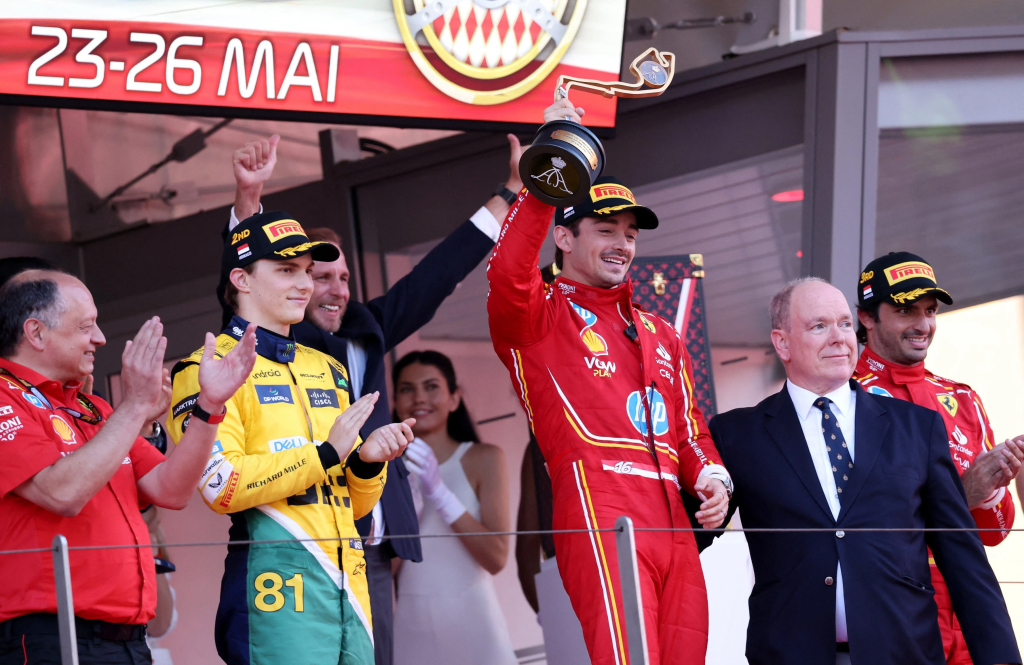
The Monaco curse was broken, Charles Leclerc won at home. Nearly two years after his last win, it was so satisfying to see Charles nail qualifying and then convert that into a decisive victory. Whilst the race may have been boring, the result made me and Charles legion of adoring fans ecstatic.
2. Oscar Piastri-
Something in the back of my head told me that Oscar was going to outperform Lando this weekend. And whilst he barely missed out on the pole, he still qualified 2nd and converted it into his first podium of the season. Whilst he’s not yet the complete package and needs to work on his tyre management, Oscar is a massive talent and I imagine it will not be too long for his first win.
3. Yuki Tsunoda-
Yuki is quickly becoming one of the most impressive performers in the sport. He should not be defined by his first year, look at his performances now. He once again maximized his weekend, qualifying and finishing in 8th to take another four points for the RB team. If Daniel Ricciardo had delivered the performances that Yuki has delivered this year, he would have already been signed to Red Bull. Yuki has done everything to prove his talent, it’s up to Red Bull to recognize it.
4. Alexander Albon-
Whilst one of my favourite drivers was busy winning, my other was busy getting his team’s first points of the season. Whilst Williams have had a poor car this year, Alex’s talents have not disappeared over the winter. He reminded us of that this week and I was happy to see Williams get some points on the board.
5. Pierre Gasly-
On the first weekend where his car showed any pace and despite his teammate divebombing him, Pierre survived and delivered a second point for the Alpine team. Whilst not the best performer in the team overall, his willingness to be a team player is appealing to the Alpine higher ups.
Monaco, the jewel in the crown. If that crown is a night cap, at least. Because this race was even more boring than Monaco usually is. A red flag on lap one led to the drivers changing their tyres under caution, eliminating the need to pit in the race. This turned a race in which the only excitement comes during the pit stop phase into a race in which there was absolutely no excitement at all. Whilst qualifying was amazing, like it always is in Monaco, the only things of note to happen during this race were during lap one, after that point it became a game of follow-the-leader. Thus, the only point of discussion are the incidents during the first lap, so be prepared to read three paragraphs discussing sixty seconds of the race.
The first incident to occur on lap one was a collision between Carlos Sainz and Oscar Piastri. Sainz went for an audacious lunge at the first corner, attempting to turn a Ferrari 1-3 into a Ferrari 1-2. I admire the effort, unfortunately for Carlos this gave him a puncture, turning the race into a Ferrari 1-20. No driver deserved to be penalized for the incident, even if it was bold from Carlos to try the move. Either way, the red flag coming out before all drivers crossed the first timing line saved Carlos’ afternoon, as it ensured he could restart back in his grid spot. Piastri’s car was damaged from the incident, but this did not matter, as it is nearly impossible to overtake at Monaco.
The second incident to occur featured F1’s resident chaos merchant of Kevin Magnussen. Kevin did exactly the same move that took Logan Sargeant out of the race at Miami, putting his nose into a closing gap and causing a collision. Not only did this move take out Sergio Perez, Kevin’s latest victim, but also Kevin’s teammate Nico Hulkenberg. After this incident, I was quite sure Kevin would be penalised, which since he was already on ten penalty points, would thereby lead to a race ban. However, despite Kevin receiving a penalty at Miami, the stewards inexplicably decided that they would take no action on this occasion. This shows the uselessness of the penalty system, as the stewards seem never willing to take the decision that would lead to a race ban. Whilst Kevin has been incredibly entertaining this season, there is little doubt that his move deserved a penalty. If the stewards want to discourage illegal driving standards, they have to be prepared to make a driver pay the consequences for their actions.
The third incident further demonstrates the stewards’ inconsistency. Esteban Ocon divebombed his teammate Pierre Gasly before the tunnel, leading to a collision that took Esteban out of the race and risked doing the same to Pierre. The stewards penalised this move with a five-place grid drop, for causing a collision. This was the right thing to do, as making such an audacious divebomb should not be allowed in F1. Yet, even harsher than the response from the stewards was the response from Alpine’s team principal, Bruno Famin. He made it clear that there would be consequences for what Ocon did, implying that Ocon may be put on the naughty step and not be allowed to participate in the next race. This would be excessively harsh on Ocon; however, I understand Famin’s thinking. He has inherited a pair of teammates who despise each other and Esteban has been open all season about his lack of desire to stay with the team. Famin feels the need to show that he is the boss and has authority to represent the team’s interests. Would banning Ocon for a race be the right move? No. But showing that you are prepared to do so sends a clear message to Pierre and Esteban, that they can’t get away with putting their own interests before the team’s. The fact that a team principle is prepared to do this to their own driver but the stewards are not prepared to ban anyone speaks to the cowardice of the stewards.
After these three events nothing happened. Everyone drove as slowly as possible and there were about three overtakes in the entire race, none of them for the points paying positions. Yet, by the end of the race, I was still filled with ecstasy. My driver, for my team, after nearly two years without a win, won at his home and got to celebrate with the Crown Prince. If even I, filled with the excitement of those events occurring, can recognise that I just witnessed the most boring race in human history, I hate to imagine how everyone else felt.
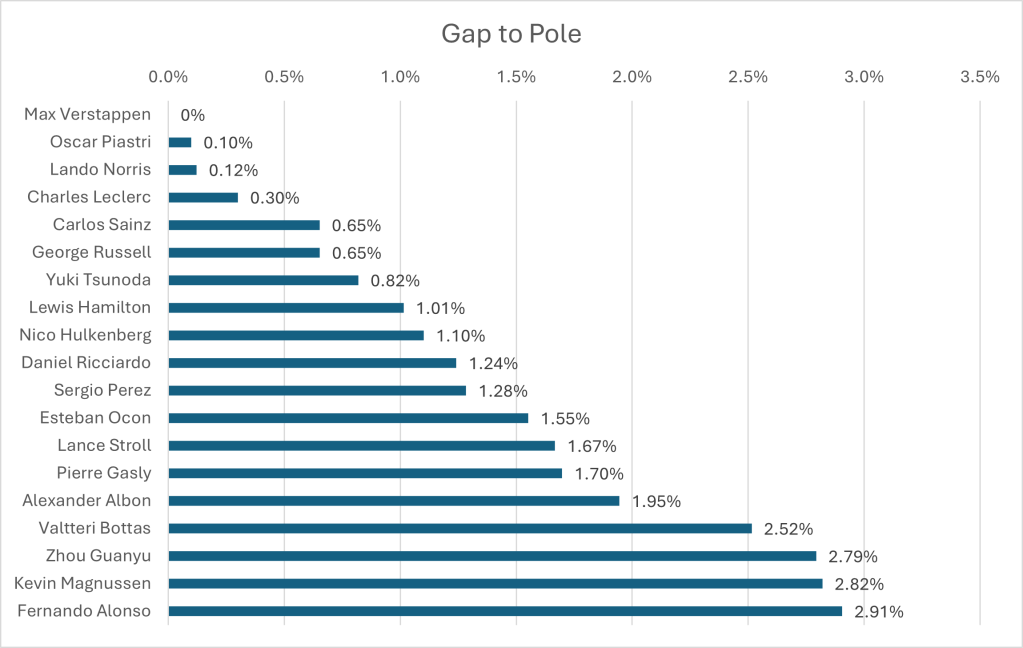
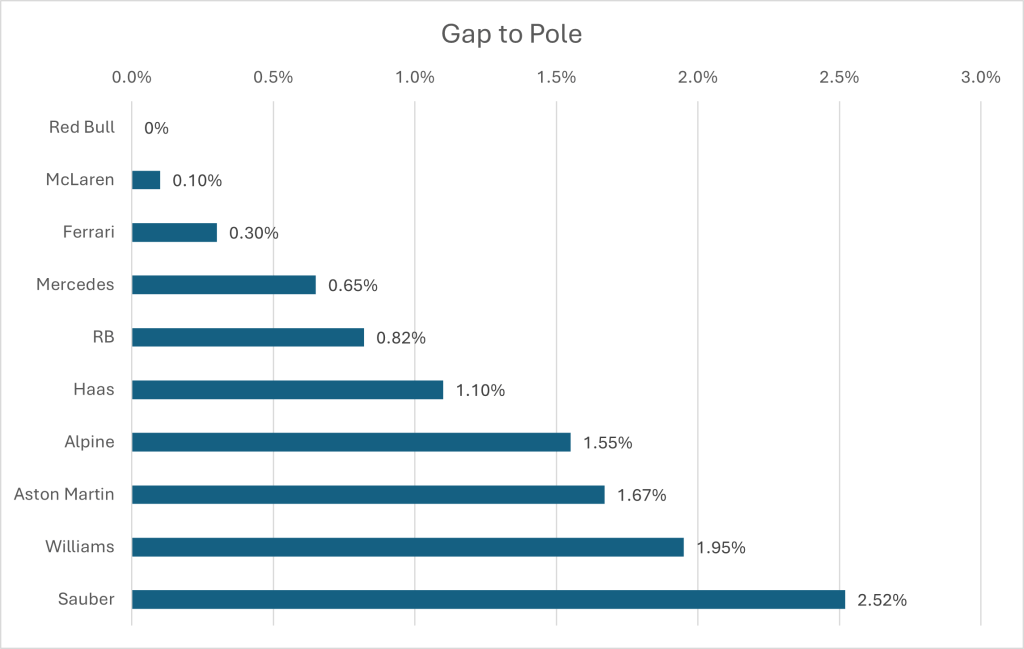
I have collated the fastest laps by each driver in qualifying, to show the average gap to the fastest driver. Whilst this extends the gap between drivers who made it to the top ten and those below, I’ve ruled using the overall fastest times a better grounding point for the true limit of the top cars, as the cars most likely to compete for points are my primary focus in these analyses.
Qualifying Pace-
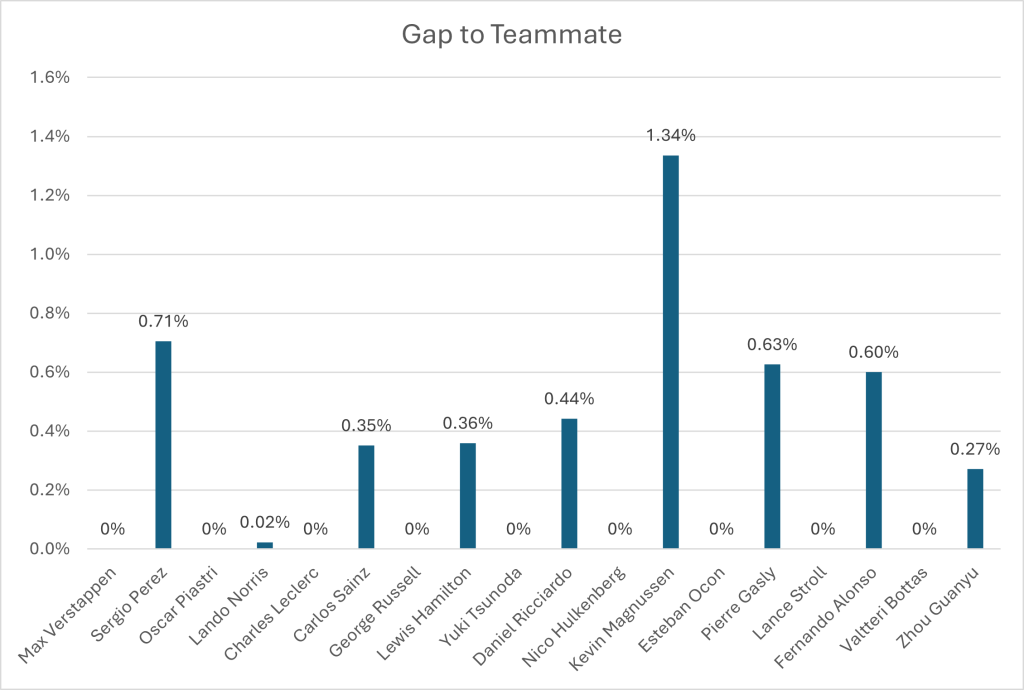
Additionally, I have collected the data for the gaps between teammates. I did this by using their lap times set in the same qualifying session. I generally compare the last session both drivers competed in, however if the fastest driver their fastest time in earlier sessions, I count these instead.
Race Pace-
I have calculated the average pace of the drivers, removing the first laps, laps in the pit lane and laps under the safety car as these are all too slow to be representative. Additionally, I removed any laps with major errors I noticed, such as when Perez or Hamilton crossed the gravel trap in Imola. I have only included drivers that completed at least 75% of the laps to not skew the season averages against drivers that never got the chance to run their cars on low fuel.
As different drivers have a varying number of race stints, this skews the overall pace. Generally, if a driver makes more stops, their pace will be faster on average. This will be considered in my final thoughts and analysis. Additionally, the average pace per stint and number of stints are recorded at the bottom of this article, for those interested in viewing more precise estimates of pace relative to other drivers on the same stint.[1]
Analysis:
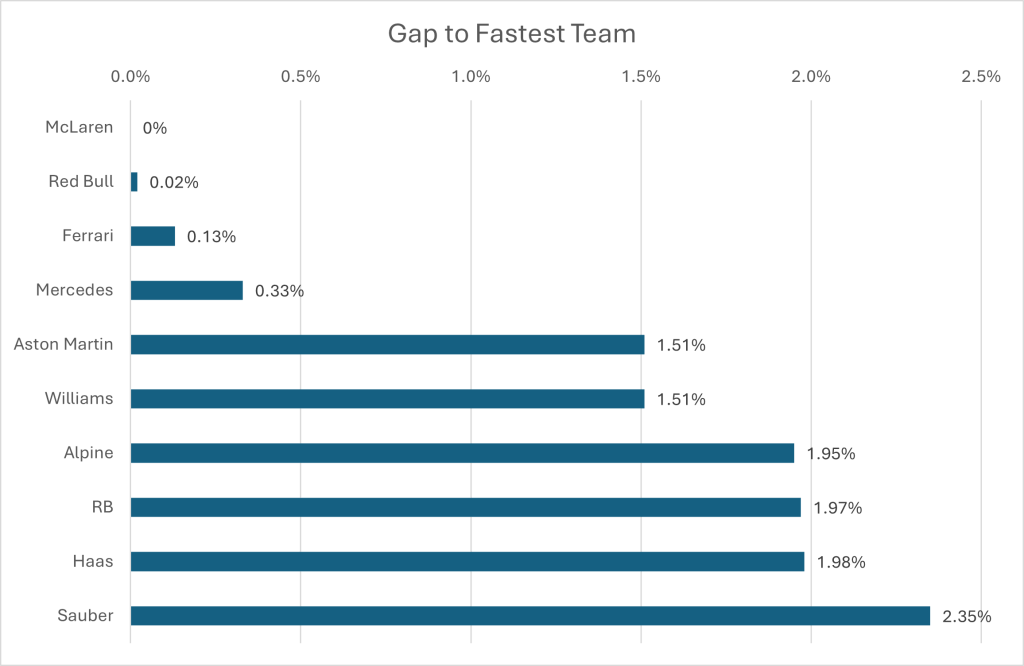
Pace was generally quite similar between the top three drivers, who all were fastest at some point in the race. Whilst the track did not suit Ferrari, their upgrades appear to have put them in the fight with Red Bull, as well as McLaren’s upgrades nearly delivering another win to Lando Norris.
Aston’s upgrades have not appeared to correlate very well and at present, their pace is similar to the lower midfield. This could be a very bad sign for their season, as upgrades not correlating was the cause of their downfall last season. If they don’t get a handle on their development, they may start to be regularly beaten by the likes of RB and Haas.
Several teams ran terrible strategies, stopping their drivers onto hard tyres incredibly early, failing to account for high tyre degradation. These drivers tended to deliver slower second stints than their initial stints, a rarity in the post-refuelling era.
Haas in particular, made a mistake when they reacted to Tsunoda’s early stop with Hulkenberg. If Hulkenberg had copied Magnussen’s strategy and stopped later he could have banked a ninth place, as he would have been able to overtake Tsunoda on newer tyres and would have covered off Stroll’s ability to overtake him. Magnussen finished less than two seconds behind Hulkenberg on this strategy, when he started in eighteenth.
Albon’s pace seems to have been bolstered by his retirement, due to the suboptimal strategies of other drivers, as usually if a driver retires, their pace is relatively worse.
Further Resources-
Qualifying Pace:
Driver
Fastest Qualifying Time
Max Verstappen
74.746 (0%)
Oscar Piastri
74.82 (+0.099%)
Lando Norris
74.837 (+0.122%)
Charles Leclerc
74.97 (+0.300%)
Carlos Sainz
75.233 (+0.652%)
George Russell
75.234 (+0.653%)
Yuki Tsunoda
75.358 (+0.819%)
Lewis Hamilton
75.504 (+1.014%)
Nico Hulkenberg
75.569 (+1.101%)
Daniel Ricciardo
75.674 (+1.242%)
Sergio Perez
75.706 (+1.284%)
Esteban Ocon
75.906 (+1.552%)
Lance Stroll
75.992 (+1.667%)
Pierre Gasly
76.015 (+1.698%)
Alexander Albon
76.2 (+1.945%)
Valtteri Bottas
76.626 (+2.515%)
Zhou Guanyu
76.834 (+2.793%)
Kevin Magnussen
76.854 (+2.820%)
Fernando Alonso
76.917 (+2.905%)
Average Race Pace:
Driver
Pace
Lando Norris
80.857 (0%)
Max Verstappen
80.876 (+0.024%)
Charles Leclerc
80.959 (+0.127%)
Oscar Piastri
81.07 (+0.263%)
George Russell
81.121 (+0.326%)
Carlos Sainz
81.199 (+0.423%)
Lewis Hamilton
81.31 (+0.560%)
Sergio Perez
81.578 (+0.891%)
Lance Stroll
82.078 (+1.510%)
Alexander Albon
82.078 (+1.510%)
Fernando Alonso
82.289 (+1.771%)
Pierre Gasly
82.434 (+1.950%)
Yuki Tsunoda
82.449 (+1.969%)
Kevin Magnussen
82.46 (+1.982%)
Nico Hulkenberg
82.55 (+2.094%)
Daniel Ricciardo
82.571 (+2.120%)
Zhou Guanyu
82.759 (+2.353%)
Logan Sargeant
82.81 (+2.416%)
Esteban Ocon
82.81 (+2.416%)
Valtteri Bottas
82.987 (+2.634%)
All Stints:
Best Stints
Pace
Russell 3rd (10L/UM)
79.934
Perez 2nd (25L/NM)
80.49
Norris 2nd (40L/UH)
80.612
Leclerc 2nd (37L/NH)
80.659
Verstappen 2nd (38L/NH)
80.723
Piastri 2nd (39L/UH)
80.779
Sainz 2nd (35L/NH)
80.91
Hamilton 2nd (35L/NH)
80.992
Verstappen 1st (22L/NM)
81.14
Russell 2nd (28L/NH)
81.156
Stroll 2nd (25L/UH)
81.276
Norris 1st (20L/NM)
81.348
Leclerc 1st (23L/NM)
81.412
Alonso 3rd (17L/UM)
81.492
Sainz 1st (25L/NM)
81.604
Piastri 1st (21L/NM)
81.609
Russell 1st (19L/NM)
81.692
Magnussen 2nd (24L/NH)
81.727
Hamilton 1st (24L/NM)
81.774
Albon 5th (21L/UM)
81.788
Albon 3rd (12L/NH)
82.007
Hulkenberg 1st (11L/NM)
82.256
Tsunoda 1st (10L/NM)
82.259
Gasly 2nd (20L/NH)
82.331
Sargeant 2nd (30L/NM)
82.35
Perez 1st (34L/NH)
82.378
Ricciardo 1st (9L/NM)
82.386
Zhou 2nd (28L/NM)
82.415
Gasly 3rd (31L/NM)
82.455
Tsunoda 2nd (49L/NH)
82.488
Ricciardo 2nd (50L/NH)
82.604
Albon 1st (8L/NM)
82.612
Hulkenberg 2nd (48L/NH)
82.617
Alonso 2nd (31L/UH)
82.626
Stroll 1st (35L/UM)
82.651
Gasly 1st (6L/NS)
82.666
Ocon 2nd (36L/NH)
82.745
Bottas 1st (6L/NM)
82.825
Ocon 1st (23L/NM)
82.912
Magnussen 1st (35L/NM)
82.962
Bottas 2nd (53L/NH)
83.005
Zhou 1st (31L/NH)
83.071
Alonso 1st (5L/NS)
83.145
Sargeant 1st (29L/NH)
83.286
Key: 1L= One Lap, 2L= Two Laps, NH= New Hards, UM= Used Mediums, NM= New Mediums, NS= New Softs
[1] I only include stints in the stint table if a driver has completed five or more representative laps, in an attempt to avoid fastest lap attempts. This has led to exclusions from the chart of Alonso’s fourth stint and Albon’s second and fourth stints.
This may be one of Max Verstappen’s greatest wins. In a weekend in which he did not have the fastest car, he made the difference, through a sublime qualifying lap and held on despite massive pressure from Norris towards the end of the race to take his 59th win.
2. Lando Norris-
Whilst slightly underperforming in qualifying, Lando made up for it with superb tyre management throughout the race. To only finish 0.7 seconds towards Verstappen, a sight we’ve barely seen during the last couple of years, shows that his win in Miami was not a one-off, but a sign of a McLaren resurgence.
3. Yuki Tsunoda-
Yuki continues to impress this year. Once again outqualifying Ricciardo, at times this weekend he looked like challenging the top teams. Whilst the overall race pace of the RB has yet to escape the midfield, Yuki still held on to score a valuable point at home. With every impressive performance, it is really starting to seem like he may actually get that Red Bull seat one day.
4. Lance Stroll-
Stroll had a quietly impressive performance this weekend. On a track that was difficult to overtake on and a weekend where his teammate was nowhere, Stroll improved from his starting position to drag his underperforming Aston Martin into the points. Whilst I’m not the biggest Lance Stroll fan, I have to give credit where it’s due.
5. Kevin Magnussen-
Kevin’s performance is going to go under looked this weekend. He was comprehensively outqualified by his teammate, yet was making move after move in a track that is difficult to overtake on, to recover to twelfth, only a few seconds behind the sister car. In a better car, he delivered a points worthy performance.
Until the last ten laps, I thought I was going to be the only person on the planet defending Imola. Imola is the recipient of valid and understandable complaints from fans. It’s difficult to overtake on, is unnecessary when there is already a fan-favourite Italian track on the calendar and seldom throws up classic races unless it rains. However, I don’t think that how easy a track is to overtake on is necessarily a count against it. Whilst incredibly difficult, it requires precision to make a move, with the last two corners proving especially challenging for drivers to nail. The track punishes mistakes with trips to the grass or gravel and requires drivers to exercise 100% concentration. It is an incredibly fun track to drive on which is vital to keep drivers bored of generic street tracks to stay in the sport. Whilst this old school track doesn’t necessarily lead to non-stop action, I find it relaxing to watch Formula One cars hustle around here.
That’s not to say nothing this weekend disappointed me. Ferrari’s upgrade package was anticipated for two weeks, with Fred Vasseur anticipating that Ferrari would be competing for a victory.[1] Friday looked promising as well, with Red Bull struggling, Ferrari appeared to be the fastest car. Yet, when it came down to qualifying and the race, Ferrari was slower than McLaren and not quick enough compared to Red Bull to challenge the excellency of Max Verstappen. The track did not suit Ferrari, which should have been more clearly communicated to fans earlier in the week. Monaco may also be a relatively painful weekend, unfortunately, with the true impact of Ferrari’s upgrades to become apparent when we return to faster tracks.
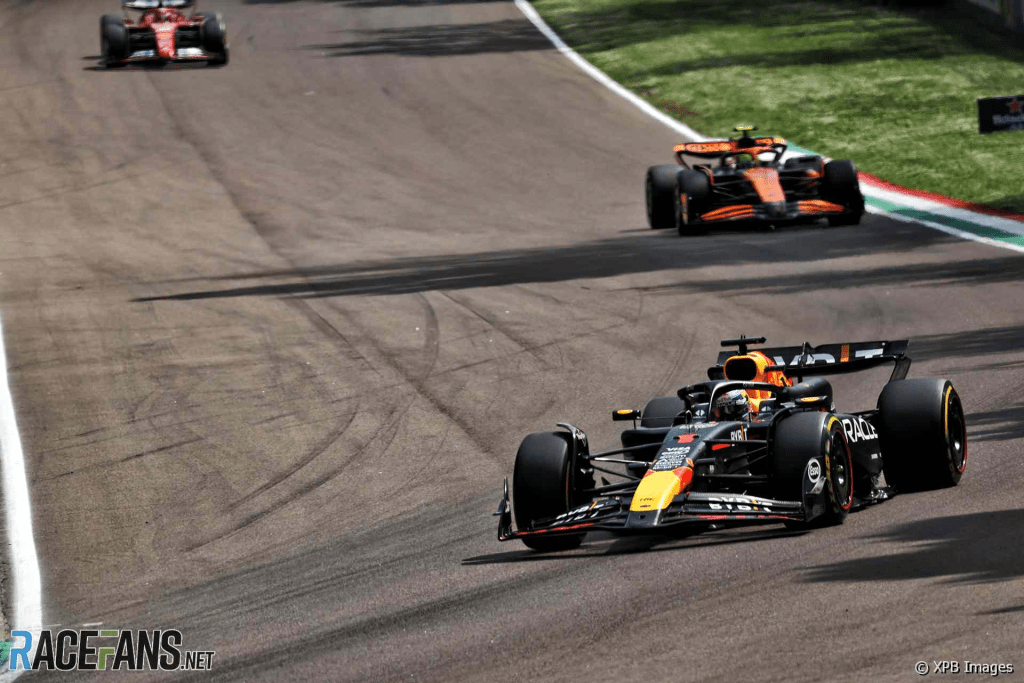
In contrast to Ferrari’s upgrades, McLaren’s are continuing to impress. Whilst in the middle of the race, it looked like Lando Norris was struggling for the pace, it instead appeared that he managed his tyres to perfection. This allowed him to charge at Max Verstappen towards the end of the race. Verstappen had to dig deep to stop Lando from getting into DRS range and attempting a move during the final laps and only won by 0.7 seconds. The last ten laps had vibes of Imola 2005, an example of how an F1 race’s quality is not always determined by the number of overtakes. Whilst Lando was not the driver I wanted to see hunting Max Verstappen down, this race showed that Red Bull is not invulnerable this season. The damp squib of a performance from Perez also emphasized this point.
In conclusion, I enjoy Imola. I understand why many don’t, but I’m never not going to have fun watching F1 drivers struggle to master a challenging, old-school circuit. I also am excited at the prospect of a season where three teams fight for wins, it’s been too long since F1 had one of those.
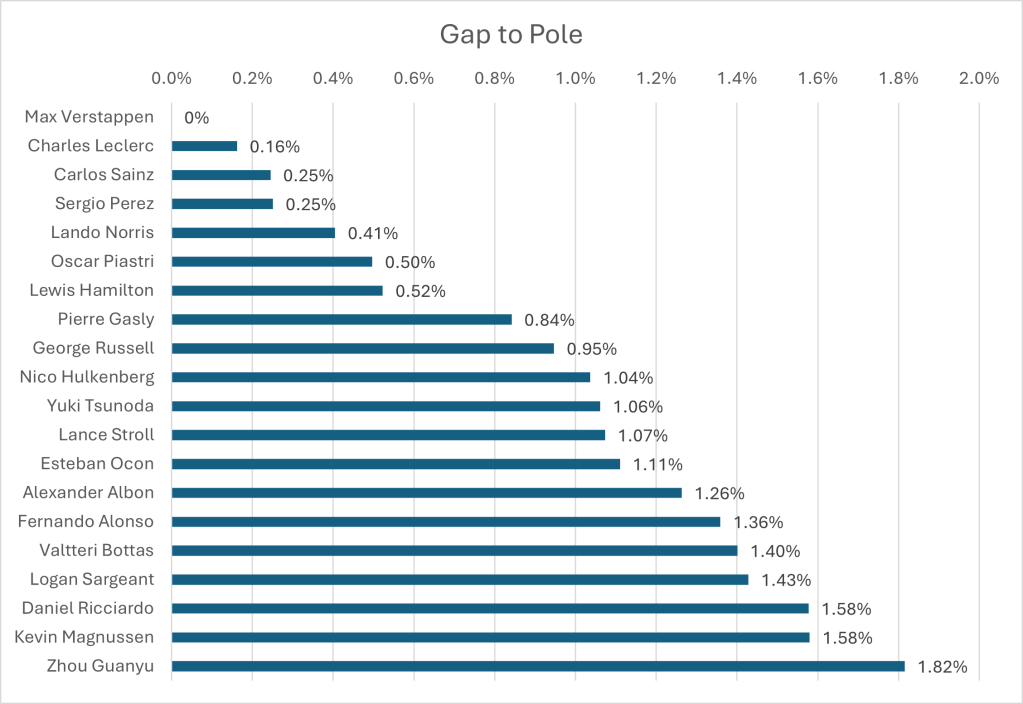
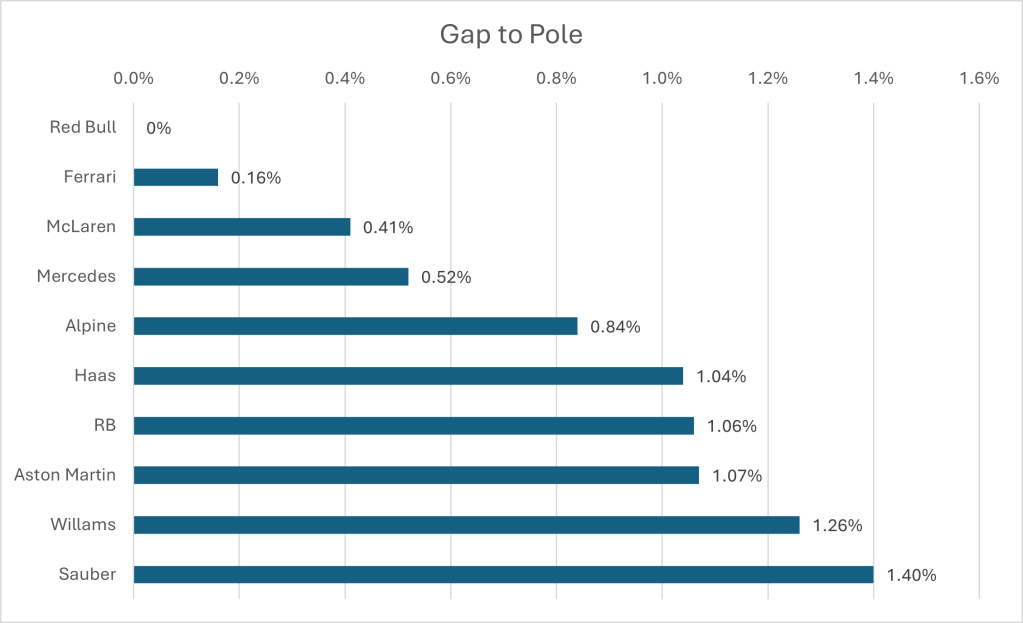
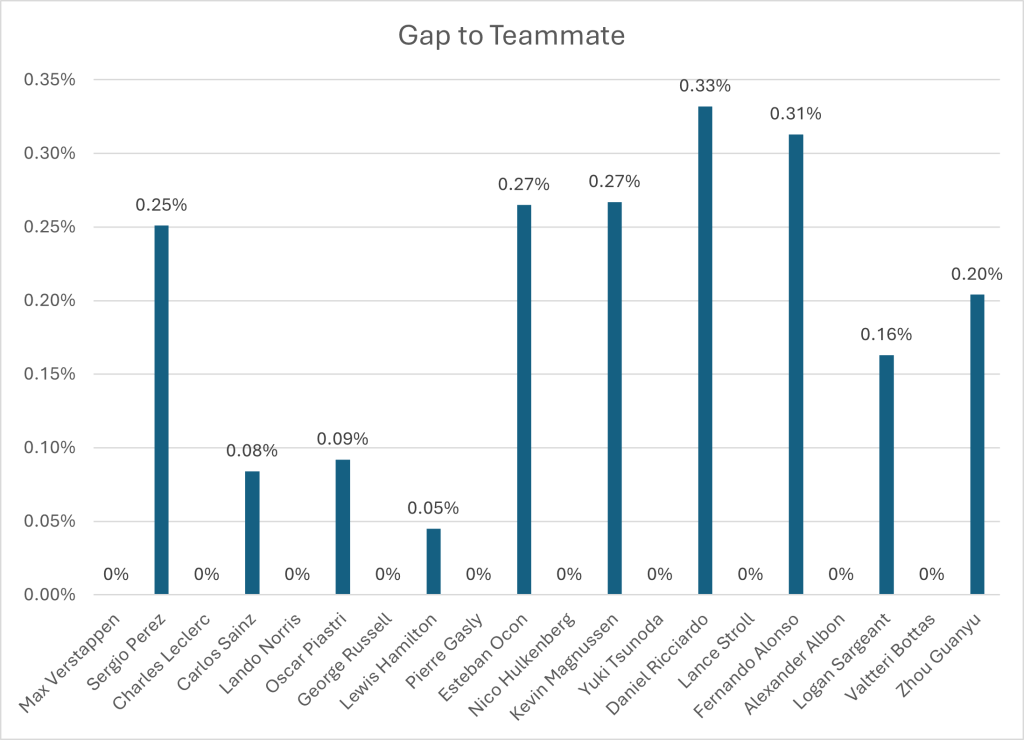
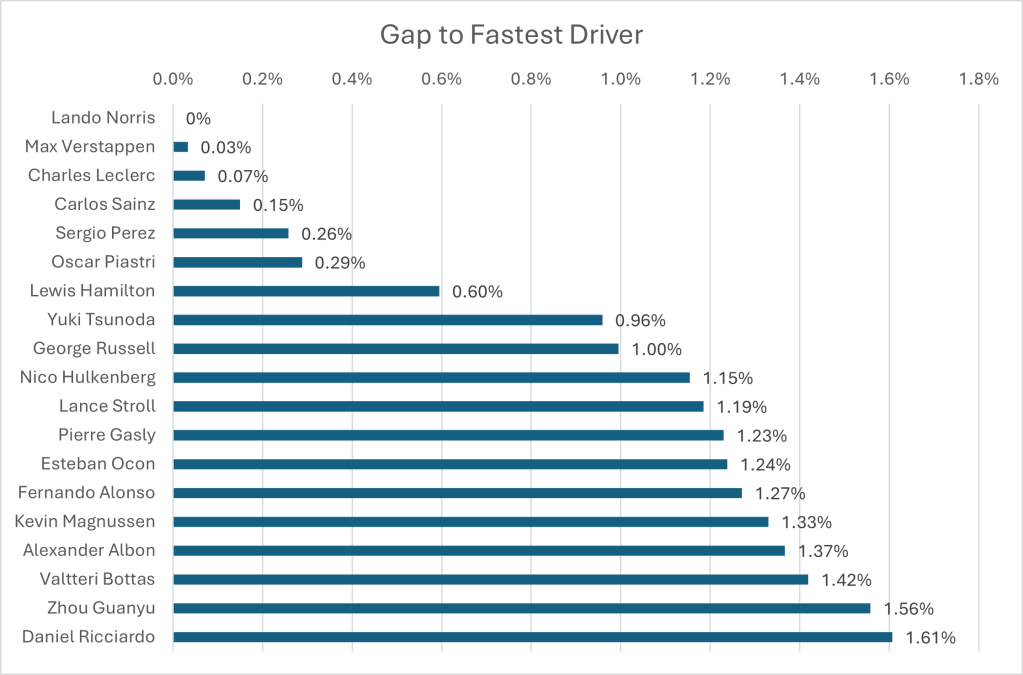
I have collated the fastest laps by each driver in qualifying, to show the average gap to the fastest driver. Whilst this extends the gap between drivers who made it to the top ten and those below, I’ve ruled using the overall fastest times a better grounding point for the true limit of the top cars, as the cars most likely to compete for points are my primary focus in these analyses.
Qualifying Pace-
Additionally, I have collected the data for the gaps between teammates. I did this by using their lap times set in the same qualifying session. I generally compare the last session both drivers competed in, however if both set their fastest times in earlier, I count these instead.
Race Pace-
I have calculated the average pace of the drivers, removing the first laps, laps in the pit lane and laps under the safety car as these are all too slow to be representative. Additionally, I removed any laps with major errors I noticed, for example spinning in the lap. In previous races, I excluded the laps after a safety car restart, as these tended to resemble the first laps, yet I counted them for China, as the long straights on the track seem to have negated the loss from cars being bunched up in the lap’s corners. I have only included drivers that completed at least 75% of the laps to not skew the season averages against drivers that never got the chance to run their cars on low fuel.[1]
As different drivers have a varying number of race stints, this skews the overall pace. Generally, if a driver makes more stops, their pace will be faster on average. This will be considered in my final thoughts and analysis. Additionally, the average pace per stint and number of stints are recorded at the bottom of this article, for those interested in viewing more precise estimates of pace relative to other drivers on the same stint.[2]
Analysis:
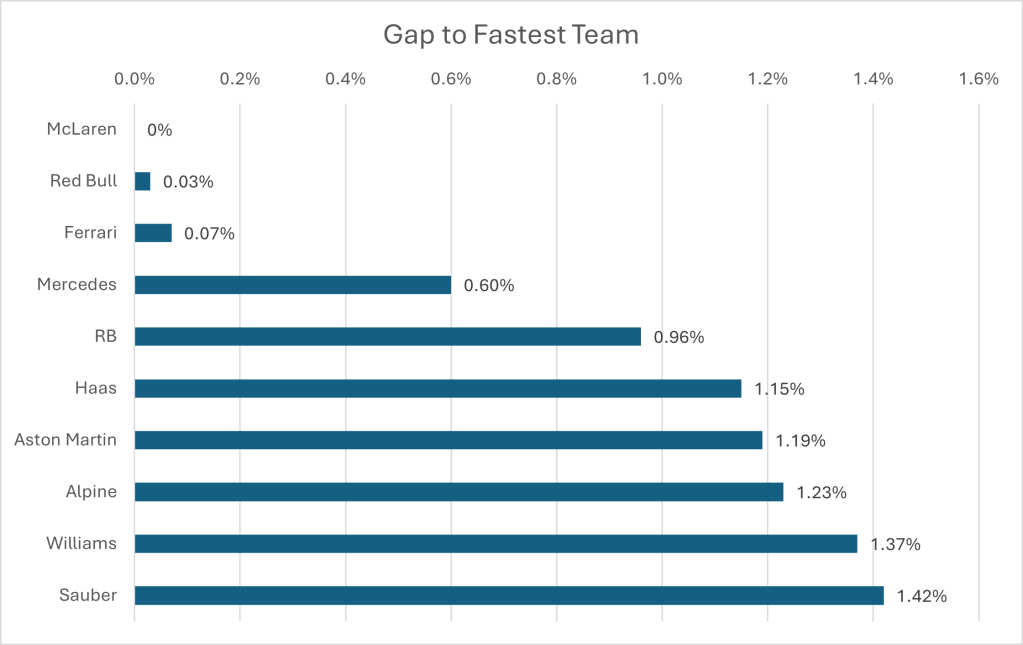
The McLaren was quite evidently the quickest car in clean air in Miami, as Piastri’s first stint and Norris’ second stint were both quicker than Verstappen’s respective stints.
The Aston Martin, especially from Alonso, was particularly slow in Miami. The team needs upgrades to improve their pace or they’re at risk of falling behind RB and maybe even Haas. Last year, Aston’s upgrades were very weak, some even making the team fall backwards, so if this trend repeats itself, Aston could be in real trouble.
Alpine is continuing to make a slow rise up the midfield. They were quicker than Williams and Sauber throughout the whole weekend. With Williams’ long-term plan being to sacrifice this year and Sauber’s never-ending incompetency, Alpine appear to be in the fight for points at least now. How far they’ll move up the midfield will be seen, but they probably expect to be with RB and Aston Martin by the end of the season.
Mercedes showed relatively solid pace in the race, particularly from Hamilton. Whilst not challenging the top three, I expect them to hold onto fourth place, when taking into account Aston’s struggles this weekend.
Further Resources-
Qualifying Pace:
Driver
Fastest Qualifying Time
Max Verstappen
87.241 (0%)
Charles Leclerc
87.382 (+0.162%)
Carlos Sainz
87.455 (+0.245%)
Sergio Perez
87.46 (+0.251%)
Lando Norris
87.594 (+0.405%)
Oscar Piastri
87.675 (+0.497%)
Lewis Hamilton
87.697 (+0.523%)
Pierre Gasly
87.976 (+0.842%)
George Russell
88.067 (+0.947%)
Nico Hulkenberg
88.146 (+1.037%)
Yuki Tsunoda
88.167 (+1.061%)
Lance Stroll
88.177 (+1.073%)
Esteban Ocon
88.209 (+1.110%)
Alexander Albon
88.343 (+1.263%)
Fernando Alonso
88.427 (+1.359%)
Valtteri Bottas
88.463 (+1.401%)
Logan Sargeant
88.487 (+1.428%)
Daniel Ricciardo
88.617 (+1.577%)
Kevin Magnussen
88.619 (+1.580%)
Zhou Guanyu
88.824 (+1.815%)
Average Race Pace:
Driver
Pace
Lando Norris
92.168 (0%)
Max Verstappen
92.198 (+0.033%)
Charles Leclerc
92.233 (+0.071%)
Carlos Sainz
92.305 (+0.150%)
Sergio Perez
92.405 (+0.258%)
Oscar Piastri
92.433 (+0.288%)
Lewis Hamilton
92.716 (+0.595%)
Yuki Tsunoda
93.051 (+0.959%)
George Russell
93.085 (+0.995%)
Nico Hulkenberg
93.231 (+1.154%)
Lance Stroll
93.26 (+1.185%)
Pierre Gasly
93.301 (+1.230%)
Esteban Ocon
93.309 (+1.238%)
Fernando Alonso
93.339 (+1.271%)
Kevin Magnussen
93.393 (+1.330%)
Alexander Albon
93.428 (+1.367%)
Valtteri Bottas
93.475 (+1.419%)
Zhou Guanyu
93.604 (+1.558%)
Daniel Ricciardo
93.649 (+1.607%)
All Stints:
Best Stints
Pace
Norris 2nd (24L/NH)
91.205
Sainz 2nd (24L/NH)
91.545
Verstappen 2nd (27L/NH)
91.576
Perez 3rd (24L/UM)
91.657
Hamilton 2nd (24L/UM)
91.68
Leclerc 2nd (30L/NH)
91.686
Piastri 3rd (16L/UM)
91.832
Piastri 2nd (6L/NH)
92.007
Tsunoda 2nd (24L/NH)
92.09
Russell 2nd (26L/NH)
92.406
Magnussen 3rd (25L/NM)
92.432
Hulkenberg 3rd (24L/NM)
92.512
Alonso 2nd (28L/UM)
92.587
Stroll 3rd (24L/UM)
92.667
Ocon 2nd (28L/NH)
92.677
Perez 2nd (8L/NH)
92.707
Bottas 3rd (24L/NM)
92.88
Ricciardo 2nd (24L/UM)
92.896
Zhou 2nd (24L/NS)
92.936
Piastri 1st (24L/NM)
92.94
Verstappen 1st (21L/NM)
92.999
Gasly 2nd (36L/NH)
93.047
Norris 1st (26L/NM)
93.057
Sainz 1st (24L/NM)
93.066
Leclerc 1st (17L/NM)
93.198
Albon 2nd (33L/NH)
93.405
Perez 1st (15L/NM)
93.442
Stroll 2nd (13L/UH)
93.712
Sargeant 2nd (13L/NH)
93.738
Bottas 2nd (13L/NH)
93.786
Hulkenberg 2nd (12L/NH)
93.786
Hamilton 1st (23L/NH)
93.797
Russell 1st (21L/UM)
93.926
Tsunoda 1st (25L/NM)
93.974
Stroll 1st (9L/UM)
94.187
Ocon 1st (20L/NM)
94.194
Gasly 1st (10L/NM)
94.216
Zhou 1st (24L/NM)
94.272
Albon 1st (8L/NM)
94.283
Hulkenberg 1st (10L/NM)
94.292
Alonso 1st (20L/UH)
94.392
Ricciardo 1st (24L/NH)
94.401
Sargeant 1st (9L/NM)
94.51
Magnussen 1st (20L/NH)
94.569
Bottas 1st (9L/NS)
94.612
Key: 1L= One Lap, 2L= Two Laps, NH= New Hards, UM= Used Mediums, NM= New Mediums, NS= New Softs
[2] I only include stints in the stint table if a driver has completed five or more representative laps, in an attempt to avoid fastest lap attempts. This has led to exclusions from the chart of Magnussen’s second stint and Albon’s third stint.
I expected little from the Miami Grand Prix. The track is my least favourite on the calendar. The dusty, abrasive track surface that is difficult to overtake on is complemented by a terrible layout that no one enjoys. Miami feels less like a Grand Prix circuit and more like trying to hold a race in a Tesco car park. So, after some of the most boring qualifying sessions in years, I was prepared to be negative. This feeling only grew when one of the most divisive, controversial, and inflammatory politicians in the world decided to turn the event into a photo-op for his deranged political campaign. Yet, after I stored all this negative energy up and was really ready to write a rant, instead I watched one of the best races in the past couple of years. A long-deserved winner, an upgraded McLaren and a chaotic Kevin Magnussen saved the weekend, pleasantly surprising millions of fans in the process.
Initially, the race looked processional. Whilst there was some good battling in the first couple of laps, mostly thanks to the Alpine drivers, Max Verstappen looked to be under control. Whilst not pulling away from the field like he usually does, Max maintained a healthy three second gap. But the first sign of trouble came when he hit a cone. Unlike the woman who hit a cone outside Bristol Zoo a couple years ago, Verstappen did continue driving. But this cone proved an ominous warning, that perhaps fate was not on Max’s side last Sunday.
Shortly after the close encounter of the coned kind, Max pitted for a new set of tyres. Initially, I expected Max to build a comfortable lead when the pit cycle had concluded. Yet, instead of closing the gap, it appeared that Lando Norris, on used tyres, in his upgraded McLaren, was actually pulling away from Verstappen. Realizing that the McLaren had a race pace advantage, it became clear that Verstappen was going to face a challenge to win the race. A possible Norris win was on the cards. And then, F1’s glorious chaos merchant decided to place the winning deck in Lando’s hands.
Throughout this season, Kevin Magnussen has been responsible for half of the entertainment. Whilst his driving standards are not always impeccable, he brings the drama that F1 sorely needs. This was evident in the Saturday sprint, where his fight with Lewis Hamilton featured wheel banging, corner cutting and three penalties, turning an otherwise boring event into a roulette of chaos. Then on Sunday, Kevin caused a safety car through a collision with Sargeant at the perfect time for Lando to pit and retain the lead.
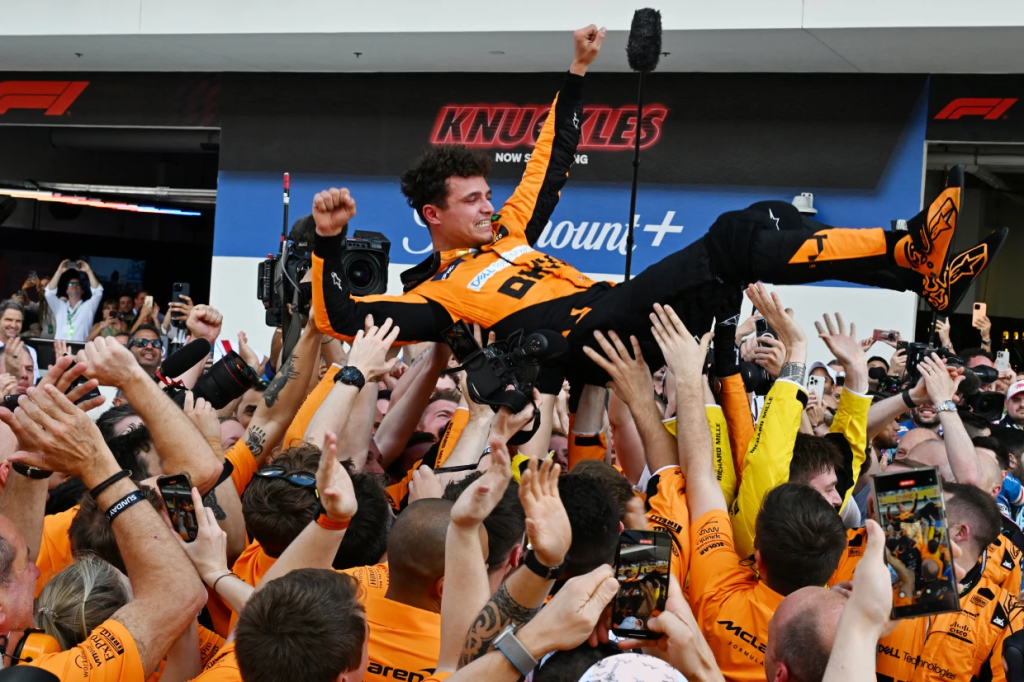
After the safety car period, Lando was ahead of Max, in a faster car, with newer tyres. He proceeded to build up the gap and win the race by around seven seconds. It has taken so long, but this race provided fans with the hope that Red Bull are not invincible. Now, with an upgraded Ferrari due in Imola, it appears that F1 may be about to get competitive again. I, for one, am unbelievably excited.
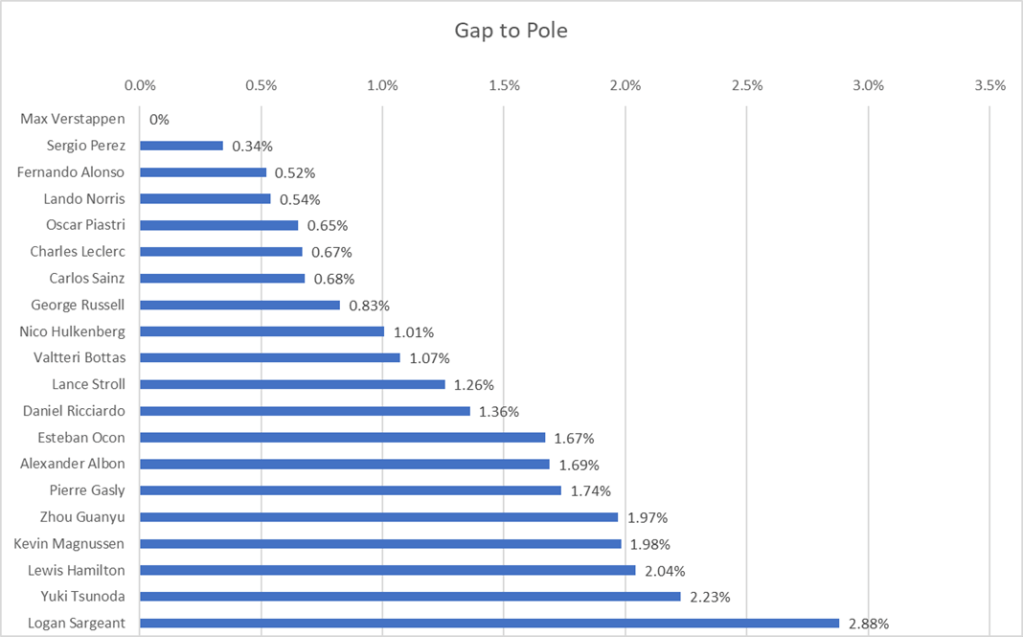
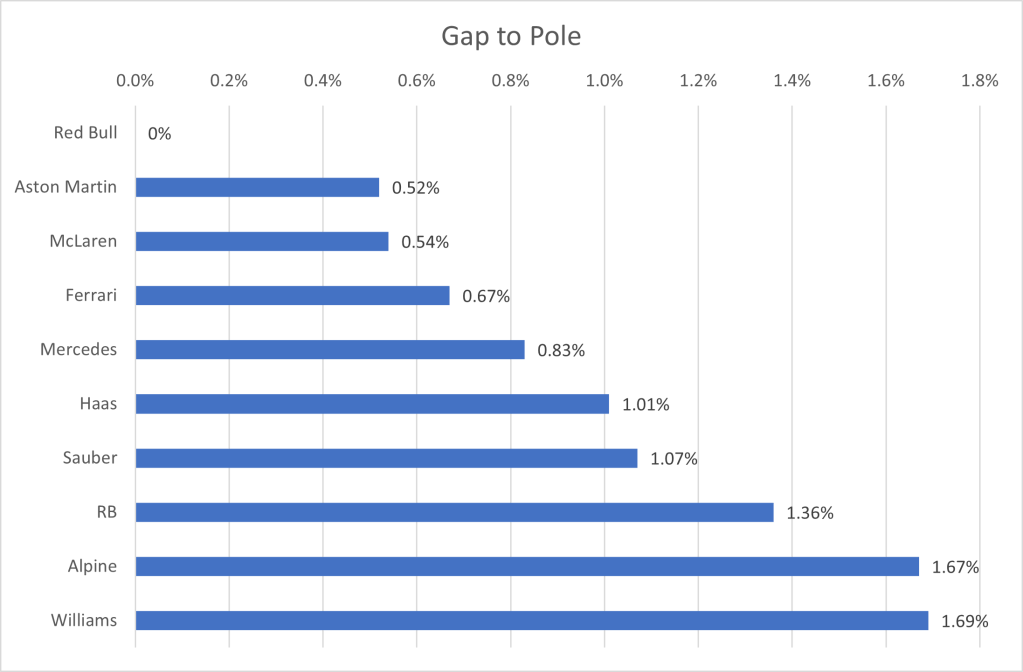
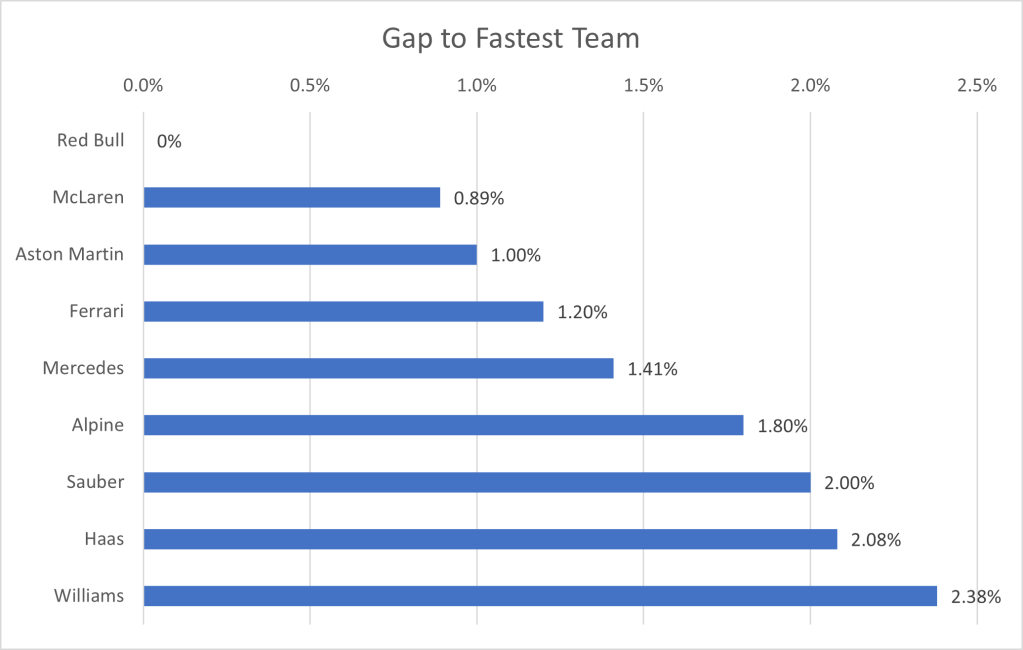
I have collated the fastest laps by each driver in qualifying, to show the average gap to the fastest driver. Whilst this extends the gap between drivers who made it to the top ten and those below, I’ve ruled using the overall fastest times a better grounding point for the true limit of the top cars, as the cars most likely to compete for points are my primary focus in these analyses.
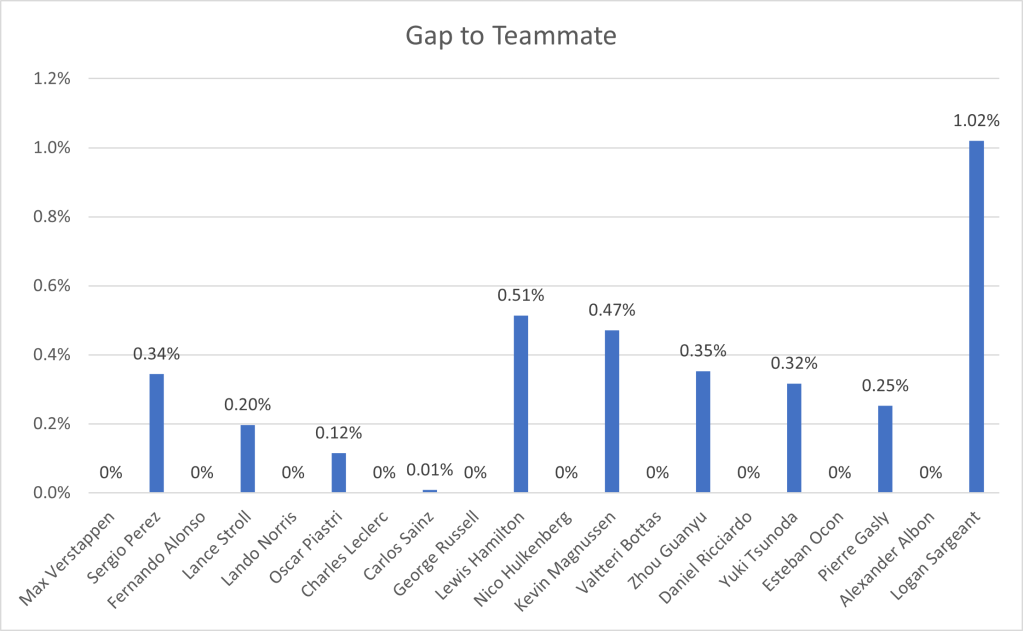
Additionally, I have collected the data for the gaps between teammates. I did this by using their lap times set in the same qualifying session. I generally compare the last session both drivers competed in, however if both set their fastest times in earlier, I count these instead.
Race Pace-
I have calculated the average pace of the drivers, removing the first laps, laps in the pit lane and laps under the safety car as these are all too slow to be representative. Additionally, I removed any laps with major errors I noticed, for example spinning in the lap. In previous races, I excluded the laps after a safety car restart, as these tended to resemble the first laps, yet I counted them for China, as the long straights on the track seem to have negated the loss from cars being bunched up in the lap’s corners. I have only included drivers that completed at least 75% of the laps to not skew the season averages against drivers that never got the chance to run their cars on low fuel. As different drivers have a varying number of race stints, this skews the overall pace. Generally, if a driver makes more stops, their pace will be faster on average. This will be considered in my final thoughts and analysis. Additionally, the average pace per stint and number of stints are recorded at the bottom of this article, for those interested in viewing more precise estimates of pace relative to other drivers on the same stint.
Analysis:
• This race offers the best direct comparison between teammates so far this season, as the opportune safety car caused most teammates to have the exact same strategy during the second half of the race. • The undercut was very powerful during this race, however the safety car negated the advantage those who had stopped early had. This proved an advantage for Norris and Leclerc, who did not pit before the safety car, however, if there was no safety car, it is likely both drivers would have lost out. • Verstappen was the only driver to complete lap twenty one of the race before the safety car was called. • As seen on Twitter, I can confirm that every lap Verstappen completed was faster than the respective laps from Perez, Leclerc, and Norris. These drivers were never faster than Verstappen, not for a lap, not for a stint and probably not even for a corner. • Piastri was significantly slower than Norris for the entire race, in every stint, even before he received damage. Whilst he has shown a lot of potential, he really needs to learn how to manage the tyres soon. This is an essential skill to be successful in the sport, if Oscar is the generational talent many have claimed, he can’t use inexperience as an excuse for bad race pace. • This was the first weekend that Alpine did not look like the slowest car. I would say, well done, but they are the Renault works team, they don’t really have too many excuses for their performance this year.
Further Resources- Qualifying Pace:
Driver
Fastest Qualifying Time
Max Verstappen
93.66 (0%)
Sergio Perez
93.982 (+0.344%)
Fernando Alonso
94.148 (+0.521%)
Lando Norris
94.165 (+0.539%)
Oscar Piastri
94.273 (+0.654%)
Charles Leclerc
94.289 (+0.671%)
Carlos Sainz
94.297 (+0.680%)
George Russell
94.433 (+0.825%)
Nico Hulkenberg
94.604 (+1.008%)
Valtteri Bottas
94.665 (+1.073%)
Lance Stroll
94.838 (+1.257%)
Daniel Ricciardo
94.934 (+1.360%)
Esteban Ocon
95.223 (+1.669%)
Alexander Albon
95.241 (+1.688%)
Pierre Gasly
95.287 (+1.737%)
Zhou Guanyu
95.505 (+1.970%)
Kevin Magnussen
95.516 (+1.982%)
Lewis Hamilton
95.573 (+2.042%)
Yuki Tsunoda
95.746 (+2.227%)
Logan Sargeant
96.358 (+2.881%)
Average Race Pace:
Driver
Pace
Max Verstappen
99.779 (0%)
Sergio Perez
100.42 (+0.643%)
Lando Norris
100.664 (+0.887%)
Fernando Alonso
100.771 (+0.995%)
Charles Leclerc
100.979 (+1.203%)
George Russell
101.19 (+1.414%)
Carlos Sainz
101.204 (+1.428%)
Lance Stroll
101.365 (+1.590%)
Pierre Gasly
101.576 (+1.802%)
Oscar Piastri
101.64 (+1.865%)
Zhou Guanyu
101.777 (+2.002%)
Nico Hulkenberg
101.854 (+2.080%)
Lewis Hamilton
101.888 (+2.114%)
Esteban Ocon
101.946 (+2.172%)
Alexander Albon
102.154 (+2.380%)
Kevin Magnussen
102.567 (+2.794%)
Logan Sargeant
102.641 (+2.869%)
All Stints:
Best Stints
Pace
Verstappen 3rd (25L/NH)
99.194
Alonso 4th (12L/NM)
99.572
Norris 2nd (25L/NH)
99.743
Perez 3rd (25L/NH)
99.849
Verstappen 2nd (7L/NH)
99.982
Leclerc 2nd (25L/NH)
100.079
Alonso 3rd (11L/NS)
100.259
Zhou 4th (15L/NS)
100.287
Sainz 2nd (27L/NH)
100.408
Stroll 5th (20L/UH)
100.485
Gasly 4th (17L/NM)
100.519
Russell 3rd (25L/NH)
100.591
Perez 2nd (6L/NH)
100.622
Verstappen 1st (11L/NM)
100.978
Piastri 3rd (25L/NH)
101.274
Hamilton 3rd (25L/NH)
101.276
Alonso 2nd (8L/NH)
101.38
Hulkenberg 3rd (25L/NH)
101.394
Russell 2nd (8L/NM)
101.45
Ocon 3rd (25L/NH)
101.457
Ricciardo 2nd (5L/NM)
101.477
Gasly 3rd (6L/NH)
101.486
Albon 3rd (25L/NH)
101.535
Perez 1st (11L/NM)
101.607
Zhou 3rd (8L/NH)
101.739
Stroll 2nd (10L/NM)
101.846
Gasly 2nd (8L/NH)
101.86
Norris 1st (19L/NM)
101.875
Magnussen 3rd (25L/NM)
101.928
Hulkenberg 2nd (11L/NH)
102.126
Leclerc 1st (19L/NM)
102.163
Sargeant 2nd (7L/NM)
102.222
Bottas 2nd (9L/NH)
102.223
Ocon 2nd (10L/NH)
102.255
Hamilton 2nd (10L/NM)
102.256
Sargeant 3rd (25L/NH)
102.295
Alonso 1st (9L/NM)
102.455
Tsunoda 2nd (11L/NM)
102.582
Piastri 1st (14L/NM)
102.583
Zhou 2nd (11L/NH)
102.606
Russell 1st (9L/NM)
102.62
Sainz 1st (15L/NM)
102.636
Stroll 1st (7L/NS)
102.825
Albon 2nd (10L/NM)
102.884
Bottas 1st (7L/NM)
103.053
Ocon 1st (7L/NM)
103.249
Hulkenberg 1st (6L/NM)
103.272
Albon 1st (7L/NM)
103.32
Gasly 1st (9L/NM)
103.381
Ricciardo 1st (12L/NM)
103.396
Tsunoda 1st (6L/NS)
103.53
Hamilton 1st (7L/NS)
103.549
Sargeant 1st (11L/NS)
103.799
Magnussen 1st (15L/NH)
103.812
Zhou 1st (6L/NM)
104.029
Key: 1L= One Lap, 2L= Two Laps, NH= New Hards, UM= Used Mediums, NM= New Mediums, NS= New Softs


 Ryan's Lil' F1 Blog