A decent race in Shanghai this weekend was buoyed by the stellar commentary of Nico Rosberg. He has the perspective of someone who deeply understands the sport, able to analyse moment-to-moment actions quickly and reasonably, alongside possessing a balanced perspective on the long-term picture of the race. He is not afraid to call out Crofty when he makes flawed observations, which afforded me the usual activity of shouting at my TV whenever I disagree with him. To accredit David Croft, he can be great at delivering hype during exciting battles, but it helps to have a more analytical voice to balance the coverage out.
Regardless of Nico Rosberg’s commentary, I enjoy this track. There are a variety of corners, all wide enough to allow for possible overtakes. This allows for drivers to attempt different lines and find unique opportunities to make those vital moves fans enjoy. The crowd also delivered, the hype for Zhou Guanyu, F1’s first Chinese driver, rivalling the support from Japanese or Dutch fans. Seeing Zhou crying at the end after finally racing at home was an incredibly wholesome moment. Whilst Zhou has not been an outstanding driver, a country that possesses over a billion people and one of the most important markets in the world needs a star to cheer.
Two weeks ago, McLaren were ruing their disappointment in Japan. But this week, their disappointment dissipated, as they unexpectedly proved the second fastest team. Whilst not having the pace to challenge Verstappen, Lando Norris maximized his pace to finish in second, a fantastic result for the team. Post-race, Lando was hopeful of achieving his long-awaited win this year and if McLaren can develop their car well, his first win seems inevitable and deserving for a driver of evident talent.
Two other topics that warrant mentioning are the arbiters of entertainment, Ferrari and Fernando. Whilst both suffered a regretful weekend, Ferrari lacking pace and Aston Martin strategy, the best overtakes all seemed to be those committed by Fernando and Charles. Fernando instantly ended Sergio Perez’s chance of winning the race by overtaking him at the start and the Ferrari’s picked their way through the slower cars. Charles humbled his on-form teammate, whilst in the meantime Alonso’s teammate humbled himself. The second half of the race proved weak for both drivers, Leclerc slowly realizing that he hadn’t been given the pace to fight Norris and Aston foolishly pitting Alonso onto soft tyres, then requiring another pit stop to finish the race. But both drivers used their talent to maximize the situations, Leclerc finishing just off of the podium and Alonso making decisive moves in his final stint to wrap up a healthy haul of points.
In conclusion, we had a decent weekend of F1 with good commentary, a solid track and a surprising second place. It’s good to have Shanghai back on the Formula One calendar, though hopefully next year we have a fight for the win.
This article is part of a series of articles I will be completing throughout the year, where I am going to analyze the average pace of the drivers and teams, in both qualifying and the races, to be able to gain a picture of performance levels.
I have collated the fastest laps by each driver in qualifying, to show the average gap to the fastest driver. One caveat that arises, is that the top 10 drivers, through progressing to the final qualifying session, have a better track condition that those who only took part in Q1 or Q2. Due to this, the gap will be larger for the drivers outside the top ten than if qualifying was performed in one representative session. However, since the final session represents the point at which the top drivers are truly pushing, I’ve ruled it a better grounding point for the true limit of the cars, rather than only focusing on the first qualifying session in which the best times are not recorded.
Qualifying Pace-
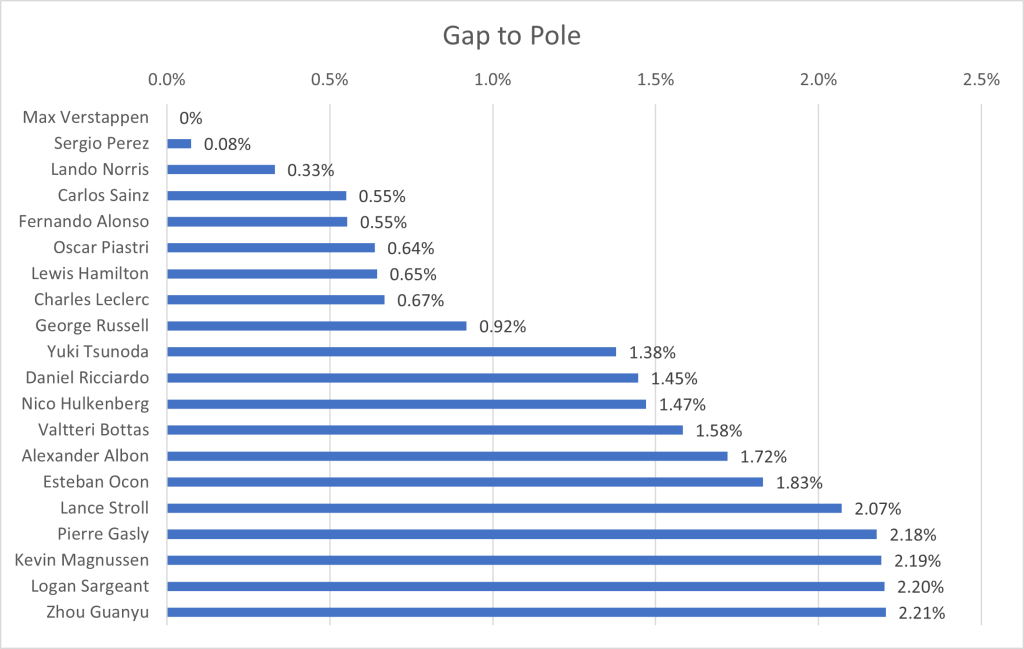
With no further ado, here are the gaps to pole:
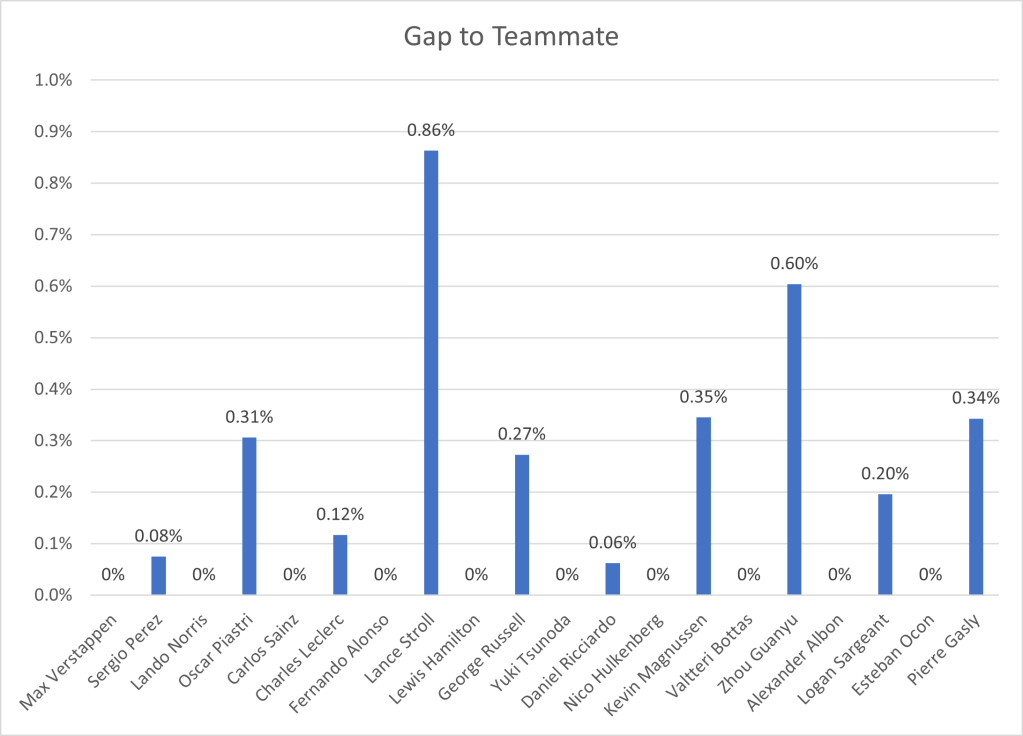
Additionally, I have collected the data for the gaps between teammates. I did this by using their fastest lap times set in the same session, so if one driver got into Q3, whilst the other only got into Q2, then I would count their Q2 times. Additionally, the lap times have to be representative, to avoid comparing out laps completed before a driver breaks down, as this would give us a very inaccurate representation of the drivers’ pace:
Race Pace-
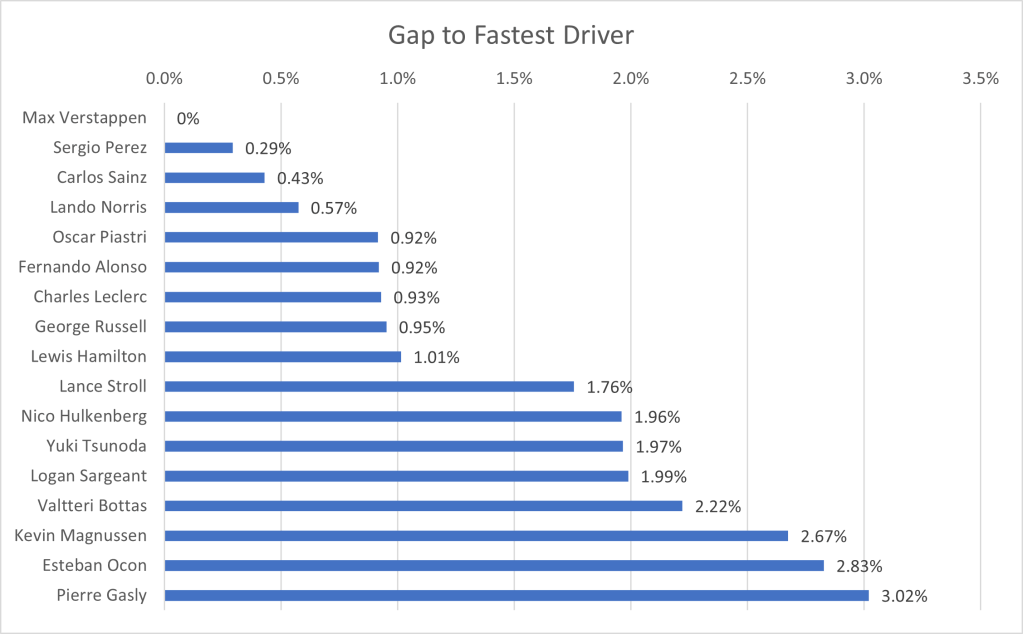
Next up in our data sets is the race pace of the drivers. I have calculated the average pace of the drivers, removing first laps, in-laps, out-laps and virtual safety car laps, as all these all not representative of a driver’s general pace. Additionally, if a driver has a spin, or another error that would greatly reduce their lap time, I have not counted these laps, as they would also not be representative of a drivers’ general pace. I have only included drivers that completed at least 75% of the race distance ((which for Japan, excludes Alexander Albon, Daniel Ricciardo and Zhou Guanyu) so to not skew the season long averages against drivers that did not drive on low fuel with the best track conditions.
As different drivers have a varying number of race stints, this skews the overall pace. Generally, if a driver makes more stops, their pace will be faster on average. This will be taken into account in my final thoughts and analysis. Additionally, the average pace per stint and number of stints are recorded at the bottom of this article, for those interested in viewing more precise estimates of pace relative to other drivers on the same stint.[2]
Analysis:
It is more difficult to directly compare drivers’ race pace than in previous races this season, due to the large variety of tyre strategies and stint lengths.
Leclerc had an amazing race, showing consistent pace and tyre management to be the only driver other than Magnussen to pull off an effective one-stop. Whilst not being as fast on average as his teammate as a result, Leclerc showed off how Ferrari has seemingly fixed their tyre woes and have provided their drivers a car that has strategic flexibility.
Both Mercedes drivers were incredibly close to each other throughout the race. Whilst Lewis was a little slower in the first stint due to damage, he then proceeded to be a little faster than George in the next two stints.
McLaren really messed up Lando Norris’ strategy in this race. Despite stopping Norris on his medium stint earlier than any other driver, the team still felt the need to stop at the same time as Leclerc for the final stint. As Norris was already behind the one-stopping Leclerc and went onto the same tyres, it was virtually impossible for him to finish ahead of Leclerc after that decision. A tyre offset is generally needed to make overtakes in Suzuka, so McLaren should have stopped Norris later and attempted to reclaim fourth place.
I have no idea what was going on with Lance Stroll’s race. His stint lengths and tyre degradation were particularly poor, only recording eight valid laps on his medium stint. Looking at the data and how fast Stroll’s tyres were degrading is concerning. Unless it comes out that his tyres were mistakenly made of Swiss cheese, Lance has really got to work on this element of his race craft to ensure never repeating a performance like this. Whilst his teammate’s stints were up there with the McLaren and Mercedes’, Lance’s were comparable to the Alpine drivers, who had the slowest car.
Further Resources-
Qualifying Pace:
Driver
Fastest Qualifying Time
Max Verstappen
88.197 (0%)
Sergio Perez
88.263 (+0.075%)
Lando Norris
88.489 (+0.331%)
Carlos Sainz
88.682 (+0.550%)
Fernando Alonso
88.686 (+0.554%)
Oscar Piastri
88.76 (+0.638%)
Lewis Hamilton
88.766 (+0.645%)
Charles Leclerc
88.786 (+0.668%)
George Russell
89.008 (+0.920%)
Yuki Tsunoda
89.413 (+1.379%)
Daniel Ricciardo
89.472 (+1.446%)
Nico Hulkenberg
89.494 (+1.471%)
Valtteri Bottas
89.593 (+1.583%)
Alexander Albon
89.714 (+1.720%)
Esteban Ocon
89.811 (+1.830%)
Lance Stroll
90.024 (+2.071%)
Pierre Gasly
90.119 (+2.179%)
Kevin Magnussen
90.131 (+2.193%)
Logan Sargeant
90.139 (+2.202%)
Zhou Guanyu
90.143 (+2.206%)
Average Race Pace:
Driver
Pace
Max Verstappen
96.028 (0%)
Sergio Perez
96.309 (+0.293%)
Carlos Sainz
96.441 (+0.430%)
Lando Norris
96.579 (+0.574%)
Oscar Piastri
96.908 (+0.916%)
Fernando Alonso
96.91 (+0.919%)
Charles Leclerc
96.921 (+0.929%)
George Russell
96.943 (+0.952%)
Lewis Hamilton
97.002 (+1.014%)
Lance Stroll
97.715 (+1.756%)
Nico Hulkenberg
97.91 (+1.960%)
Yuki Tsunoda
97.916 (+1.966%)
Logan Sargeant
97.937 (+1.988%)
Valtteri Bottas
98.161 (+2.221%)
Kevin Magnussen
98.596 (+2.674%)
Esteban Ocon
98.743 (+2.827%)
Pierre Gasly
98.928 (+3.020%)
All Stints:
Best Stints
Pace
Sainz 3rd (16L/NH)
94.726
Verstappen 3rd (18L/NH)
94.727
Hamilton 3rd (13L/UM)
94.822
Perez 3rd (19L/NH)
94.92
Russell 3rd (15L/UM)
95.206
Sargeant 4th (10L/NS)
95.671
Alonso 3rd (19L/NH)
95.779
Piastri 3rd (20L/NH)
95.798
Leclerc 2nd (26L/NH)
95.889
Norris 3rd (26L/NH)
95.941
Sargeant 3rd (5L/NM)
96.056
Hulkenberg 2nd/3rd (18L/NH)
96.185
Hamilton 2nd (14L/NH)
96.387
Russell 2nd (13L/NH)
96.475
Verstappen 2nd (16L/NM)
96.523
Stroll 4th (17L/NS)
96.644
Sainz 2nd (19L/UM)
97.036
Perez 2nd (16L/NM)
97.039
Norris 2nd (13L/NH)
97.298
Verstappen 1st (12L/NM)
97.321
Tsunoda 2nd/3rd (29L/NH)
97.346
Alonso 2nd (18L/NM)
97.401
Piastri 2nd (18L/NH)
97.506
Stroll 3rd (10L/NH)
97.591
Ocon 3rd (18L/NM)
97.416
Norris 1st (7L/NM)
97.614
Perez 1st (11L/NM)
97.648
Gasly 3rd (19L/NH)
97.682
Sargeant 2nd (10L/NH)
97.754
Magnussen 2nd (29L/NH)
97.827
Bottas 2nd/3rd (29L/NH)
97.829
Sainz 1st (11L/NM)
97.909
Leclerc 1st (22L/NM)
98.14
Alonso 1st (9L/NS)
98.318
Piastri 1st (8L/NM)
98.334
Ocon 2nd (12L/NH)
98.593
Russell 1st (18L/NH)
98.727
Bottas 1st/2nd (14L/NH)
98.749
Stroll 2nd (8L/NM)
98.849
Gasly 2nd (14L/NM)
98.877
Tsunoda 1st/2nd (13L/NH)
98.897
Hamilton 1st (19L/NH)
98.948
Hulkenberg 1st/2nd (26L/NH)
99.01
Stroll 1st (8L/NS)
99.012
Sargeant 1st (18L/NH)
99.82
Magnussen 1st (18L/NM)
99.836
Ocon 1st (15L/NH)
100.457
Gasly 1st (12L/NH)
100.961
Key: 1L= One Lap, 2L= Two Laps, NH= New Hards, UM= Used Mediums, NM= New Mediums, NS= New Softs
[1] I only count a stint if a driver has completed five or more laps, to avoid short stints for fastest lap attempts skewing the data on the table. This has led to the official first stints of Tsunoda, Bottas and Hulkenberg (who only recorded one valid lap in his first stint) not being included in the table, though this is represented through the labeling of their stints as 1st/2nd and 2nd/3rd
Once again, Max dominated. He drove away from the field and had a pace advantage over everyone else. There’s little else to say, his performance was next to perfect, as it is every weekend.
2. Sergio Perez-
Whilst his teammate still dominated, Sergio Perez also had a fantastic weekend. On a track he has struggled at in the past, he nearly matched Max in qualifying. Whilst missing his chances to pass Max at the start and win the race, Sergio still delivered fantastic pace and audacious overtakes to ensure that Red Bull achieved their third 1-2 of the season.
3. Carlos Sainz-
Carlos once again proved the stronger Ferrari driver over the weekend. He maximized his good starting position to continue his 100% podium rate this season.[1] People are already starting to question why Ferrari made the call to replace Carlos, he is clearly one of the best drivers in F1. After spending years being underrated, it appears that F1 fans, teams and casual spectators are waking up to this fact. Ferrari currently have the best line-up in F1, let’s hope they don’t lose it.
4. Charles Leclerc-
Whilst not having the best qualifying performance, Charles more than made up for it in the race. Charles and Ferrari executed a fantastic one-stop strategy that no other driver could make work. Charles’ ability to post consistent lap times with minimal degradation (even compared to his own teammate) show that he is maximizing that Ferrari in the races. Once he has improved his qualifying, Charles could be unstoppable this season.
5. Yuki Tsunoda-
Last, but definitely not least, is the home hero Yuki Tsunoda. He was able to beat his teammate in qualifying, run a sublime strategy in the race and finish in front of an Aston Martin to get the last point on the table. His attitude is amazing, he puts the team before himself and combined with Perez’s strong performances, he has guaranteed that Daniel Ricciardo will never drive a Red Bull again. Getting a point at home clearly meant so much to Yuki and as someone who remembers his first year, when he was consistently outqualified by Pierre Gasly and swore too much on the radio, it has been a pleasure to see Yuki grow into one of F1’s most solid performers.
F1 delivered a thrilling Japanese Grand Prix. Often one of the best tracks for drivers, Suzuka has recently proved a difficult track to make overtakes. However, mixed up tyre strategies provided for battles throughout the field this year. Whilst the final result was predictable, the action was exciting, something that should please any fan of good racing.
Red Bull returned to dominate the field after their Australian hiccup. Whilst Verstappen’s win was expected, what surprised was how close Sergio Perez was throughout this weekend. Japan is one of Verstappen’s best tracks and Sergio had a relentless struggle here last season. I fully expected him to qualify in seventh and finish around fifth. Yet, Perez seems to have stepped up his game, only being 0.066 seconds slower than Verstappen in qualifying. He then proceeded to have an entertaining race, battling the rest of the field after his pit stops, to finish exactly where Red Bull need him to. Also, overtaking both Mercedes through 130R was inspired. Channeling his inner Alonso, Perez showed that he has the bravery to stop the second Red Bull seat going down under.
McLaren have had a slightly less fortunate week than the bulls. I fear I was not firm enough in the article I wrote on McLaren’s performance earlier in the year. Whilst the article I wrote back then expressed doubts and reservations on McLaren’s expectations of challenging Red Bull, I was actually certain that they would not be the second-best team this year. Thus, it was not to my surprise to see McLaren now claiming that it would now take another twelve months of development to improve, followed by the shock announcement that David Sanchez, who only started his job three months ago, was leaving.[1] Despite this, the grand prix itself was not even that bad for McLaren. They still look like they are solidly the third best team and can challenge for podiums in the right circumstances. But the team set expectations too high at the beginning of the year, disappointing their drivers and exemplifying the amusement of Ferrari fans. If McLaren had set realistic expectations, people would be singing their plaudits for seemingly dethroning Mercedes as a top team. Instead, we’re all busy wondering what happened to the Red Bull challenger we were promised.
This week’s stewards thankfully proved to be more competent than the ones in Australia. Towards the end of the race, Fernando was delivering another defensive masterclass, driving slowly to keep Piastri in DRS to stop George Russell from being able to advance and overtake on his faster tyres. No twenty second penalty was given to Fernando for driving slowly this week, but when Russell and Piastri had a moment at the chicane, I was nervous that one of them would get an unnecessary penalty. This was because the divebomb Russell made to attempt to overtake Piastri led to Piastri going off the track to avoid a collision. I was initially hesitant that Piastri may get a penalty for leaving the track, when his space was incredibly limited, but then Russell was put under investigation for pushing Piastri off the track. This was even though Piastri benefited from not taking the chicane. But the stewards took the right decision this week, to not punish hard racing. After Australia’s debacle, I was pleased to see the attitude of ‘let them race’ being adopted. I hope future stewards can learn from the fair handling of this incident.
Overall, a good weekend for F1. Suzuka reminded us why it was one of the greatest tracks in F1 history, moves were made across the field, Tsunoda got some points at home and Alpine dropped back like a stone. I couldn’t really have asked for much more.[2]
This article is part of a series of articles I will be completing throughout the year, where I am going to analyze the average pace of the drivers and teams, in both qualifying and the races, to be able to gain a picture of performance levels.
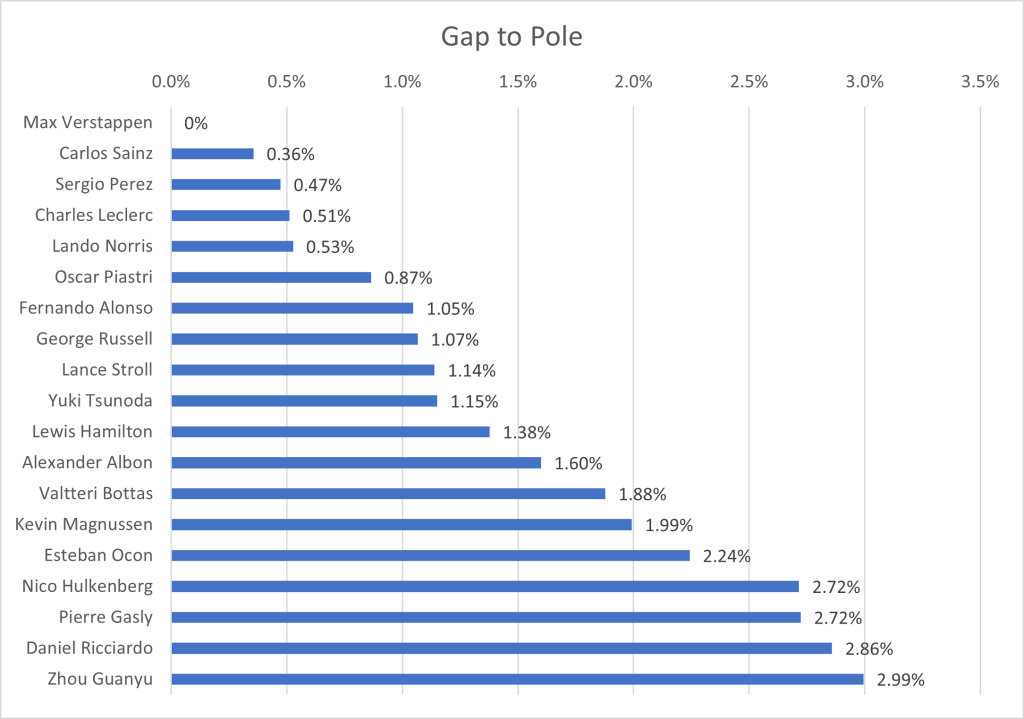
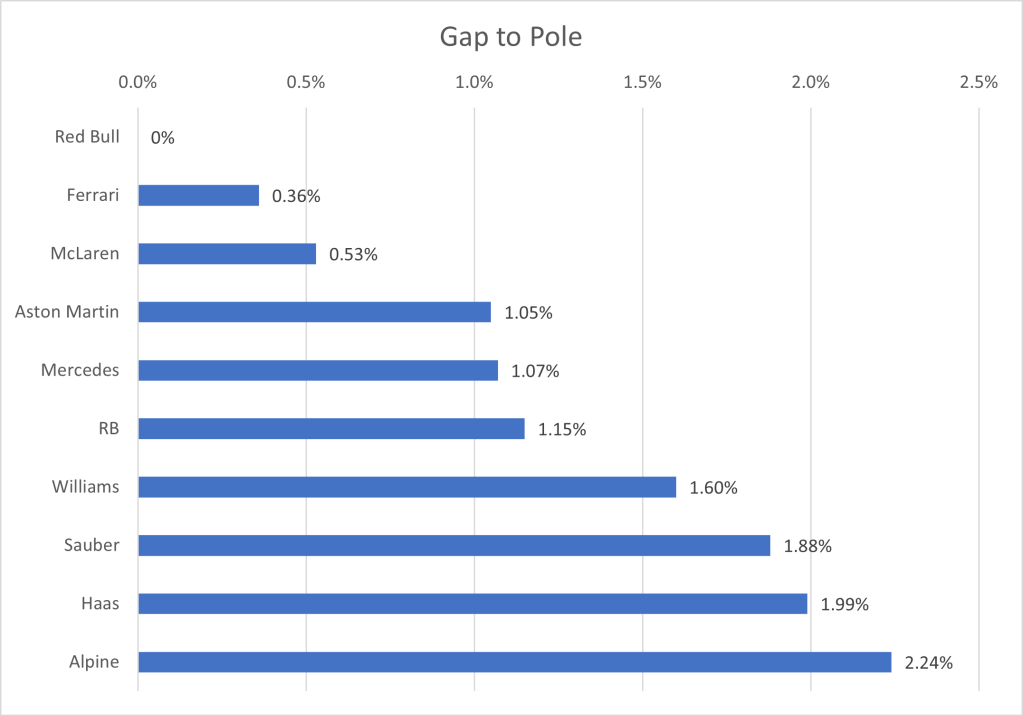
I have collated the fastest laps by each driver in qualifying, to show the average gap to the fastest driver. One caveat that arises, is that the top 10 drivers, through progressing to the final qualifying session, have a better track condition that those who only took part in Q1 or Q2. Due to this, the gap will be larger for the drivers outside the top ten than if qualifying was performed in one representative session. However, since the final session represents the point at which the top drivers are truly pushing, I’ve ruled it a better grounding point for the true limit of the cars, rather than only focusing on the first qualifying session in which the best times are not recorded.
Qualifying Pace-
With no further ado, here are the gaps to pole:
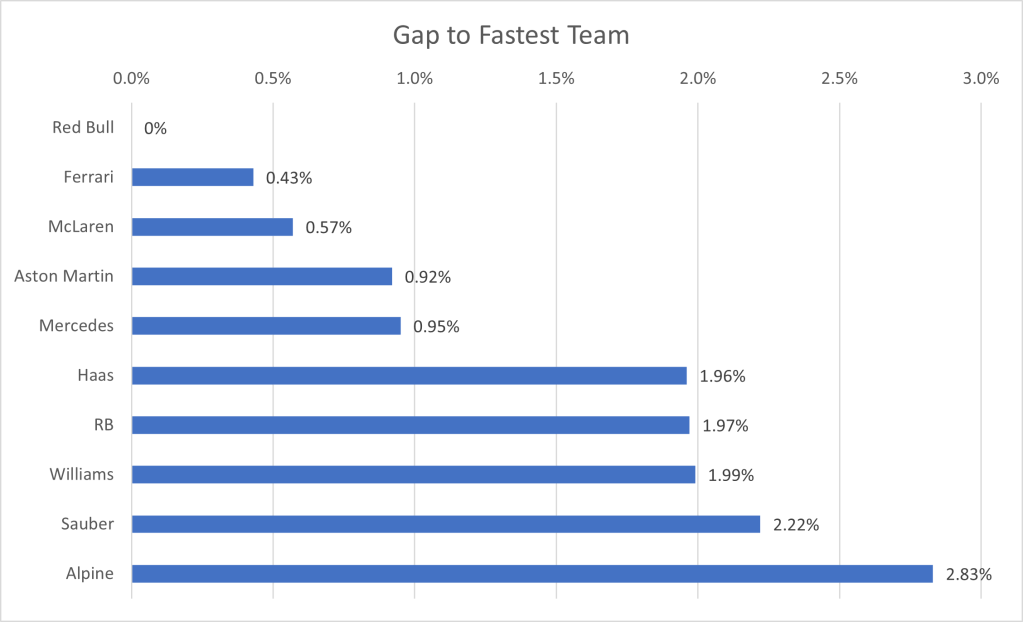
And for the teams:
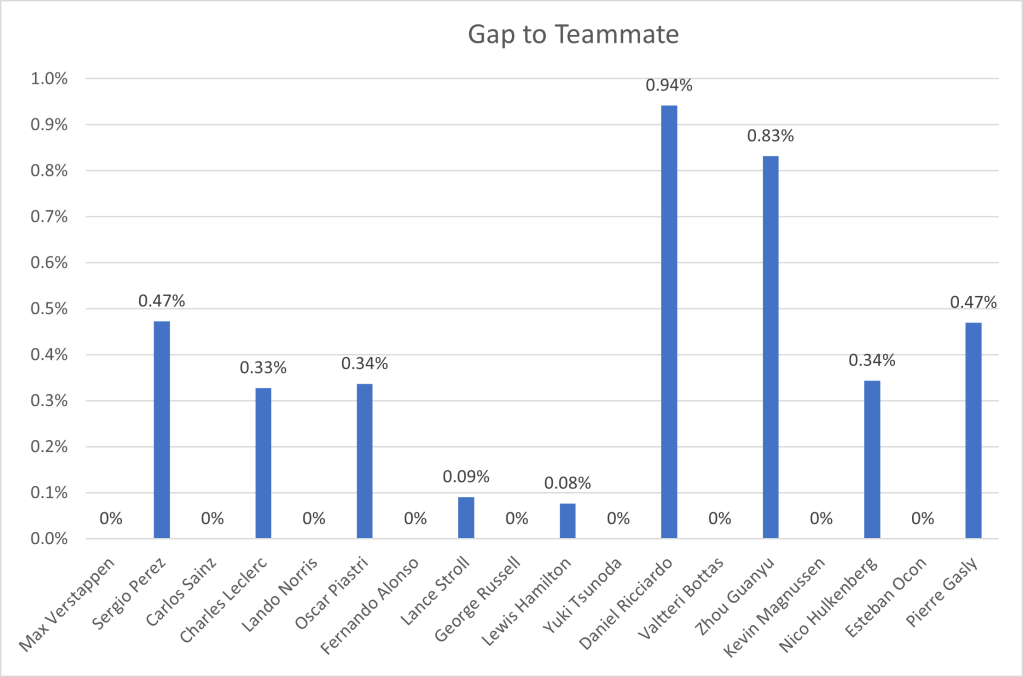
Additionally, I have collected the data for the gaps between teammates. I did this by using their fastest lap times set in the same session, so if one driver got into Q3, whilst the other only got into Q2, then I would count their Q2 times. Additionally, the lap times have to be representative, to avoid comparing out laps completed before a driver breaks down, as this would give us a very inaccurate representation of the drivers’ pace. Williams have no comparison for Australia, as Sargeant did not take part in the weekend after Albon’s crash:
Race Pace-
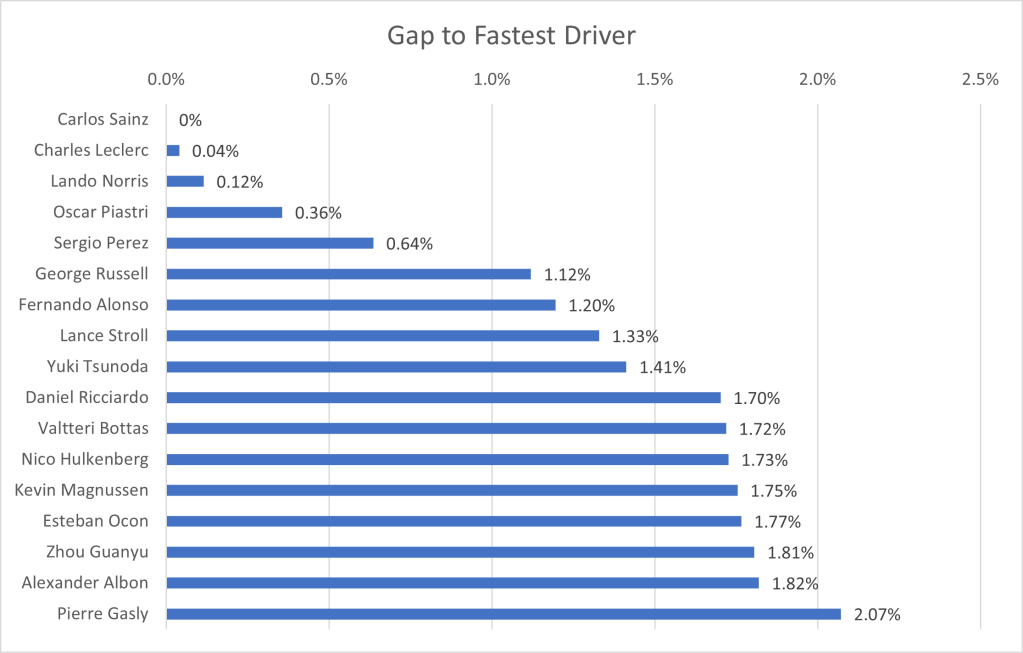
Next up in our data sets is the race pace of the drivers. I have calculated the average pace of the drivers, removing first laps, in-laps, out-laps and virtual safety car laps, as all these all not representative of a driver’s general pace. Additionally, if a driver has a spin, or another error that would greatly reduce their lap time, I have not counted these laps, as they would also not be representative of a drivers’ general pace.[1] I have only included drivers that completed at least 75% of the race distance (which for Australia, excludes Lewis Hamilton and Max Verstappen) so to not skew the season long averages against drivers that did not drive on low fuel with the best track conditions.
As different drivers have a varying number of race stints, this skews the overall pace. Generally, if a driver makes more stops, their pace will be faster on average. This will be taken into account in my final thoughts and analysis. Additionally, the average pace per stint and number of stints are recorded at the bottom of this article, for those interested in viewing more precise estimates of pace relative to other drivers on the same stint.[2]
And for the teams:
Analysis:
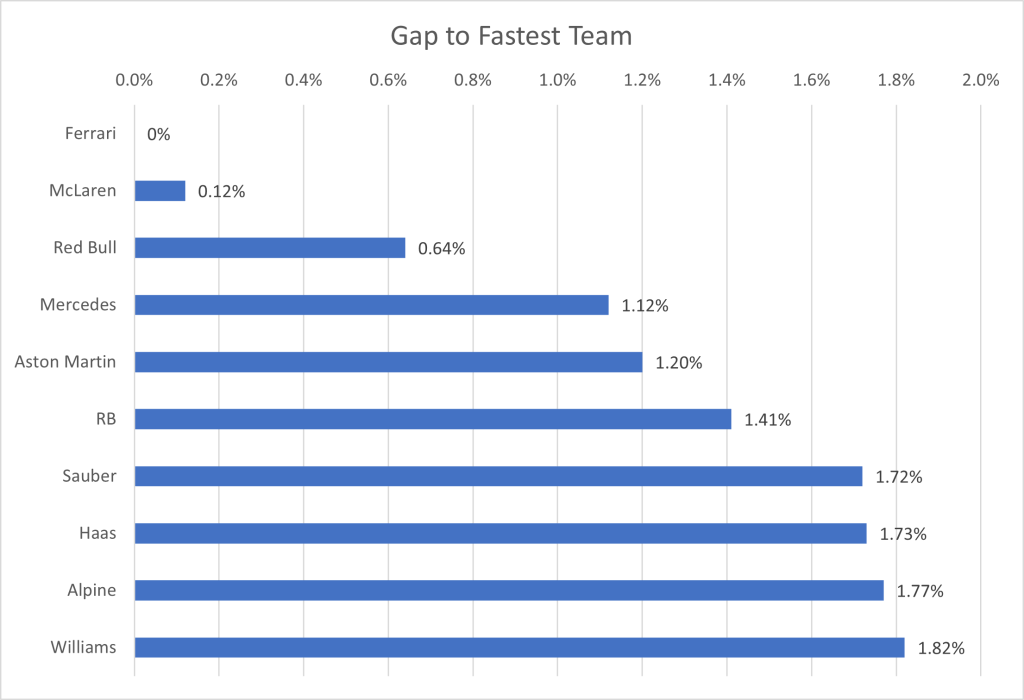
Ferrari had a good chance to win this race even if Verstappen did not retire. Perez’s pace was far off the Ferrari’s and McLaren’s; being 0.64% off Sainz’s average. This is more than Perez has been behind Verstappen for the first two races of the season, implying that Verstappen’s pace would have been slower too, albeit with track position.
Leclerc, whilst weaker than Sainz throughout the weekend, started to show signs of improvement during his final stint, with his lap times dipping into the 79-second range. The Ferrari has seemed a tad inconsistent over the first few rounds, so my interpretation of this race’s data is that Leclerc is beginning to learn how to extract the maximum from his car but isn’t quite there yet.
The McLaren race pace was also great in Australia. Whilst not quite measuring up to Ferrari in qualifying, they were with them in the race. Norris even set the fastest stint of the race. McLaren could be challenging for wins around similar circuits.
There were three clear tiers this weekend, which are beginning to show up in the averages. The top tier is Red Bull, Ferrari and McLaren, the middle tier seems to be Aston Martin, Mercedes and RB and the other teams seem to be in the lower tier. At this point, only the top three teams seem to hold any hope of race wins.
Lap 18 was not included in the analysis for most drivers due to the presence of the VSC. Ocon and Bottas were exceptions as they were only around halfway through lap 17 when the green flag was called. The other notable exception was Magnussen, who seemed to have a perfect reaction to the green flag, as unlike every other driver in a similar position on the track to him, his lap time did not appear to be an outlier.
Additionally, Magnussen appeared to have a minor problem in the last few laps, as the times began to dramatically drop. Without this drop off he would have outpaced Hulkenberg.
Bottas showed decent pace throughout the race. He may have been in the hunt for points if Sauber’s pit stops were not occurring.
Further Resources-
Qualifying Pace:
Driver
Fastest Qualifying Time
Max Verstappen
75.915 (0%)
Carlos Sainz
76.185 (+0.356%)
Sergio Perez
76.274 (+0.473%)
Charles Leclerc
76.304 (+0.512%)
Lando Norris
76.315 (+0.527%)
Oscar Piastri
76.572 (+0.865%)
Fernando Alonso
76.71 (+1.047%)
George Russell
76.724 (+1.066%)
Lance Stroll
76.78 (+1.139%)
Yuki Tsunoda
76.788 (+1.150%)
Lewis Hamilton
76.96 (+1.377%)
Alexander Albon
77.13 (+1.600%)
Valtteri Bottas
77.34 (+1.877%)
Kevin Magnussen
77.427 (+1.992%)
Esteban Ocon
77.617 (+2.242%)
Nico Hulkenberg
77.976 (+2.715%)
Pierre Gasly
77.982 (+2.723%)
Daniel Ricciardo
78.085 (+2.858%)
Zhou Guanyu
78.188 (+2.994%)
Average Race Pace:
Driver
Pace
Carlos Sainz
81.458 (0%)
Charles Leclerc
81.491 (+0.040%)
Lando Norris
81.552 (+0.115%)
Oscar Piastri
81.749 (+0.356%)
Sergio Perez
81.977 (+0.636%)
George Russell
82.37 (+1.120%)
Fernando Alonso
82.432 (+1.195%)
Lance Stroll
82.541 (+1.329%)
Yuki Tsunoda
82.609 (+1.413%)
Daniel Ricciardo
82.844 (+1.702%)
Valtteri Bottas
82.858 (+1.719%)
Nico Hulkenberg
82.864 (+1.726%)
Kevin Magnussen
82.887 (+1.754%)
Esteban Ocon
82.897 (+1.766%)
Zhou Guanyu
82.93 (+1.806%)
Alexander Albon
82.941 (+1.820%)
Pierre Gasly
83.146 (+2.072%)
All Stints:
Best Stints
Pace
Norris 3rd (16L/UH)
80.333
Sainz 3rd (15L/NH)
80.485
Piastri 3rd (16L/UH)
80.561
Leclerc 3rd (22L/NH)
80.588
Russell 3rd (10L/NH)
80.7
Perez 3rd (21L/NH)
81.084
Alonso 3rd (18L/UH)
81.096
Stroll 3rd (18L/UH)
81.447
Sainz 2nd (22L/NH)
81.543
Tsunoda 3rd (19L/NH)
81.711
Gasly 3rd (13L/NH)
81.711
Norris 2nd (22L/UH)
81.764
Hulkenberg 3rd (20L/NH)
81.91
Ocon 4th (12L/UH)
81.93
Leclerc 2nd (21L/NH)
82.016
Perez 2nd (17L/NH)
82.18
Magnussen 3rd (22L/NH)
82.188
Bottas 3rd (18L/NH)
82.191
Piastri 2nd (25L/UH)
82.215
Zhou 2nd/3rd (19L/NH)
82.231
Ricciardo 2nd/3rd (26L/NH)
82.344
Sainz 1st (14L/NM)
82.367
Albon 2nd/3rd (28L/NH)
82.618
Russell 2nd (33L/NH)
82.731
Leclerc 1st (7L/NM)
82.754
Alonso 2nd (22L/UM)
82.764
Norris 1st (12L/NM)
82.787
Piastri 1st (7L/NM)
82.798
Hulkenberg 2nd (16L/NM)
82.887
Ocon 2nd (5L/NH)
83.077
Ocon 3rd (24L/NH)
83.12
Tsunoda 2nd (23L/NH)
83.126
Stroll 2nd (25L/UH)
83.155
Bottas 2nd (25L/UH)
83.155
Perez 1st (12L/NM)
83.177
Russell 1st (6L/NM)
83.168
Alonso 1st (15L/UH)
83.192
Hamilton 2nd (7L/NH)
83.205
Albon 1st/2nd (17L/NH)
83.252
Gasly 2nd (22L/NH)
83.263
Stroll 1st (6L/UM)
83.264
Zhou 1st/2nd (25L/UH)
83.273
Ricciardo 1st/2nd (20L/NH)
83.284
Magnussen 2nd (23L/NH)
83.347
Tsunoda 1st (7L/NM)
83.349
Hamilton 1st (5L/NS)
83.456
Bottas 1st (6L/UM)
83.624
Ocon 1st (7L/NM)
83.662
Magnussen 1st (5L/NM)
83.851
Hulkenberg 1st (15L/NH)
84.112
Gasly 1st (15L/NM)
84.219
Key: 1L= One Lap, 2L= Two Laps, NH= New Hards, UH= Used Hards, NM= New Mediums, NS= New Softs
Albon, Ricciardo and Zhou had either two or three stints, as I did not count their opening stints due to them being too short.
[1] For example, I removed Oscar Piastri’s lap 38, as he went into the gravel and lost at least 5 seconds. Albon lap 56, Ricciardo lap 53 and Gasly lap 16 also looked suspect, but I was unable to find any evidence of a major mistake, so these laps were left in.
[2] I only count a stint if a driver has completed five or more laps, to avoid short stints for fastest lap attempts skewing the data on the table. This has led to the official first stints of Albon, Ricciardo and Zhou not being included in the table, though this is represented through the labeling of their stints as 1st/2nd and 2nd/3rd
What more is there to say about Carlos’ performance that hasn’t already been said? After having an operation for appendicitis two weeks before, Sainz returned and won the race in a dominant fashion. It was a truly superhuman performance from Carlos, who continues to prove himself a driver who deserves to be in a top seat.
2. Lando Norris-
Sainz’s former teammate maximized all his opportunities in Australia. After pit strategy put Norris behind his teammate, Oscar Piastri, McLaren later ordered Piastri to let Norris past on lap 29. Norris then proceeded to build a 30 second gap to his teammate in 29 laps. This shows that Norris was dominant in the McLaren team in Australia and he believes that he could have beaten Leclerc to second, with better strategy.
3. Yuki Tsunoda-
Tsunoda is beginning to embarrass Daniel Ricciardo. In a year in which Ricciardo was supposed to prove he was still the driver who left Red Bull, he’s instead proving he is the driver who was dropped from McLaren. Whilst Ricciardo was nowhere during his home race, Yuki was consistently in the hunt for points and he left with six of them. Whether Yuki’s performances become consistent enough to lead to a Red Bull seat is yet to be seen, but he may have already ended Ricciardo’s chances.
4. Lance Stroll-
Lance deserves praise for his performance this weekend. He outqualified Alonso and finished ahead of him in the race, albeit this was assisted by Alonso’s debatable penalty. But still, Lance showed good pace, kept it clean and scored a large haul of points for Aston Martin to help maximize their opportunities in a week their silver rivals did anything but.
5. Nico Hulkenberg-
Nico Hulkenberg made it back-to-back points finishes in Australia. Whilst not maximizing qualifying, he maximized his race performance, to finish in front of all the other cars in the midfield, bar Tsunoda. With three front running cars retiring in Australia, this resulted in 9th and 10th finishing places for Haas, further bringing forward their revival under new team principle Komatsu.
This article is part of a series of articles I will be completing throughout the year, where I am going to analyze the average pace of the drivers and teams, in both qualifying and the races, to be able to gain a picture of performance levels.
I have collated the fastest laps by each driver in qualifying, to show the average gap to the fastest driver. One caveat that arises, is that the top 10 drivers, through progressing to the final qualifying session, have a better track condition that those who only took part in Q1 or Q2. Due to this, the gap will be larger for the drivers outside the top ten than if qualifying was performed in one representative session. However, since the final session represents the point at which the top drivers are truly pushing, I’ve ruled it a better grounding point for the true limit of the cars, rather than only focusing on the first qualifying session in which the best times are not recorded.
Qualifying Pace-
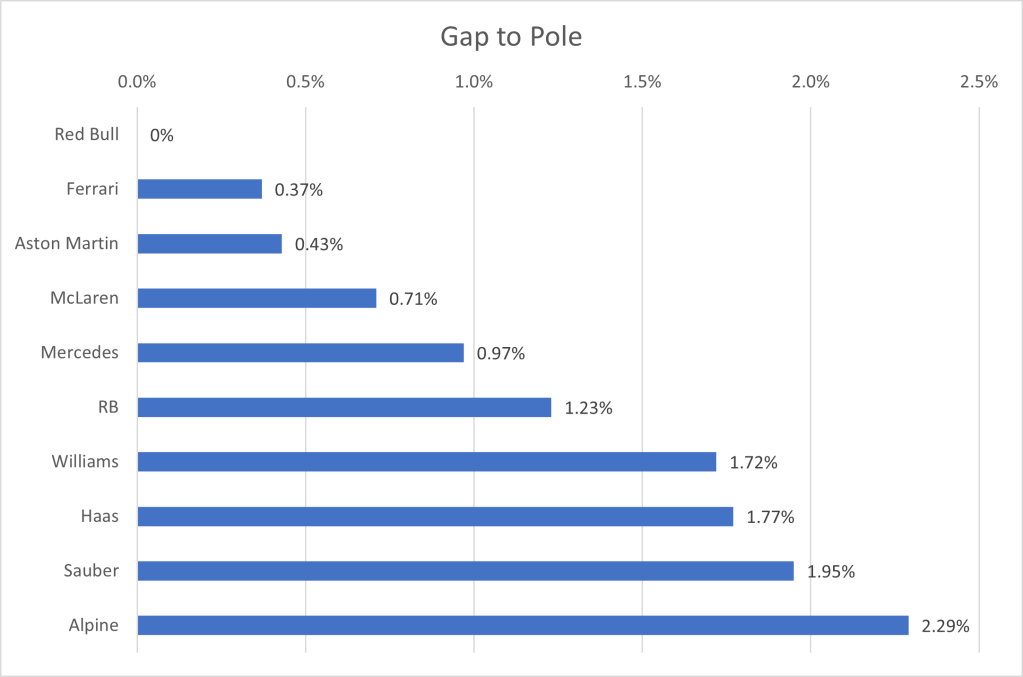
With no further ado, here are the gaps to pole:
And for the teams:
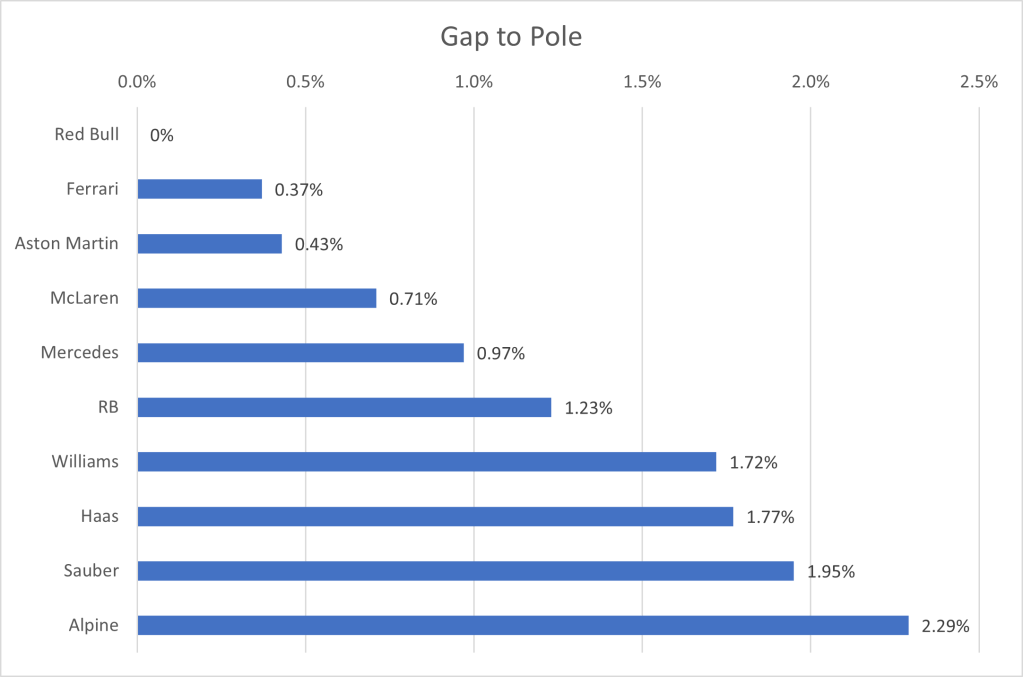
Additionally, I have collected the data for the gaps between teammates. I did this by using their fastest lap times set in the same session, so if one driver got into Q3, whilst the other only got into Q2, then I would count their Q2 times. Additionally, the lap times have to be representative, to avoid comparing out laps completed before a driver breaks down, as this would give us a very inaccurate representation of the drivers’ pace. Sauber have no comparison for Saudi, as Zhou did not set any times in qualifying:
Race Pace-
Next up in our data sets is the race pace of the drivers. I have calculated the average pace of the drivers, removing first laps, in-laps, out-laps, safety car laps and restarts after a safety car or red flag, as all these all not representative of a driver’s general pace. Additionally, if a driver has a spin, or another error that would greatly reduce their lap time, I have not counted these laps, as they would also not be representative of a drivers’ general pace.[1] I have only included drivers that completed at least 75% of the race distance (which for Saudi Arabia, excludes Lance Stroll and Pierre Gasly) so to not skew the season long averages against drivers that did not drive on low fuel with the best track conditions.
As different drivers have a varying number of race stints, this skews the overall pace. Generally, if a driver makes more stops, their pace will be faster on average. This will be taken into account in my final thoughts and analysis. Additionally, the average pace per stint and number of stints are recorded at the bottom of this article, for those interested in viewing more precise estimates of pace relative to other drivers on the same stint.[2]
And for the teams:
Analysis-
There is a similar trend to in Bahrain, the Ferrari looks like it has slightly better degradation to the Red Bull. Leclerc’s hard tyre stint began with him setting times up to a second closer than the Red Bulls, but by the end of the stint, Leclerc was matching and beating the Red Bull’s times, even recording fastest lap on the final lap when Verstappen was also going for a fastest lap attempt.
The McLaren appears to have some good pace behind it. Even though Piastri was stuck in Hamilton’s dirty air on used hard tyres for half the race, once he was out of dirty air, his lap times were around equal with Perez and only slightly behind Leclerc and Verstappen. Additionally, Norris posted the fastest stint of the race on his soft tyres, beating Hamilton’s pace. The McLaren has yet to prove to be a Red Bull challenger, but with an aggressive update schedule, it may still win some races this year.
Norris and Hamilton both performed the fastest strategy for pace, but because others stopped under the safety car, they lost track position. They did however, have their pace slightly exaggerated in the averages. This makes the Mercedes look slightly better in the race pace averages, appearing to be the fourth fastest car. Comparing Alonso and Russell’s 2nd stints, it is clear that Alonso was slightly faster than the Mercedes.
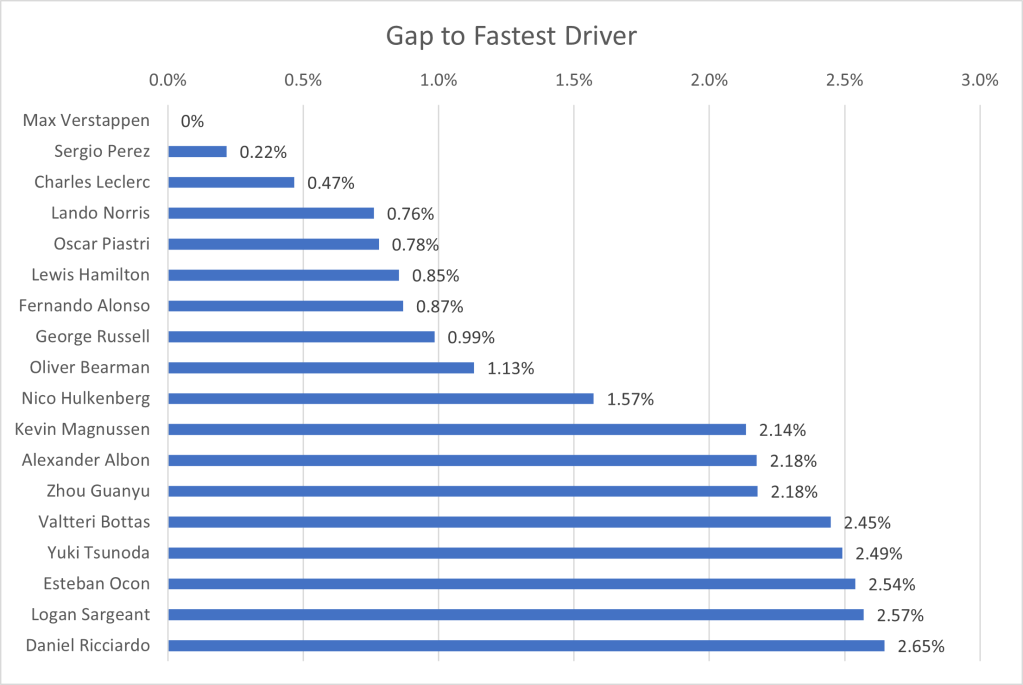
The bottom half of the field all had their averages skewed by Magnussen driving deliberately slowly, thus four teams have race pace averages of more than 2%, when no team achieved this in Bahrain.
Further Resources-
Qualifying Pace:
Driver
Fastest Qualifying Time
Max Verstappen
87.472 (0%)
Charles Leclerc
87.791 (+0.365%)
Sergio Perez
87.807 (+0.383%)
Fernando Alonso
87.846 (+0.428%)
Oscar Piastri
88.089 (+0.705%)
Lando Norris
88.132 (+0.755%)
Lance Stroll
88.25 (+0.889%)
George Russell
88.316 (+0.965%)
Lewis Hamilton
88.46 (+1.130%)
Yuki Tsunoda
88.547 (+1.229%)
Oliver Bearman
88.642 (+1.338%)
Alexander Albon
88.98 (+1.724%)
Kevin Magnussen
89.02 (+1.770%)
Daniel Ricciardo
89.025 (+1.775%)
Nico Hulkenberg
89.055 (+1.810%)
Valtteri Bottas
89.179 (+1.951%)
Esteban Ocon
89.475 (+2.290%)
Pierre Gasly
89.479 (+2.294%)
Logan Sargeant
89.526 (+2.348%)
Average Race Pace:
Driver
Pace
Max Verstappen
92.883 (0%)
Sergio Perez
93.085 (+0.217%)
Charles Leclerc
93.317 (+0.467%)
Lando Norris
93.59 (+0.761%)
Oscar Piastri
93.607 (+0.779%)
Lewis Hamilton
93.677 (+0.854%)
Fernando Alonso
93.691 (+0.869%)
George Russell
93.798 (+0.985%)
Oliver Bearman
93.934 (+1.131%)
Nico Hulkenberg
94.344 (+1.573%)
Kevin Magnussen
94.866 (+2.135%)
Alexander Albon
94.904 (+2.175%)
Zhou Guanyu
94.907 (+2.178%)
Valtteri Bottas
95.157 (+2.448%)
Yuki Tsunoda
95.197 (+2.491%)
Esteban Ocon
95.242 (+2.539%)
Logan Sargeant
95.271 (+2.570%)
Daniel Ricciardo
95.342 (+2.647%)
All Stints:
Best Stints
Pace
Norris 2nd (12L/US)
92.28
Hamilton 2nd (13L/US)
92.333
Verstappen 2nd (40L/NH)
92.753
Hulkenberg 2nd (16L/NH)
92.776
Zhou 2nd (7L/NS)
92.818
Perez 2nd (40L/NH)
92.957
Bottas 3rd (13L/NS)
93.156
Leclerc 2nd (40L/NH)
93.167
Piastri 2nd (40L/UH)
93.483
Alonso 2nd (40L/UH)
93.555
Russell 2nd (40L/NH)
93.633
Bearman 2nd (40L/NH)
93.669
Verstappen 1st (5L/NM)
93.927
Norris 1st (31L/NM)
94.097
Perez 1st (5L/NM)
94.109
Hamilton 1st (30L/NM)
94.259
Leclerc 1st (5L/NM)
94.513
Piastri 1st (5L/NM)
94.603
Magnussen 2nd (40L/NH)
94.713
Albon 2nd (40L/NH)
94.75
Alonso 1st (5L/UM)
94.78
Ocon 2nd (39L/NH)
95.03
Sargeant 2nd (39L/NH)
95.068
Tsunoda 2nd (39L/NH)
95.099
Russell 1st (5L/NM)
95.122
Ricciardo 2nd (38L/NH)
95.186
Hulkenberg 1st (27L/NM)
95.273
Zhou 1st (35L/NM)
95.324
Bottas 2nd (24L/NH)
95.885
Tsunoda 1st (5L/NM)
95.964
Bearman 1st (5L/NS)
96.058
Magnussen 1st (5L/NM)
96.09
Albon 1st (5L/NM)
96.132
Ricciardo 1st (5L/NM)
96.524
Sargeant 1st (5L/NM)
96.848
Bottas 1st (5L/NS)
96.865
Ocon 1st (5L/NM)
96.893
Key: 1L= One Lap, 2L= Two Laps, NH= New Hards, UH= Used Hards, NM= New Mediums, NS= New Softs
This weekend, we were witness to one of the best stories F1 has provided in a long time. Carlos Sainz, who only two weeks ago was recovering from appendicitis, won the race. Furthermore, Max Verstappen retired. Whilst most F1 fans would never wish bad luck on any driver, F1 needed a Verstappen retirement, if merely for reminding casual fans that it is possible for other people to win an F1 race. It’s not often I agree with Crofty, but when he declared that this was a result F1 needed, I completely concurred. A smile was on my face seeing a Ferrari 1-2.
All this almost distracted from the fact that I found the race boring.
Yes, even without Max Verstappen, a processional race with limited overtaking still occurred. In terms of track action, it appeared to have the least of the three races so far, the only racing highlights being Magnussen and Tsunoda making switchback moves at turn ten. This is because F1 has outgrown the Melbourne circuit. Narrow cars that can navigate the tight circuit of Melbourne have been replaced with wide cars that struggle to overtake here, which is a shame as the circuit provides one of the best vibes on the calendar.
Yet still, Sainz winning almost made this race appear to be a classic.
With little on track action throughout the middle of the race, attention was drawn to Sauber’s pit stops. Sauber appears to have decided to honor their gambling sponsorship by making the odds of a successful pit stop roughly the same as the odds of big winnings on a slot machine. The official reason behind their 30-50 second pit stops is that they have bought new wheel gun equipment for the year. Unfortunately, these wheel guns do not work properly with their car. If any other team did this they would become the laughing stock of F1, for failing on something so basic to success. However, as Sauber is already the most anonymous and mediocre, their pit stops just become another problem they have to solve. Still, the team should be embarrassed, especially when looking at statistics showing that they have already spent more time doing pit stops in three races than nine drivers did for the whole of last year.[1]
After a long race with little action, the most controversial moment suddenly happened on the last lap. George Russell crashed and this was partially caused by Alonso slowing down for turn six early, in order to get a better exit, likely to defend from Russell at the overtaking zone. Alonso’s actions, despite no contact with Russell, earned him a 20-second penalty, demoting him from 6th to 8th. The steward’s defense was that this was due to Alonso lifting, braking and downshifting a hundred meters earlier than on every other lap, before beginning to accelerate again, as by his own admission, he made a mistake.[2] The stewards argued that as this was inconsistent with Alonso’s previous laps, that it constituted driving ‘unnecessarily slowly… in a manner that could be deemed potentially dangerous.’[3] The stewards also argued that they were not taking the consequences of the incident into account.[4] The last point is obviously false. Hulkenberg moved under braking to cut off Alex Albon earlier in the race ‘in a manner that could be deemed potentially dangerous.’ Yet as Albon reacted and avoided Hulkenberg, no penalty was handed out. Additionally, back in Saudi, Magnussen backed up the entire midfield pack for multiple laps. If drivers didn’t react to Magnussen driving ‘unnecessarily slowly’ then there could have been a concertina effect where multiple cars crashed into each other. Yet this did not happen. So, Magnussen was allowed, in that case, to drive ‘unnecessarily slowly’. Presumably as Magnussen was lifting a hundred meters earlier for many laps, rather than just one, this made it safe? If Alonso had made the exact same move, yet Russell had reacted to it and slowed down accordingly, there would have been no penalty. Alonso’s move may have contributed to Russell’s accident, yet to punish a driver for the impact of their dirty air, itself a problem exemplified by F1’s wide cars, seems inconsistent and unfair.
So, F1 provided us with bad racing, long pit stops and awful stewarding. Yet still, the novelty of Verstappen winning made up for that. I just hope the next time Verstappen doesn’t win, there’s actually a good race to analyse, rather than merely a good result.
It was another faultless weekend from Max Verstappen, being virtually unchallenged on the way to his 56th victory. In contrast to the tight qualifying in Bahrain, Verstappen looked fully in control to take pole in Saudi. Whilst facing mild pressure to get past Norris after the safety car period, Verstappen retaking the lead was an inevitability. Once he got past Norris and back into the lead, he was his usual unstoppable self. Verstappen is once again on nine race victories in a row, a record that looked unbeatable a couple years ago, until Max beat it. After the next couple of races, Max may even beat his own win streak. As I will get very used to saying this year, he’s on another level.
2. Sergio Perez-
Much has been made of Sergio Perez’s performances over the last three years, as he becomes the latest in a list of unlucky drivers who have found themselves as teammates to an all time great. Thus, I’m assessing Sergio’s performances with the expectation that he will probably not beat Verstappen. From this standard, Perez had a pretty faultless weekend. Qualifying 3rd, albeit only 0.016 seconds behind Charles Leclerc, Perez quickly passed Leclerc on lap four. From there, he shadowed Verstappen for the rest of the race, overtaking Norris a few laps after Verstappen had and delivering Red Bull a perfect 1-2 finish. In a weekend in which the driver many want to replace Perez was thoroughly trounced by his teammate, Perez is beginning to solidify his hold on that second Red Bull.
3. Oscar Piastri-
Oscar delivered on his McLaren’s potential this weekend, outqualifying his more experienced teammate and finishing the race as best of the rest. Whilst spending far too much time stuck behind Lewis Hamilton in the race, this was the fault of the McLaren lacking straight line speed, rather than Oscar underperforming. It also did not affect his final position, as the podium was out of reach given the pace of that Ferrari. Either way, he kept Alonso behind and was rewarded with 4th in the race and 5th in the championship. Last year Oscar proved that he deserved his seat and if he can keep outqualifying and outracing Norris, he can show why so many experts see him as a Verstappen/Leclerc level talent.
4. Oliver Bearman-
From one impressive young talent to another, Ollie was outstanding this weekend. After only having a single practice session to learn the car, he was already on the pace. Whilst qualifying was not perfect, Ollie missing out on Q3 by less than a tenth of a second, Ollie’s race more than made up for this. He showed good pace, made decisive overtakes and kept both Lando Norris and Lewis Hamilton behind at the end of the race on old hard tyres. Whilst winning F2 is the most obvious path to Formula One, a performance like this shows all the F1 teams that he has the minerals to deliver in the top level of motorsports.
5. Haas-
I’m breaking my own rules slightly here, by giving half a point to both Haas drivers. Kevin Magnussen deserves acknowledgement for successfully holding back the midfield pack, which gained Haas their first point of the season. However, whilst a great example of unorthodoxy winning the day, I’m deducting half a point from Magnussen as he was only in this position after receiving twenty seconds of penalties, that ruined his own race. Thus, half a point also goes to Hulkenberg, the Haas driver who has been consistently delivering the best pace for the last year, as well as the driver who was able to capitalize on his team’s tactics to earn that point, something that may prove a rarity for those teams in the bottom half of the field.
This article is part of a series of articles I will be completing throughout the year, where I am going to analyze the average pace of the drivers and teams, in both qualifying and the races, to be able to gain a picture of performance levels.
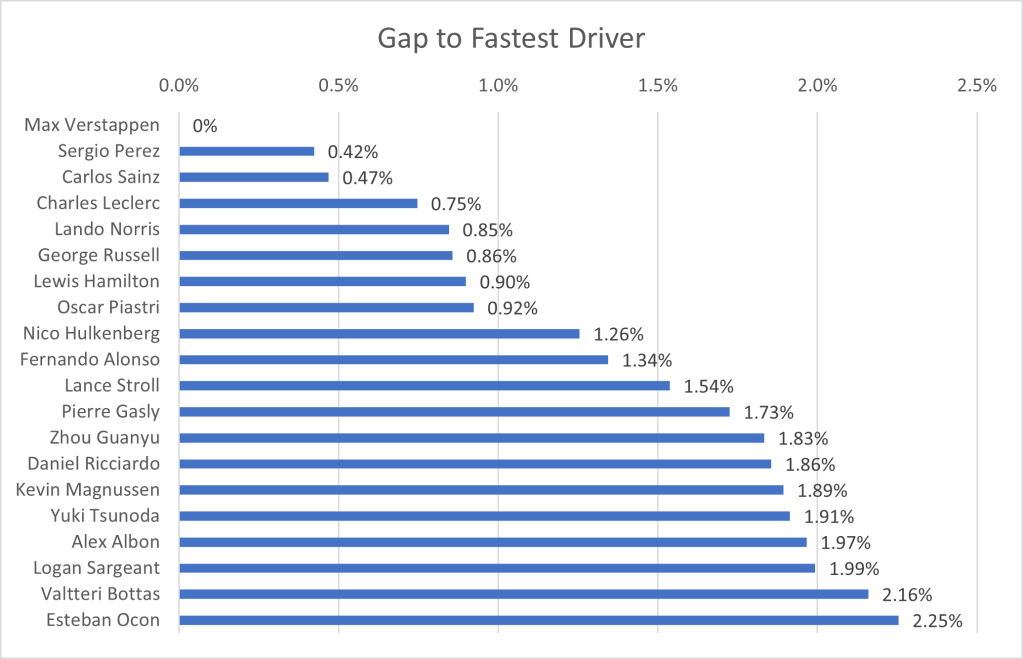
I have collated the fastest laps by each driver in qualifying, to show the average gap to the fastest driver. One caveat that arises, is that the top 10 drivers, through progressing to the final qualifying session, have a better track condition that those who only took part in Q1 or Q2. Due to this, the gap will be larger for the drivers outside the top ten than if qualifying was performed in one representative session. However, since the final session represents the point at which the top drivers are truly pushing, I’ve ruled it a better grounding point for the true limit of the cars, rather than only focusing on the first qualifying session in which the best times are not recorded.
Qualifying Pace-
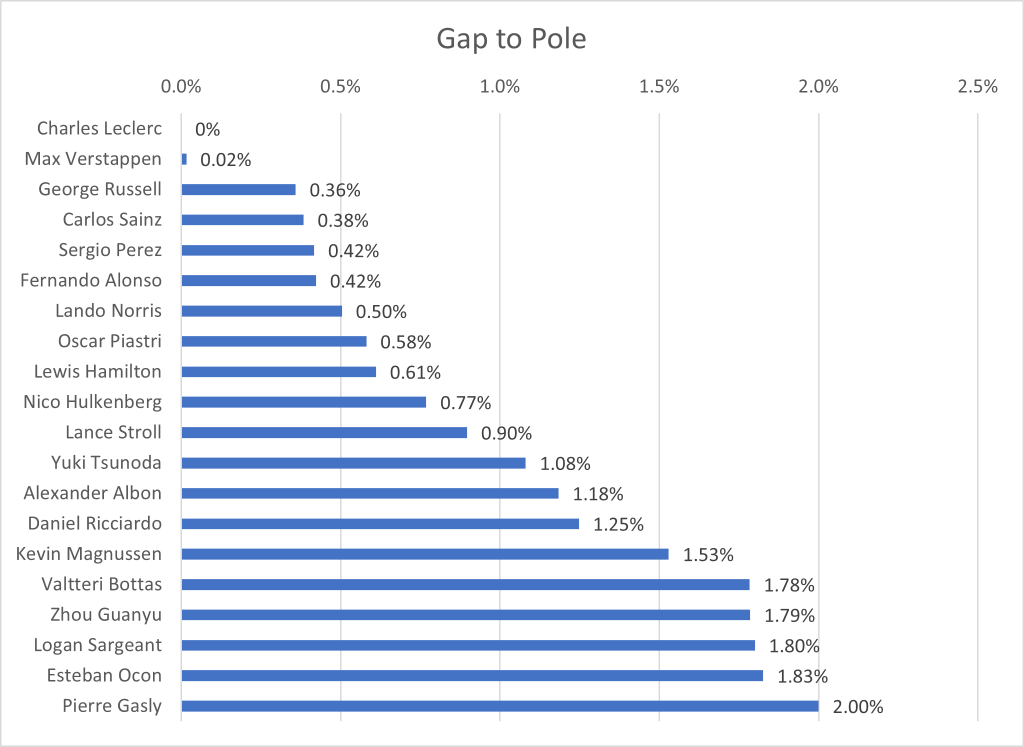
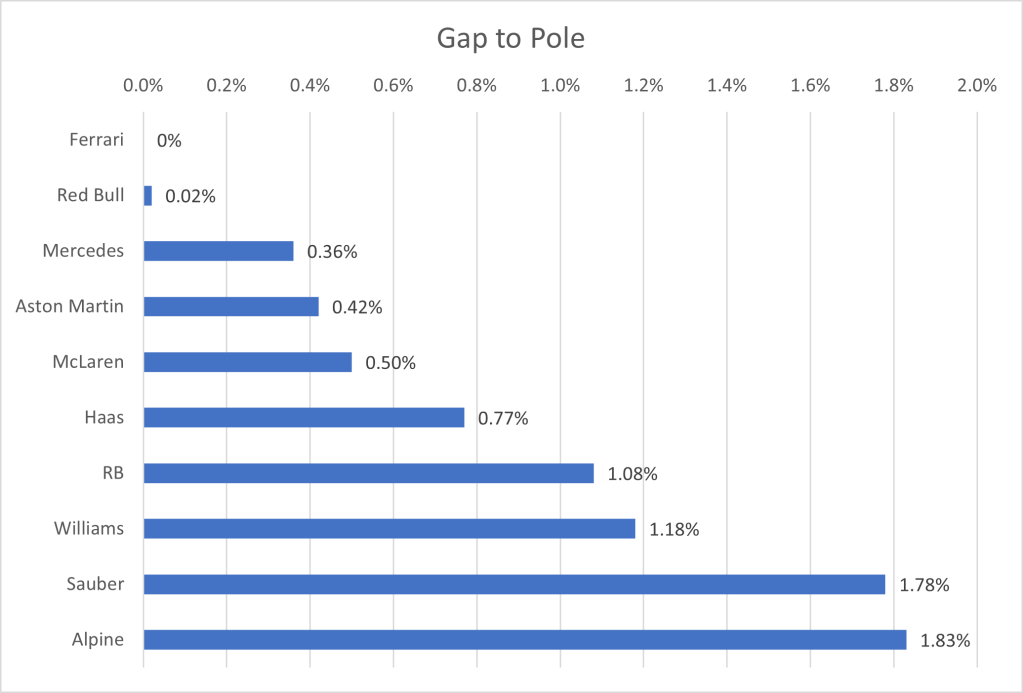
With no further ado, here are the gaps to pole[1]:
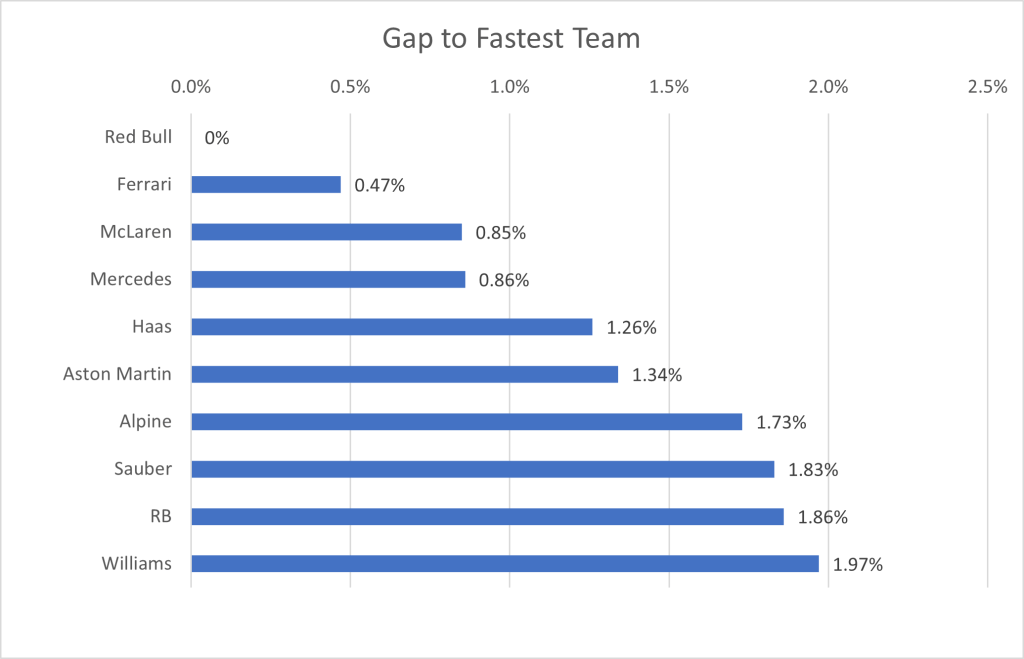
And for the teams:
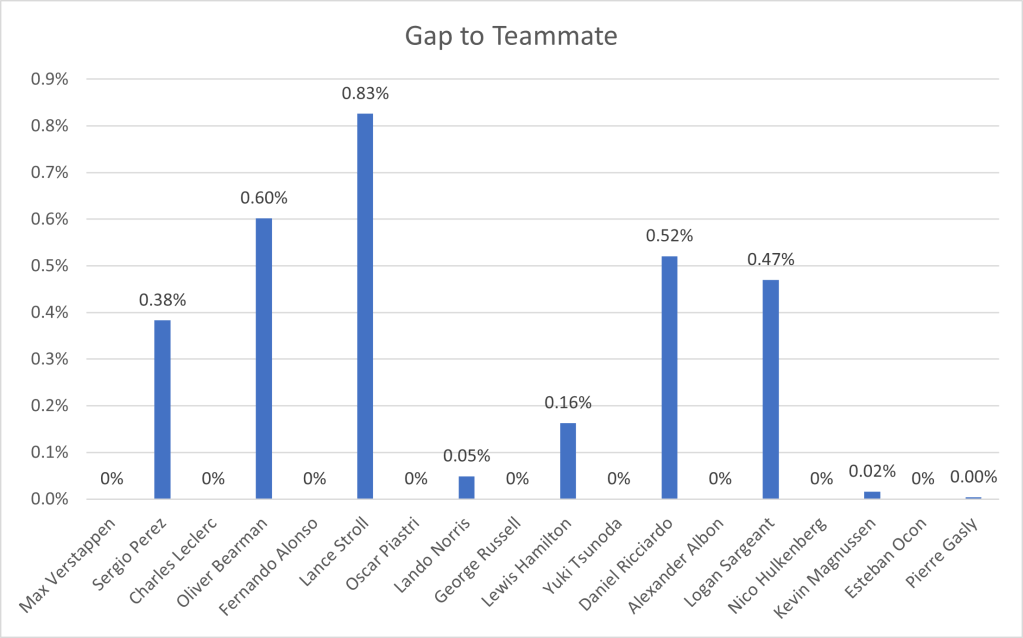
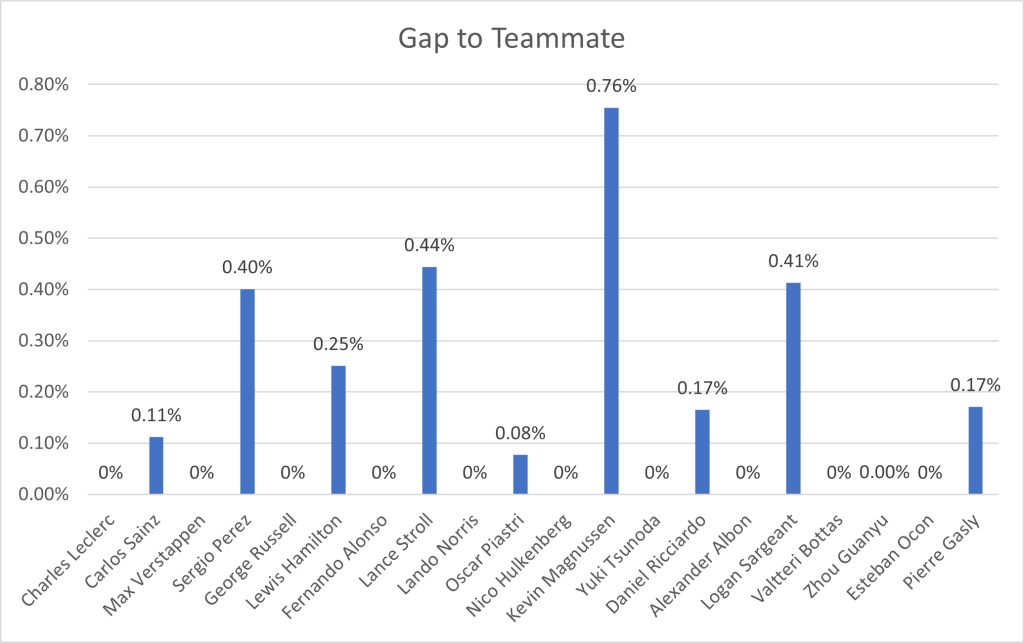
Additionally, I have collected the data for the gaps between teammates. I did this by using their fastest lap times set in the same session, so if one driver got into Q3, whilst the other only got into Q2, then I would count their Q2 times. Additionally, the lap times have to be representative, to avoid comparing out laps completed before a driver breaks down, as this would give us a very inaccurate representation of the drivers’ pace:
Race Pace-
Next up in our data sets is the race pace of the drivers. I have calculated the average pace of the drivers, removing first laps, in-laps, out-laps and safety car laps, all not representative of a driver’s general pace. Additionally, if a driver has a spin, or another error that would greatly reduce their lap time, I have not counted these laps, as they would also not be representative of a drivers’ general pace. I have only included drivers that completed at least 75% of the race distance (which for Bahrain, happens to be all the drivers) so to not skew the season long averages against drivers that did not drive on low fuel with the best track conditions.
As different drivers have a varying number of race stints, this skews the overall pace. Generally, if a driver makes more stops, their pace will be faster on average. This will be taken into account in my final thoughts and analysis. Additionally the average pace per stint and number of stints are recorded at the bottom of this article, for those interested in viewing more precise estimates of pace relative to other drivers on the same stint.[2]
And for the teams:
Analysis-
The Ferrari [and the Mercedes, for that matter] appear to have better tyre degradation than the Red Bull, at least based on this preliminary data. Sainz’s average time throughout a stint barely dropped at all, whilst Verstappen and Perez on the same tyre dropped around a second throughout the stint. This being ubiquitous between Verstappen and Perez also lessens the possibility that this was merely due to the drivers taking it easy. The primary problem, at the moment, is that the Red Bull begins stints so much faster than the Ferrari, that the degradation at the end of the stint fails to matter. But if this proves to be a theme throughout this season, then Ferrari could start challenging for race wins.[3]
Verstappen’s relative dominance over Perez is clear within their third stints. Verstappen set the fastest lap on lap 39 and this appeared to take a lot out of his soft tyres, setting quite slow times on lap 40 and 41. Nevertheless, by lap 43 Verstappen began posting times consistently faster than Perez.
The McLaren and the Mercedes showed pretty similar pace throughout the race, positing beginning stint times within a few tenths of each other, all having similar degradation and there being little between the average pace of the four drivers. This may have been compounded by spending some of the race in each other’s dirty air, but they still appear to be the most evenly matched of the top five teams.
Haas do not look bad based on this data, Hulkenberg in particular impressing. His first stint was only slower than Verstappen, Perez, Russell and Sainz and his third stint was quicker than the McLarens’. Overall, his pace was better than both Aston Martins. Whilst tyre differential from his early stop to new hard tyres may have played a part in this, as well as placing him outside the dirty air, the Haas team still have a lot to be proud of, completely exceeding the standards they set for themselves.
Pierre Gasly’s average pace is exaggerated by his being one of two drivers to have four race stints. This led to his fourth stint on new softs being the seventh fastest of the race. Without Gasly’s four stints, it’s likely that Alpine would be the slowest team on average in both qualifying and the race. This is looking like an incredibly difficult year for Alpine, which is a shame, because they have two talented young drivers who now look like they’ll be competing with each other to not be last.
Further Resources-
Qualifying Pace:
Driver
Fastest Qualifying Time
Charles Leclerc
89.165 (0%)
Max Verstappen
89.179 (+0.016%)
George Russell
89.485 (+0.359%)
Carlos Sainz
89.507 (+0.384%)
Sergio Perez
89.537 (+0.417%)
Fernando Alonso
89.542 (+0.423%)
Lando Norris
89.614 (+0.504%)
Oscar Piastri
89.683 (+0.581%)
Lewis Hamilton
89.71 (+0.611%)
Nico Hulkenberg
89.851 (+0.769%)
Lance Stroll
89.965 (+0.897%)
Yuki Tsunoda
90.129 (+1.081%)
Alexander Albon
90.221 (+1.184%)
Daniel Ricciardo
90.278 (+1.248%)
Kevin Magnussen
90.529 (+1.530%)
Valtteri Bottas
90.756 (+1.784%)
Zhou Guanyu
90.757 (+1.785%)
Logan Sargeant
90.77 (+1.800%)
Esteban Ocon
90.793 (+1.826%)
Pierre Gasly
90.948 (+2.000%)
Average Race Pace:
Driver
Pace
Max Verstappen
95.654 (0%)
Sergio Perez
96.059 (+0.423%)
Carlos Sainz
96.103 (0.469%)
Charles Leclerc
96.368 (+0.746%)
Lando Norris
96.464 (+0.845%)
George Russell
96.474 (+0.857%)
Lewis Hamilton
96.514 (+0.899%)
Oscar Piastri
96.538 (+0.923%)
Nico Hulkenberg
96.855 (+1.255%)
Fernando Alonso
96.94 (+1.344%)
Lance Stroll
97.124 (+1.537%)
Pierre Gasly
97.305 (+1.725%)
Zhou Guanyu
97.407 (+1.833%)
Daniel Ricciardo
97.429 (+1.855%)
Kevin Magnussen
97.465 (+1.893%)
Yuki Tsunoda
97.486 (+1.914%)
Alex Albon
97.535 (+1.966%)
Logan Sargeant
97.561 (+1.993%)
Valtteri Bottas
97.719 (+2.159%)
Esteban Ocon
97.811 (+2.254%)
All Stints:
Best Stints
Pace
Verstappen 3rd (19L/NS)
94.685
Alonso 3rd (15L/NH)
94.992
Perez 3rd (20L/NS)
95.037
Sainz 3rd (21L/NH)
95.052
Leclerc 3rd (22L/NH)
95.222
Hamilton 3rd (23L/NH)
95.414
Gasly 4th (12L/NS)
95.473
Hulkenberg 3rd (14L/US)
95.493
Piastri 3rd (22L/NH)
95.506
Norris 3rd (23L/NH)
95.527
Verstappen 2nd (18L/NH)
95.58
Russell 3rd (25L/NH)
95.72
Sargeant 4th (14L/NS)
95.977
Ricciardo 3rd (20L/NS)
96.149
Sainz 2nd (19L/NH)
96.279
Perez 2nd (22L/NH)
96.281
Albon 3rd (19L/NH)
96.287
Stroll 3rd (29L/NH)
96.432
Magnussen 3rd (23L/NH)
96.501
Gasly 3rd (10L/NH)
96.541
Sargeant 3rd (10L/NH)
96.675
Tsunoda 2nd (21L/NH)
96.677
Norris 2nd (18L/NH)
96.767
Zhou 3rd (27L/NH)
96.856
Leclerc 2nd (21L/NH)
96.898
Piastri 2nd (20L/NH)
96.898
Hamilton 2nd (19L/NH)
96.939
Verstappen 1st (15L/US)
96.972
Russell 2nd (18L/NH)
96.973
Hulkenberg 2nd (19L/NH)
96.997
Bottas 3rd (25L/NH)
97.037
Ocon 3rd (25L/NH)
97.087
Alonso 2nd (24L/NH)
97.299
Russell 1st (9L/US)
97.571
Perez 1st (10L/US)
97.615
Zhou 2nd (17L/NH)
97.663
Sainz 1st (12L/US)
97.665
Tsunoda 2nd (18L/NH)
97.703
Stroll 2nd (16L/NH)
97.752
Hulkenberg 1st (17L/NH)
97.816
Ricciardo 2nd (20L/NH)
97.842
Norris 1st (11L/US)
97.926
Leclerc 1st (9L/US)
97.934
Albon 2nd (19L/NH)
97.956
Bottas 2nd (16L/NH)
97.962
Magnussen 2nd (19L/NH)
97.97
Gasly 2nd (17L/NH)
98.081
Piastri 1st (10L/US)
98.086
Hamilton 1st (10L/US)
98.237
Ocon 2nd (18L/NH)
98.293
Alonso 1st (13L/US)
98.524
Stroll 1st (7L/NS)
98.558
Tsunoda 1st (12L/NS)
98.574
Albon 1st (13L/NS)
98.742
Sargeant 2nd (16L/NH)
98.823
Magnussen 1st (9L/NS)
98.861
Zhou 1st (7L/NS)
98.911
Sargeant 1st (8L/NS)
98.916
Gasly 1st (10L/NS)
98.947
Ocon 1st (8L/NS)
98.986
Ricciardo 1st (11L/US)
99.004
Bottas 1st (10L/NS)
99.038
Key: 1L= One Lap, 2L= Two Laps, NS= New Softs, US= Used Softs, NH= New Hards
[1] Or, more accurately, the fastest time in qualifying, which in this case, was not pole, as Leclerc set a faster time than Verstappen’s pole time in Qualifying 2.
[2] I only count a stint if a driver has completed five or more laps, to avoid short stints for fastest lap attempts skewing the data on the table.
[3] I discounted the third stints when coming to this conclusion, as the Red Bull and Ferrari were on different tyres.


 Ryan's Lil' F1 Blog