This may be one of Max Verstappen’s greatest wins. In a weekend in which he did not have the fastest car, he made the difference, through a sublime qualifying lap and held on despite massive pressure from Norris towards the end of the race to take his 59th win.
2. Lando Norris-
Whilst slightly underperforming in qualifying, Lando made up for it with superb tyre management throughout the race. To only finish 0.7 seconds towards Verstappen, a sight we’ve barely seen during the last couple of years, shows that his win in Miami was not a one-off, but a sign of a McLaren resurgence.
3. Yuki Tsunoda-
Yuki continues to impress this year. Once again outqualifying Ricciardo, at times this weekend he looked like challenging the top teams. Whilst the overall race pace of the RB has yet to escape the midfield, Yuki still held on to score a valuable point at home. With every impressive performance, it is really starting to seem like he may actually get that Red Bull seat one day.
4. Lance Stroll-
Stroll had a quietly impressive performance this weekend. On a track that was difficult to overtake on and a weekend where his teammate was nowhere, Stroll improved from his starting position to drag his underperforming Aston Martin into the points. Whilst I’m not the biggest Lance Stroll fan, I have to give credit where it’s due.
5. Kevin Magnussen-
Kevin’s performance is going to go under looked this weekend. He was comprehensively outqualified by his teammate, yet was making move after move in a track that is difficult to overtake on, to recover to twelfth, only a few seconds behind the sister car. In a better car, he delivered a points worthy performance.
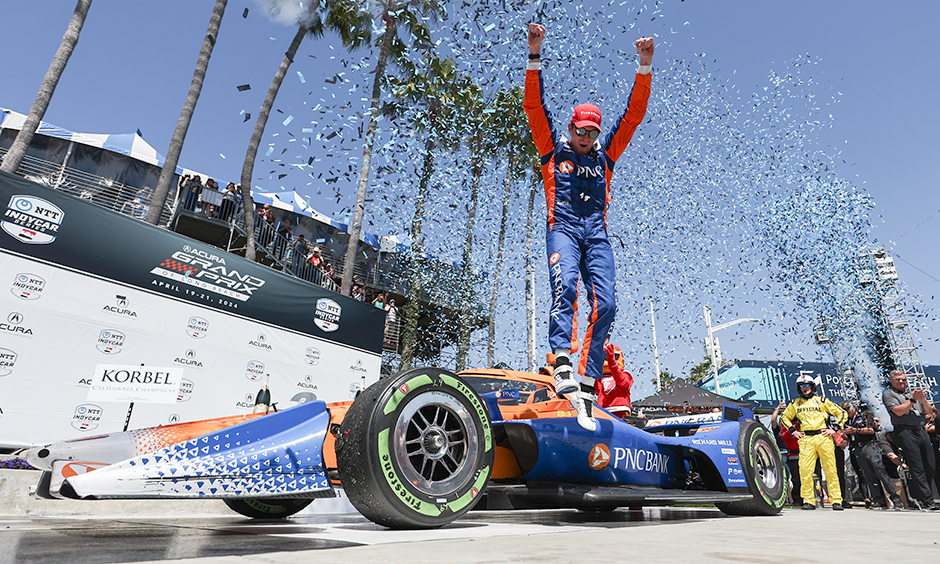
After a couple of duds, IndyCar returned to Long Beach to deliver a thriller. Strategy determined the day, but only one driver could make the winning strategy work. Six-time champion Scott Dixon reminded us that when fuel saving is required, there’s no other driver to back.
The race opened with some frantic, exciting laps, as the drivers jostled, given the importance of gaining early track position in a race where tyre saving could prove key. Felix Rosenqvist, who took a sensational pole on Saturday, once again did not have the race pace, losing several places to put himself out of the contention for the win. Will Power built a healthy lead over the field in the first stint, at this point looking like a shoo-in for victory lane. Yet fate had other plans, instigated by Christian Rasmussen’s crash causing an early caution period.
In response to the caution, amongst other drivers, Will Power and Scott Dixon jumped into pit lane, whilst Power’s teammate, Josef Newgarden stayed out. Those who pitted had to enter extreme fuel saving mode, making winning the race far harder for Will Power. A few laps later Dixon opportunistically overtook Power, ending Power’s chances and placing himself in the hot seat of leading the alternate strategy. And whilst Power lost out through this strategy, Dixon somehow won. Dixon’s team Chip Ganassi, Power’s Team Penske and even Scott Dixon himself were convinced that it would be impossible to save enough fuel at winning pace, yet not even physics could prevent this sensation.
Yet before winning the race, Scott Dixon still had to handle a fast-charging and determined Josef Newgarden, who caught Dixon easily. Nothing but perfection would be able to prevent Penske from taking victory at this point, yet Scott took every line correctly, keeping Josef in his dirty air, preventing what should have been an easy pass from even looking possible. Dixon was about to take one of the most unlikely wins in recent IndyCar history. As for his rival at Team Penske, he still had a little more to lose.
A few laps before the end the Dixon-Newgarden battle evolved into a four car battle for the win. Newgarden’s closing speed combined with a slight misjudgment from Colton Herta behind meant that Josef was hit from behind. Unfortunately for Penske, what looked like slight contact put Newgarden’s car into anti-stall, causing them to not only lose the win, but the podium. No penalty was given to Herta, in what on balance seemed a fair decision. In comparison to Pato O’Ward completely out breaking himself and slamming into his teammate at the race’s start, or Lance Stroll’s antics behind the safety car in F1, Herta’s mistake was slight and did not result in major contact. The IndyCar stewards recognized that this resembled the contact that can occur in wheel-to-wheel combat, to Penske’s disappointment. Though whilst disappointing rival teams, for motorsports to remain fun I believe there should be leniency given for some slight contact to encourage aggressive and competitive racing. Herta displayed maturity after the race though, immediately taking responsibility for his slight mistake. In comparison to Lance Stroll’s inability to take any responsibility for his actions, I’m glad that one driver this weekend was able to demonstrate how to maturely respond to one’s errors.
So, we had a bold fuel strategy leading to an unexpected winner and four-car battle for the race lead. These are the races IndyCar is known for, a chess-like strategy that leaves the audience guessing who will take victory until the final laps. It’s taken six weeks longer than it should have to say this, but IndyCar is back.
This article is part of a series of articles I will be completing throughout the year, where I am going to analyze the average pace of the drivers and teams, in both qualifying and the races, to be able to gain a picture of performance levels.
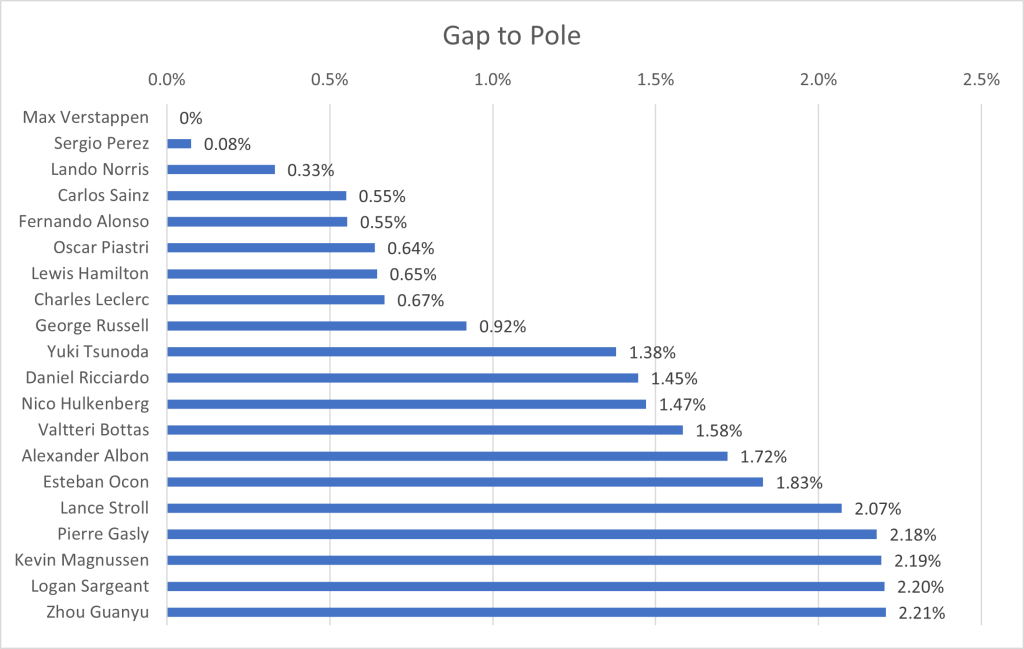
I have collated the fastest laps by each driver in qualifying, to show the average gap to the fastest driver. One caveat that arises, is that the top 10 drivers, through progressing to the final qualifying session, have a better track condition that those who only took part in Q1 or Q2. Due to this, the gap will be larger for the drivers outside the top ten than if qualifying was performed in one representative session. However, since the final session represents the point at which the top drivers are truly pushing, I’ve ruled it a better grounding point for the true limit of the cars, rather than only focusing on the first qualifying session in which the best times are not recorded.
Qualifying Pace-
With no further ado, here are the gaps to pole:
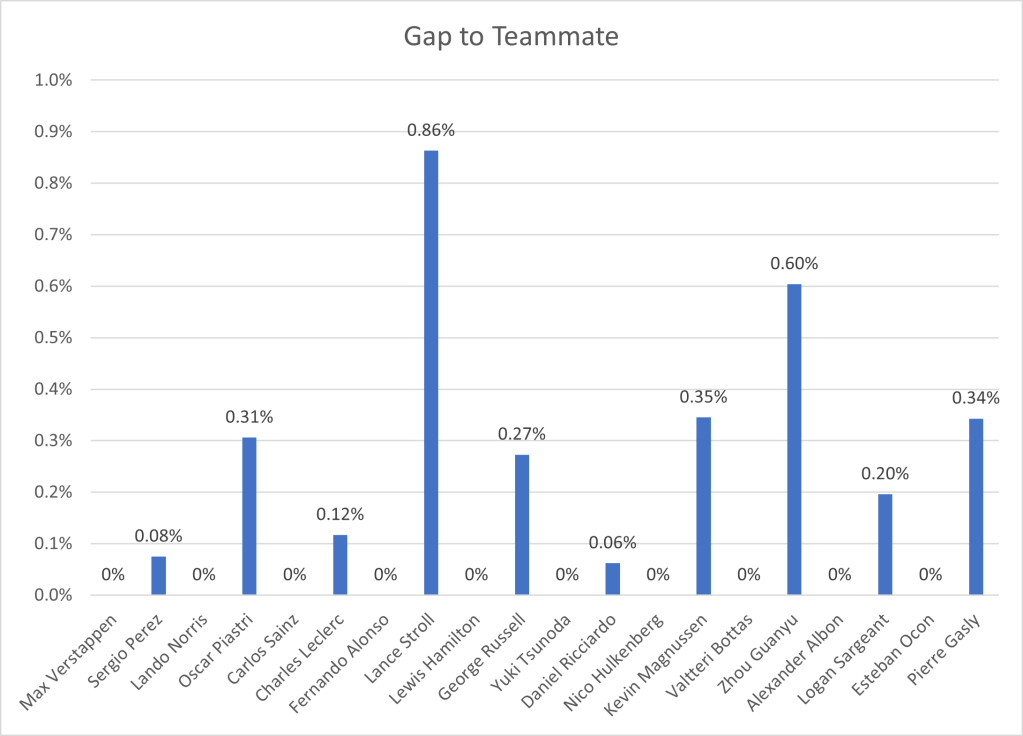
Additionally, I have collected the data for the gaps between teammates. I did this by using their fastest lap times set in the same session, so if one driver got into Q3, whilst the other only got into Q2, then I would count their Q2 times. Additionally, the lap times have to be representative, to avoid comparing out laps completed before a driver breaks down, as this would give us a very inaccurate representation of the drivers’ pace:
Race Pace-
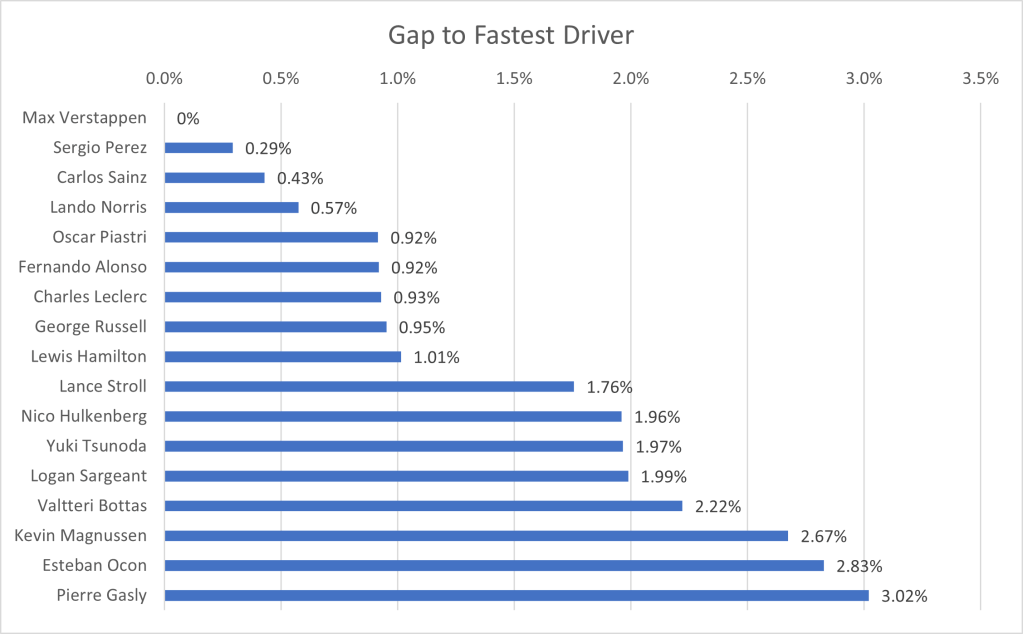
Next up in our data sets is the race pace of the drivers. I have calculated the average pace of the drivers, removing first laps, in-laps, out-laps and virtual safety car laps, as all these all not representative of a driver’s general pace. Additionally, if a driver has a spin, or another error that would greatly reduce their lap time, I have not counted these laps, as they would also not be representative of a drivers’ general pace. I have only included drivers that completed at least 75% of the race distance ((which for Japan, excludes Alexander Albon, Daniel Ricciardo and Zhou Guanyu) so to not skew the season long averages against drivers that did not drive on low fuel with the best track conditions.
As different drivers have a varying number of race stints, this skews the overall pace. Generally, if a driver makes more stops, their pace will be faster on average. This will be taken into account in my final thoughts and analysis. Additionally, the average pace per stint and number of stints are recorded at the bottom of this article, for those interested in viewing more precise estimates of pace relative to other drivers on the same stint.[2]
Analysis:
It is more difficult to directly compare drivers’ race pace than in previous races this season, due to the large variety of tyre strategies and stint lengths.
Leclerc had an amazing race, showing consistent pace and tyre management to be the only driver other than Magnussen to pull off an effective one-stop. Whilst not being as fast on average as his teammate as a result, Leclerc showed off how Ferrari has seemingly fixed their tyre woes and have provided their drivers a car that has strategic flexibility.
Both Mercedes drivers were incredibly close to each other throughout the race. Whilst Lewis was a little slower in the first stint due to damage, he then proceeded to be a little faster than George in the next two stints.
McLaren really messed up Lando Norris’ strategy in this race. Despite stopping Norris on his medium stint earlier than any other driver, the team still felt the need to stop at the same time as Leclerc for the final stint. As Norris was already behind the one-stopping Leclerc and went onto the same tyres, it was virtually impossible for him to finish ahead of Leclerc after that decision. A tyre offset is generally needed to make overtakes in Suzuka, so McLaren should have stopped Norris later and attempted to reclaim fourth place.
I have no idea what was going on with Lance Stroll’s race. His stint lengths and tyre degradation were particularly poor, only recording eight valid laps on his medium stint. Looking at the data and how fast Stroll’s tyres were degrading is concerning. Unless it comes out that his tyres were mistakenly made of Swiss cheese, Lance has really got to work on this element of his race craft to ensure never repeating a performance like this. Whilst his teammate’s stints were up there with the McLaren and Mercedes’, Lance’s were comparable to the Alpine drivers, who had the slowest car.
Further Resources-
Qualifying Pace:
Driver
Fastest Qualifying Time
Max Verstappen
88.197 (0%)
Sergio Perez
88.263 (+0.075%)
Lando Norris
88.489 (+0.331%)
Carlos Sainz
88.682 (+0.550%)
Fernando Alonso
88.686 (+0.554%)
Oscar Piastri
88.76 (+0.638%)
Lewis Hamilton
88.766 (+0.645%)
Charles Leclerc
88.786 (+0.668%)
George Russell
89.008 (+0.920%)
Yuki Tsunoda
89.413 (+1.379%)
Daniel Ricciardo
89.472 (+1.446%)
Nico Hulkenberg
89.494 (+1.471%)
Valtteri Bottas
89.593 (+1.583%)
Alexander Albon
89.714 (+1.720%)
Esteban Ocon
89.811 (+1.830%)
Lance Stroll
90.024 (+2.071%)
Pierre Gasly
90.119 (+2.179%)
Kevin Magnussen
90.131 (+2.193%)
Logan Sargeant
90.139 (+2.202%)
Zhou Guanyu
90.143 (+2.206%)
Average Race Pace:
Driver
Pace
Max Verstappen
96.028 (0%)
Sergio Perez
96.309 (+0.293%)
Carlos Sainz
96.441 (+0.430%)
Lando Norris
96.579 (+0.574%)
Oscar Piastri
96.908 (+0.916%)
Fernando Alonso
96.91 (+0.919%)
Charles Leclerc
96.921 (+0.929%)
George Russell
96.943 (+0.952%)
Lewis Hamilton
97.002 (+1.014%)
Lance Stroll
97.715 (+1.756%)
Nico Hulkenberg
97.91 (+1.960%)
Yuki Tsunoda
97.916 (+1.966%)
Logan Sargeant
97.937 (+1.988%)
Valtteri Bottas
98.161 (+2.221%)
Kevin Magnussen
98.596 (+2.674%)
Esteban Ocon
98.743 (+2.827%)
Pierre Gasly
98.928 (+3.020%)
All Stints:
Best Stints
Pace
Sainz 3rd (16L/NH)
94.726
Verstappen 3rd (18L/NH)
94.727
Hamilton 3rd (13L/UM)
94.822
Perez 3rd (19L/NH)
94.92
Russell 3rd (15L/UM)
95.206
Sargeant 4th (10L/NS)
95.671
Alonso 3rd (19L/NH)
95.779
Piastri 3rd (20L/NH)
95.798
Leclerc 2nd (26L/NH)
95.889
Norris 3rd (26L/NH)
95.941
Sargeant 3rd (5L/NM)
96.056
Hulkenberg 2nd/3rd (18L/NH)
96.185
Hamilton 2nd (14L/NH)
96.387
Russell 2nd (13L/NH)
96.475
Verstappen 2nd (16L/NM)
96.523
Stroll 4th (17L/NS)
96.644
Sainz 2nd (19L/UM)
97.036
Perez 2nd (16L/NM)
97.039
Norris 2nd (13L/NH)
97.298
Verstappen 1st (12L/NM)
97.321
Tsunoda 2nd/3rd (29L/NH)
97.346
Alonso 2nd (18L/NM)
97.401
Piastri 2nd (18L/NH)
97.506
Stroll 3rd (10L/NH)
97.591
Ocon 3rd (18L/NM)
97.416
Norris 1st (7L/NM)
97.614
Perez 1st (11L/NM)
97.648
Gasly 3rd (19L/NH)
97.682
Sargeant 2nd (10L/NH)
97.754
Magnussen 2nd (29L/NH)
97.827
Bottas 2nd/3rd (29L/NH)
97.829
Sainz 1st (11L/NM)
97.909
Leclerc 1st (22L/NM)
98.14
Alonso 1st (9L/NS)
98.318
Piastri 1st (8L/NM)
98.334
Ocon 2nd (12L/NH)
98.593
Russell 1st (18L/NH)
98.727
Bottas 1st/2nd (14L/NH)
98.749
Stroll 2nd (8L/NM)
98.849
Gasly 2nd (14L/NM)
98.877
Tsunoda 1st/2nd (13L/NH)
98.897
Hamilton 1st (19L/NH)
98.948
Hulkenberg 1st/2nd (26L/NH)
99.01
Stroll 1st (8L/NS)
99.012
Sargeant 1st (18L/NH)
99.82
Magnussen 1st (18L/NM)
99.836
Ocon 1st (15L/NH)
100.457
Gasly 1st (12L/NH)
100.961
Key: 1L= One Lap, 2L= Two Laps, NH= New Hards, UM= Used Mediums, NM= New Mediums, NS= New Softs
[1] I only count a stint if a driver has completed five or more laps, to avoid short stints for fastest lap attempts skewing the data on the table. This has led to the official first stints of Tsunoda, Bottas and Hulkenberg (who only recorded one valid lap in his first stint) not being included in the table, though this is represented through the labeling of their stints as 1st/2nd and 2nd/3rd
What more is there to say about Carlos’ performance that hasn’t already been said? After having an operation for appendicitis two weeks before, Sainz returned and won the race in a dominant fashion. It was a truly superhuman performance from Carlos, who continues to prove himself a driver who deserves to be in a top seat.
2. Lando Norris-
Sainz’s former teammate maximized all his opportunities in Australia. After pit strategy put Norris behind his teammate, Oscar Piastri, McLaren later ordered Piastri to let Norris past on lap 29. Norris then proceeded to build a 30 second gap to his teammate in 29 laps. This shows that Norris was dominant in the McLaren team in Australia and he believes that he could have beaten Leclerc to second, with better strategy.
3. Yuki Tsunoda-
Tsunoda is beginning to embarrass Daniel Ricciardo. In a year in which Ricciardo was supposed to prove he was still the driver who left Red Bull, he’s instead proving he is the driver who was dropped from McLaren. Whilst Ricciardo was nowhere during his home race, Yuki was consistently in the hunt for points and he left with six of them. Whether Yuki’s performances become consistent enough to lead to a Red Bull seat is yet to be seen, but he may have already ended Ricciardo’s chances.
4. Lance Stroll-
Lance deserves praise for his performance this weekend. He outqualified Alonso and finished ahead of him in the race, albeit this was assisted by Alonso’s debatable penalty. But still, Lance showed good pace, kept it clean and scored a large haul of points for Aston Martin to help maximize their opportunities in a week their silver rivals did anything but.
5. Nico Hulkenberg-
Nico Hulkenberg made it back-to-back points finishes in Australia. Whilst not maximizing qualifying, he maximized his race performance, to finish in front of all the other cars in the midfield, bar Tsunoda. With three front running cars retiring in Australia, this resulted in 9th and 10th finishing places for Haas, further bringing forward their revival under new team principle Komatsu.
This article is part of a series of articles I will be completing throughout the year, where I am going to analyze the average pace of the drivers and teams, in both qualifying and the races, to be able to gain a picture of performance levels.
I have collated the fastest laps by each driver in qualifying, to show the average gap to the fastest driver. One caveat that arises, is that the top 10 drivers, through progressing to the final qualifying session, have a better track condition that those who only took part in Q1 or Q2. Due to this, the gap will be larger for the drivers outside the top ten than if qualifying was performed in one representative session. However, since the final session represents the point at which the top drivers are truly pushing, I’ve ruled it a better grounding point for the true limit of the cars, rather than only focusing on the first qualifying session in which the best times are not recorded.
Qualifying Pace-
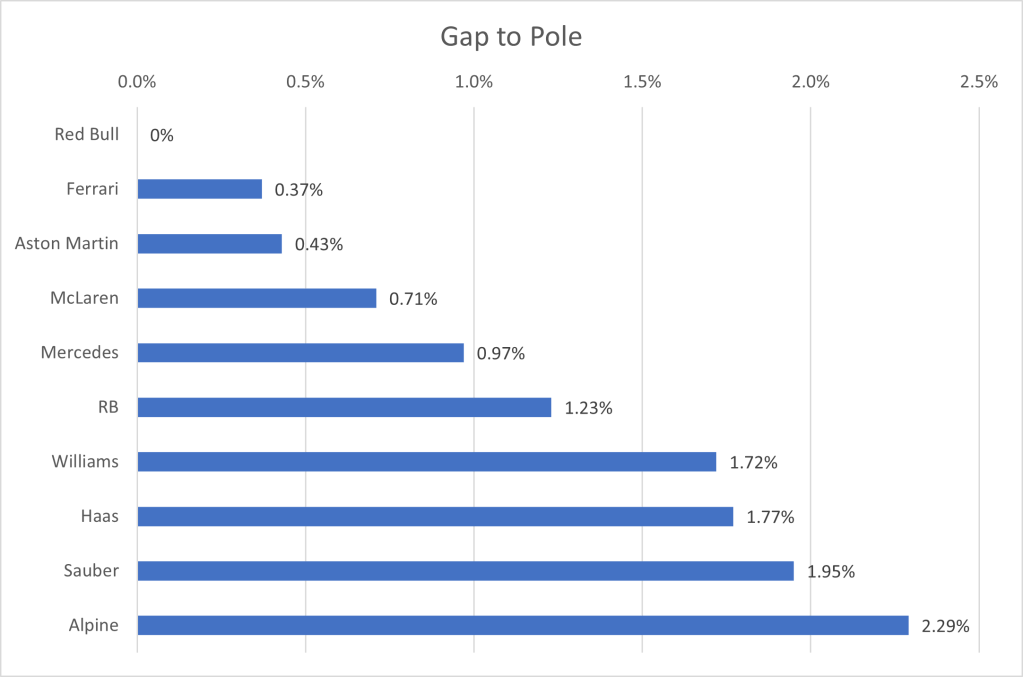
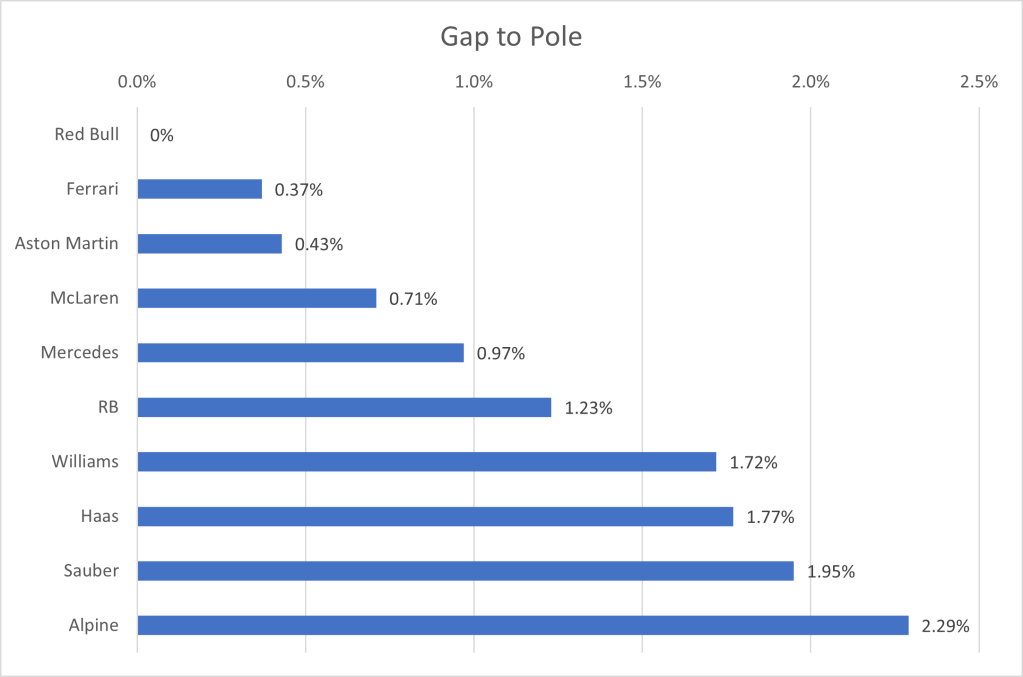
With no further ado, here are the gaps to pole:
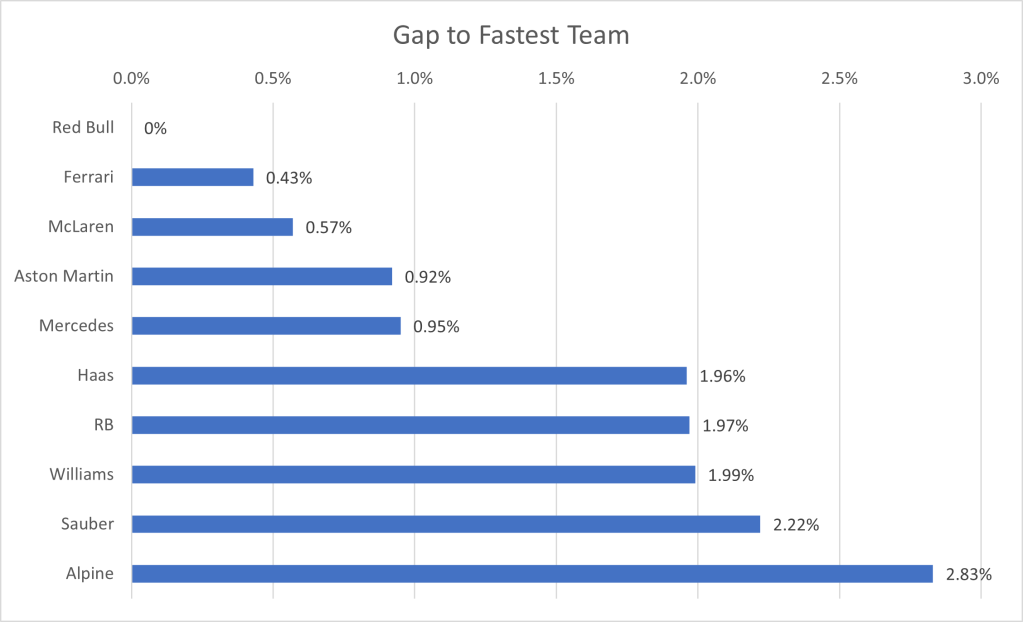
And for the teams:
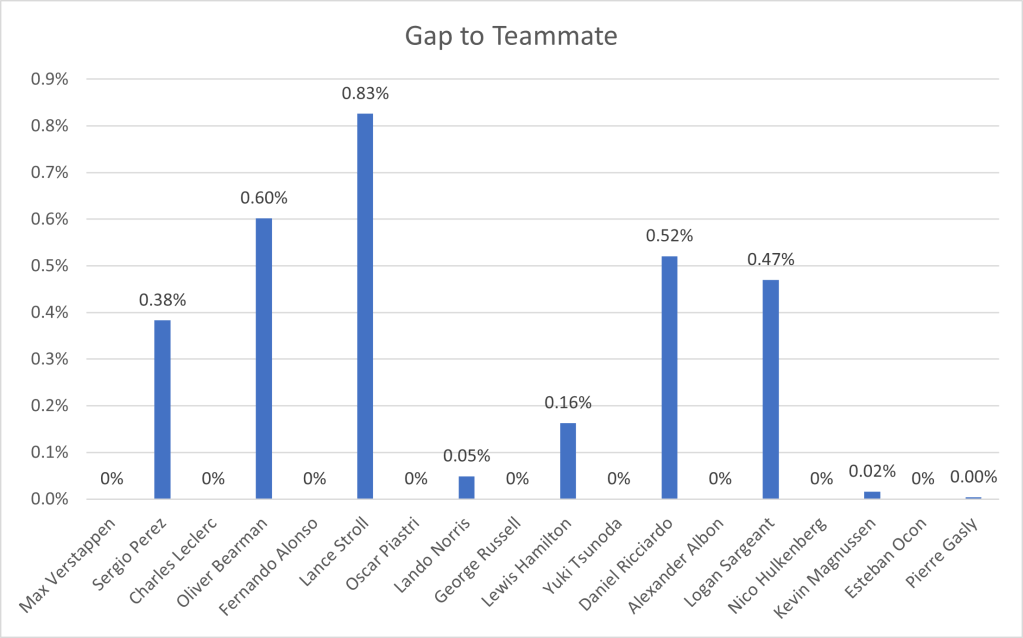
Additionally, I have collected the data for the gaps between teammates. I did this by using their fastest lap times set in the same session, so if one driver got into Q3, whilst the other only got into Q2, then I would count their Q2 times. Additionally, the lap times have to be representative, to avoid comparing out laps completed before a driver breaks down, as this would give us a very inaccurate representation of the drivers’ pace. Sauber have no comparison for Saudi, as Zhou did not set any times in qualifying:
Race Pace-
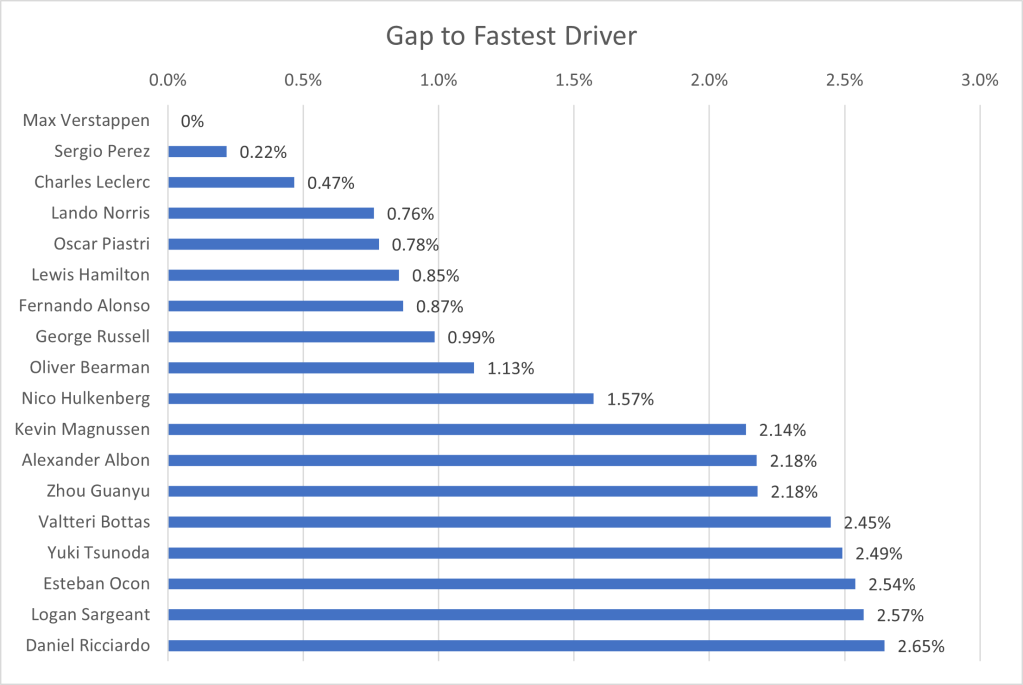
Next up in our data sets is the race pace of the drivers. I have calculated the average pace of the drivers, removing first laps, in-laps, out-laps, safety car laps and restarts after a safety car or red flag, as all these all not representative of a driver’s general pace. Additionally, if a driver has a spin, or another error that would greatly reduce their lap time, I have not counted these laps, as they would also not be representative of a drivers’ general pace.[1] I have only included drivers that completed at least 75% of the race distance (which for Saudi Arabia, excludes Lance Stroll and Pierre Gasly) so to not skew the season long averages against drivers that did not drive on low fuel with the best track conditions.
As different drivers have a varying number of race stints, this skews the overall pace. Generally, if a driver makes more stops, their pace will be faster on average. This will be taken into account in my final thoughts and analysis. Additionally, the average pace per stint and number of stints are recorded at the bottom of this article, for those interested in viewing more precise estimates of pace relative to other drivers on the same stint.[2]
And for the teams:
Analysis-
There is a similar trend to in Bahrain, the Ferrari looks like it has slightly better degradation to the Red Bull. Leclerc’s hard tyre stint began with him setting times up to a second closer than the Red Bulls, but by the end of the stint, Leclerc was matching and beating the Red Bull’s times, even recording fastest lap on the final lap when Verstappen was also going for a fastest lap attempt.
The McLaren appears to have some good pace behind it. Even though Piastri was stuck in Hamilton’s dirty air on used hard tyres for half the race, once he was out of dirty air, his lap times were around equal with Perez and only slightly behind Leclerc and Verstappen. Additionally, Norris posted the fastest stint of the race on his soft tyres, beating Hamilton’s pace. The McLaren has yet to prove to be a Red Bull challenger, but with an aggressive update schedule, it may still win some races this year.
Norris and Hamilton both performed the fastest strategy for pace, but because others stopped under the safety car, they lost track position. They did however, have their pace slightly exaggerated in the averages. This makes the Mercedes look slightly better in the race pace averages, appearing to be the fourth fastest car. Comparing Alonso and Russell’s 2nd stints, it is clear that Alonso was slightly faster than the Mercedes.
The bottom half of the field all had their averages skewed by Magnussen driving deliberately slowly, thus four teams have race pace averages of more than 2%, when no team achieved this in Bahrain.
Further Resources-
Qualifying Pace:
Driver
Fastest Qualifying Time
Max Verstappen
87.472 (0%)
Charles Leclerc
87.791 (+0.365%)
Sergio Perez
87.807 (+0.383%)
Fernando Alonso
87.846 (+0.428%)
Oscar Piastri
88.089 (+0.705%)
Lando Norris
88.132 (+0.755%)
Lance Stroll
88.25 (+0.889%)
George Russell
88.316 (+0.965%)
Lewis Hamilton
88.46 (+1.130%)
Yuki Tsunoda
88.547 (+1.229%)
Oliver Bearman
88.642 (+1.338%)
Alexander Albon
88.98 (+1.724%)
Kevin Magnussen
89.02 (+1.770%)
Daniel Ricciardo
89.025 (+1.775%)
Nico Hulkenberg
89.055 (+1.810%)
Valtteri Bottas
89.179 (+1.951%)
Esteban Ocon
89.475 (+2.290%)
Pierre Gasly
89.479 (+2.294%)
Logan Sargeant
89.526 (+2.348%)
Average Race Pace:
Driver
Pace
Max Verstappen
92.883 (0%)
Sergio Perez
93.085 (+0.217%)
Charles Leclerc
93.317 (+0.467%)
Lando Norris
93.59 (+0.761%)
Oscar Piastri
93.607 (+0.779%)
Lewis Hamilton
93.677 (+0.854%)
Fernando Alonso
93.691 (+0.869%)
George Russell
93.798 (+0.985%)
Oliver Bearman
93.934 (+1.131%)
Nico Hulkenberg
94.344 (+1.573%)
Kevin Magnussen
94.866 (+2.135%)
Alexander Albon
94.904 (+2.175%)
Zhou Guanyu
94.907 (+2.178%)
Valtteri Bottas
95.157 (+2.448%)
Yuki Tsunoda
95.197 (+2.491%)
Esteban Ocon
95.242 (+2.539%)
Logan Sargeant
95.271 (+2.570%)
Daniel Ricciardo
95.342 (+2.647%)
All Stints:
Best Stints
Pace
Norris 2nd (12L/US)
92.28
Hamilton 2nd (13L/US)
92.333
Verstappen 2nd (40L/NH)
92.753
Hulkenberg 2nd (16L/NH)
92.776
Zhou 2nd (7L/NS)
92.818
Perez 2nd (40L/NH)
92.957
Bottas 3rd (13L/NS)
93.156
Leclerc 2nd (40L/NH)
93.167
Piastri 2nd (40L/UH)
93.483
Alonso 2nd (40L/UH)
93.555
Russell 2nd (40L/NH)
93.633
Bearman 2nd (40L/NH)
93.669
Verstappen 1st (5L/NM)
93.927
Norris 1st (31L/NM)
94.097
Perez 1st (5L/NM)
94.109
Hamilton 1st (30L/NM)
94.259
Leclerc 1st (5L/NM)
94.513
Piastri 1st (5L/NM)
94.603
Magnussen 2nd (40L/NH)
94.713
Albon 2nd (40L/NH)
94.75
Alonso 1st (5L/UM)
94.78
Ocon 2nd (39L/NH)
95.03
Sargeant 2nd (39L/NH)
95.068
Tsunoda 2nd (39L/NH)
95.099
Russell 1st (5L/NM)
95.122
Ricciardo 2nd (38L/NH)
95.186
Hulkenberg 1st (27L/NM)
95.273
Zhou 1st (35L/NM)
95.324
Bottas 2nd (24L/NH)
95.885
Tsunoda 1st (5L/NM)
95.964
Bearman 1st (5L/NS)
96.058
Magnussen 1st (5L/NM)
96.09
Albon 1st (5L/NM)
96.132
Ricciardo 1st (5L/NM)
96.524
Sargeant 1st (5L/NM)
96.848
Bottas 1st (5L/NS)
96.865
Ocon 1st (5L/NM)
96.893
Key: 1L= One Lap, 2L= Two Laps, NH= New Hards, UH= Used Hards, NM= New Mediums, NS= New Softs


 Ryan's Lil' F1 Blog