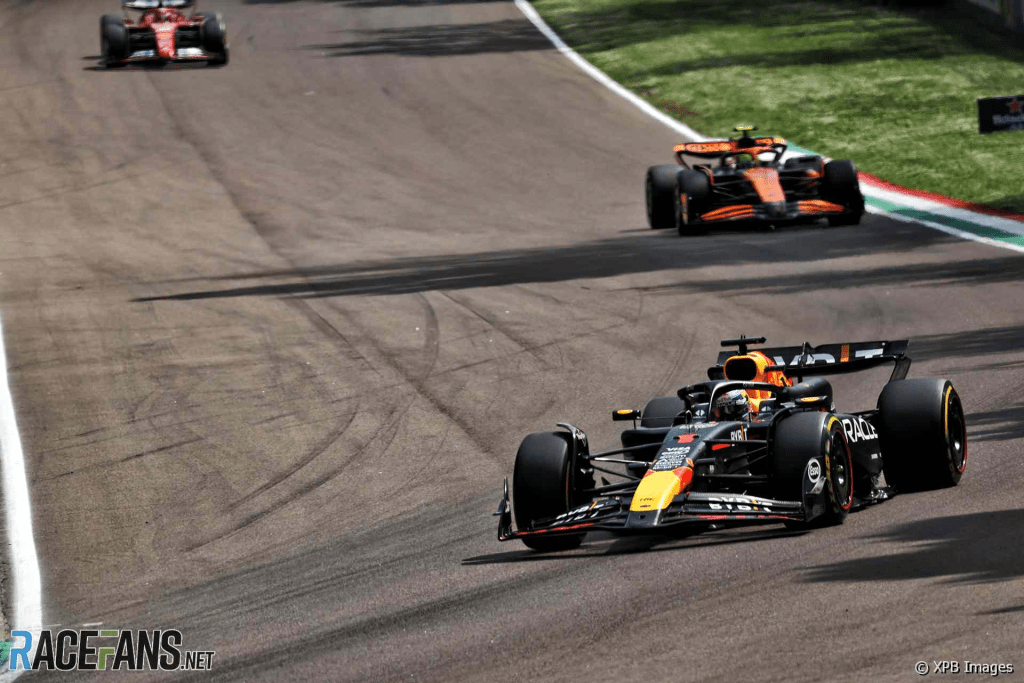
Max had one of the greatest starts I’ve seen in Imola, timing his braking to perfection to pass Piastri around the outside. From there, he showed superior pace in clean air and took advantage of perfect safety car timing to take his second win of the season.
2. Lando Norris-
Whilst he had a poor qualifying, Lando made up for it in the race. Unlike his teammate, Lando didn’t reactively stop early. This proved to be the right choice for the frontrunners, as traffic nullified the advantage that fresher tyres brought. Taking this strategy allowed for Lando to overtake his teammate after the safety car restart, ending a three-race streak of being beaten by Oscar.
3. Alexander Albon-
Albon had an outstanding race in Imola and for a while looked like he might drag his Williams onto the podium. Staunch defending from Charles Leclerc prevented that from happening and Albon had to settle for fifth, but this was still his joint best performance of the year.
4. Charles Leclerc-
Charles took advantage of an excellent strategy to undercut the slower cars he was behind. Unfortunately, terrible luck with the safety car timing relegated Charles to sixth place behind his teammate. But he was still obviously the stronger Ferrari driver throughout the race and deserved better.
5. Fernando Alonso-
Fernando Alonso put together a fantastic qualifying to start the race in fifth place. He looked set on for his first points of the year, but a poor strategy and atrocious luck meant he had to settle for eleventh. But he was still, in my opinion, one of the five best drivers of the weekend.
One of Max’s best victories. He responded to the increasing pressure bearing down on him by McLaren in style, as he climbed from seventeenth on the grid to victory at the flag. Whilst some of this was aided by fortuitous timing of the red flag, Max was consistently one of the fastest drivers on the circuit and was making splendid moves from lap one. Also, unlike his former championship rival, Max didn’t make any mistakes during the race. It was absolutely clinical and simply lovely. His fourth world championship is now all but guaranteed.
2. Esteban Ocon-
Esteban Ocon had an amazing race as well, even briefly looking like he would take victory before Verstappen overtook him at the second safety car restart. To fight for victory in a car that had previously recorded a best finish of ninth was a great turnaround. Haas are lucky to have Ocon in their team next year.
3. Pierre Gasly-
Gasly also had a great race to grant a double podium finish (the Enstone team’s first since 2013). With a magnificent result, Alpine jumped up the standings from ninth to sixth.
4. George Russell-
Had Mercedes’ strategy been a little better, George might have taken his second win in Brazil. Whilst it was not to be, Russell has a lot of positives to take home from the Brazilian Grand Prix. He showed star-quality pace compared to his teammate, executed a perfect start to lead the first stint of the race and didn’t make the major mistakes some of the other ‘top’ drivers in the sport demonstrated.
5. Yuki Tsunoda-
Yuki Tsunoda had an amazing qualifying, to start third in the junior Red Bull team. Whilst being held back by his RB team’s strategy, Yuki still maximized his race to finish seventh when Oscar Piastri’s ten second penalty was applied.
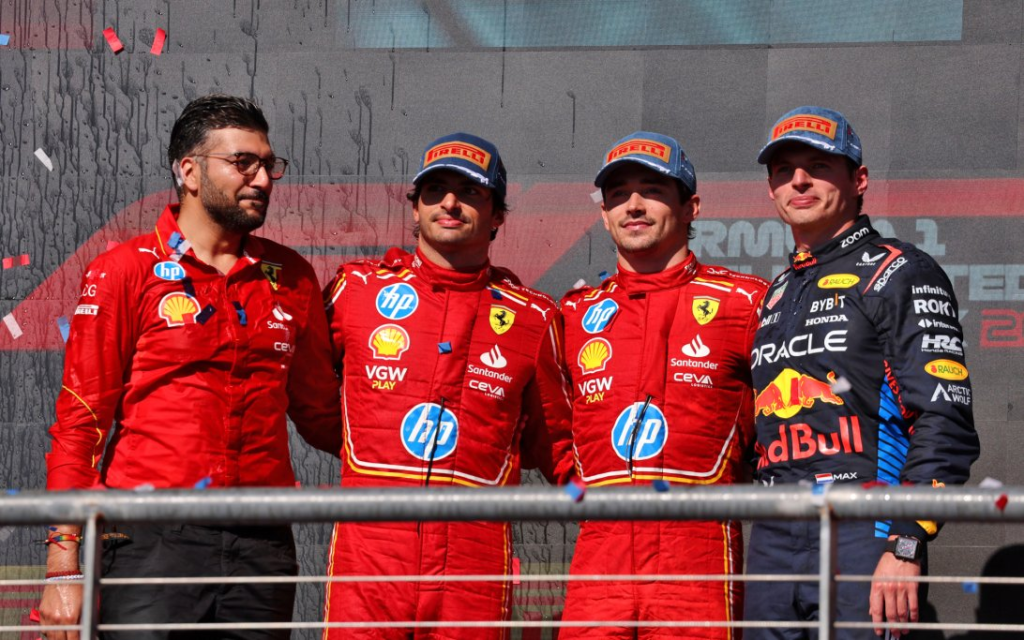
The United States Grand Prix was a good race. Not quite in the top tier, but fun battles, varying strategies and a Ferrari 1-2 all bolstered the entertainment last weekend. COTA is one of the better F1 circuits, with a steady flow of varied corners that promote battling and unconventional moves throughout the laps. A race at the Circuit of the Americas is often an entertaining watch, so when the result is also to my liking, I receive a welcome boost to my dwindling serotonin count.
Lando Norris delivered a great lap in qualifying to earn pole position after George Russell crashed during the final laps. But as fans have witnessed throughout this season, a Lando Norris pole usually results in someone else leading after the first lap. This time Lando had a woeful start, failing to cover the inside line from Max Verstappen despite having the space to. When you Verstappen an inch, he takes a mile, as he lunged into the first corner, pushing Lando off the track in the process. Whilst this worked for Verstappen, it resulted in the door being left wide open and Charles Leclerc wasted no time in waltzing through that door to take the lead. From there, in the car that showed the most race pace throughout the weekend, Leclerc was never at threat of losing the lead. Lando’s sloppy start placed a win straight into Ferrari’s hands.
Despite a relatively embarrassing start, Lando can take pride in not being the driver who humiliated himself the most at COTA. That goes to Lewis Hamilton. Lewis, the seven-time world champion, qualified in nineteenth, behind his former teammate Valtteri Bottas in the slowest car. If that wasn’t enough, Lewis then spun out on his own on lap three. This was an uncharacteristically terrible performance for a driver of Lewis’ calibre and by the time his career has ended, this may go down as his worst weekend. Whilst this sounds harsh, it’s only because Lewis is a driver who is rightly rated so highly that this performance is notable. I’m not devoting an entire paragraph to Zhou Guanyu’s equally embarrassing performance, since I expected it from him.
Throughout the race the Ferrari’s easily dominated. After Carlos Sainz undercut Max Verstappen to take second, Max’s only worry was finishing behind his closest championship rival, Lando in the McLaren. McLaren recovered from their poor track position relatively well, pitting much later than their rivals to hunt down Verstappen towards the race’s conclusion. When Lando Norris caught up to Max Verstappen, they had a cinematic battle, with Max judging his car positioning perfectly to ensure that Lando had as little chance as possible of finding a way past him. This battle was thrilling to watch, if only it wasn’t ruined by the stewards.
As Lando finally got a good run on Max Verstappen, he looked to make the move around the outside of turn 12. Yet, Max, ever the expert at pushing to the edge of the rulebook, completely outbraked himself, pushing himself and Norris off the track. Lando proceeded to still make the overtake outside the track limits and McLaren were convinced that they would not receive a penalty as Lando had nowhere else to go. Yet, the stewards had a different interpretation, arguing that since Max was ahead of Lando at the apex of the corner, that it constituted an illegal overtake by Lando. I feel that this was a poor argument, as the only reason that Verstappen was ever ahead at the apex was because he had no intention of making the corner. Yet for this, the stewards punished Lando with a five second penalty, pushing back behind Max at the race finish. This is an example of bad stewarding that fails to let the drivers race each other without risking a penalty. Even more infuriating was the fact that there were multiple very similar incidents throughout the weekend, yet the stewards came to completely different, inconsistent decisions each time. This is not good enough.
However, the bad stewarding didn’t stop me from loving another exciting win for Charles. Beyond that, the fantastic performances from Franco Colapinto and Liam Lawson made the case that the crop of young drivers we have coming into F1 is going to make one of the most talented fields we have ever seen. The race was exhilarating, and the result was what I wanted to happen, so I’m happy with the US Grand Prix.
This may be the best performance of Lando’s career yet. He took a commanding pole position and proceeded to drive away from the rest of the field. It was a truly dominant and faultless display, one Lando has proven he is capable of. If Lando became a more consistent driver and delivered on this potential every weekend, he’d easily be championship material.
2. Max Verstappen-
It feels odd to sing Max Verstappen’s praises for coming in second, so used we are to seeing him dominate the rest of the field. But, in a car that has not been performing well at all in recent races, Max got the absolute maximum out of it, qualifying just behind Lando Norris and finishing comfortably ahead of every driver not named Lando Norris.
3. Fernando Alonso-
Fernando had a quiet but commanding performance in Singapore to finish at the top of the midfield. These performances are becoming common in 2024 and whilst I wish that Aston Martin was closer to the podium, Fernando is still one of the most consistent drivers in the sport.
4. Nico Hulkenberg-
Nico Hulkenberg is probably regretting leaving Haas at this point in the season, because his stint with the US outfit has really revitalized his career. And yet again, Nico maximized, qualifying in sixth and finishing the race in ninth place to take two more points for the team. Haas is slowly catching up to RB and will probably catch them with a few more point finishes.
5. Franco Colapinto-
Franco Colapinto is continuing to impress in his rookie races for Williams. He made a fantastic divebomb at turn one to put himself into the points, after only being narrowly outqualified by his teammate. Whilst strategy made it so that Franco missed out on consecutive points finishes, he only finished just outside of the points in eleventh. For his third race, the hardest race of the year, this performance was fantastic.
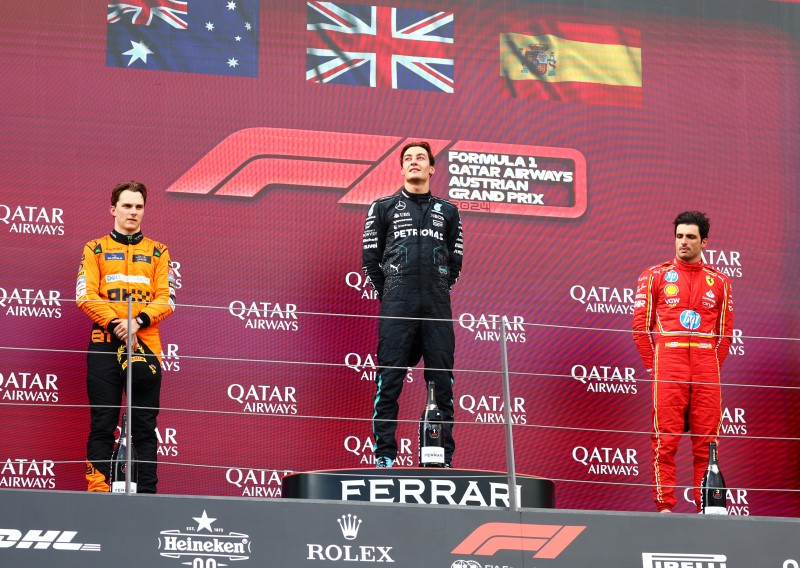
The Red Bull Ring is always a fun track. With a simple layout and three DRS zones, the track encourages overtaking and battling throughout many laps. The Grand Prix this year was a good watch, providing entertaining battles and late race drama. Whilst the race felt like it was lacking a cohesive narrative and felt more like a series of disconnected events, the events in themselves were fun. Not fun for a Leclerc fan, but the action towards the end of the race distracted from that particular disappointment.
Before the drama at the race’s conclusion, there were limited moments of intrigue throughout the first two stints. In particular, there were some exciting teammate rivalries to ruminate on. The first example came when the Haas cars made their first stops, with Magnussen and Hulkenberg proceeding to pass and repass each other as their respective engineers begged for them to work together to save tyres. It took a few minutes of convincing and some colourful language from Magnussen to get there, but eventually the Haas boys calmed down and recorded their best finish of the season. The Alpine boys were not so quick to settle, as they engaged in yet another vicious battle. Whilst it was a tremendously foolish idea to ever make Ocon and Gasly teammates, it provides fans with the entertainment of watching two people who absolutely despise each other fight. As always, the way they raced each other demonstrated their feelings, as they were fighting through for multiple laps, whilst pushing each other off the track at every opportunity. Eventually Gasly passed Ocon, but the fighting likely lost both drivers time and tyres. However, the fact that at any track these drivers never stop fighting makes up for the lack of sensibility with a flurry of entertainment.
Whilst the first two thirds of the race were not boring, it was during the final third that the main spectacle came to pass. Red Bull had already made a mistake during practice, using too many medium tyres when these would prove the strongest in the race. Thus, they had to put Verstappen on an old set of mediums for his final stint. Combined with a slow pit stop and a lock up, this put Lando Norris right on Verstappen’s tail. For a number of laps, Norris tried to hustle his way past, in a battle that was as thrilling as it was silly. Both drivers didn’t show their best qualities during this duel. On Norris’ behalf, his hastiness to overtake Max led him to commit to some silly divebombs and opportunistic overtakes. This showed a lack of solid race craft during high pressure moments from Lando. On Verstappen’s behalf, he demonstrated his willingness to be too aggressive when he feels he can get away with breaking the rules. Virtually every time Norris attempted to overtake, Max would move in the braking zone to push Lando into backing out. The stewards repeatedly failed to intervene to stop Verstappen’s illegal tactics, despite the rule breaking being obvious to anyone watching the race. With Norris and Verstappen both getting increasingly angry at each other’s driving, there was only one way this battle could end.
Thus, on lap 64, as Norris tried to overtake, Max moved under braking again. But Norris didn’t back down and they collided in a dramatic fashion. This gave both of them punctures and was a fantastic example of why the stewards should punish illegal tactics before those tactics lead to the inevitable. One would have thought that the stewards would have learnt their lesson from the events of 2021, but instead they let history repeat itself. Whilst I often criticize Lando Norris, in this moment I have to praise his resolve. He showed Verstappen that he wasn’t prepared to be pushed around. Whilst Norris lost out more from the collision, as he had to retire whilst Verstappen finished fifth, this is still good if Norris wants to be in regular battle with Verstappen. Norris needs to carry the aggression forward throughout the season, as you can only beat Verstappen by meeting his aggression.
The collision between the leaders led to the biggest surprise of the afternoon, George Russell winning. This was the first Mercedes victory since Russell’s win in Brazil 2022 and whilst it fell into his hands, it was nevertheless well deserved. George has been fantastic this year, regularly outqualifying his teammate and proving that he can become Mercedes’ team leader. He drove a perfect weekend, making no mistakes where others faltered. I said that he needed to win another race during my Canada review, to prove his critics wrong. George delivered in the best way possible and I’m sure the Mercedes factory enjoyed their champagne Monday.
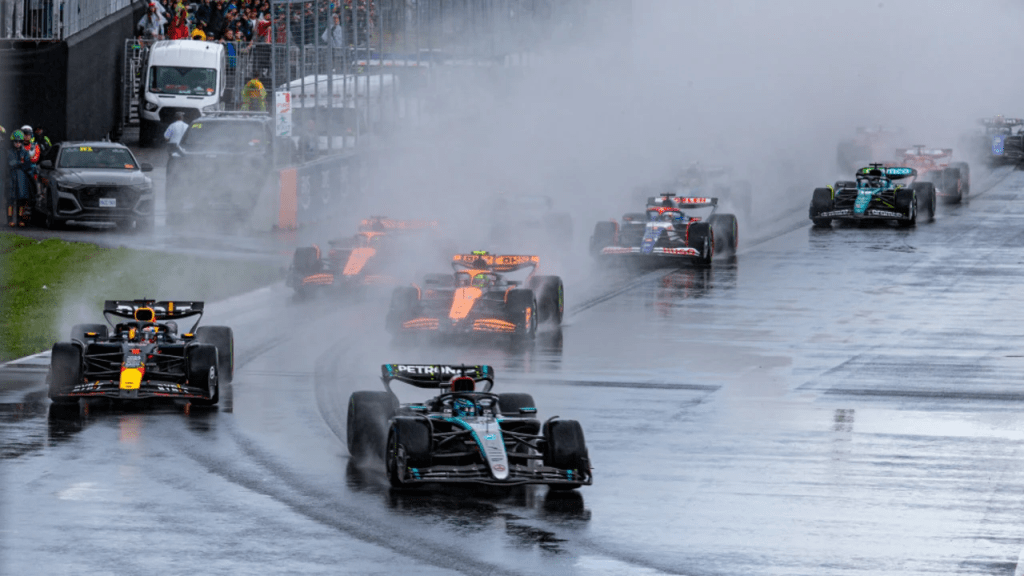
Thrilling conditions often bespoke a thrilling race. Which is exactly what Formula One provided in Canada. Featuring a three-way battle for the win, incidents aplenty and Alex Albon making the overtake of the year, Canada delivered a wet-to-dry classic that fans will be talking about for years to come.
After an equally thrilling qualifying, which saw George Russell and Max Verstappen set the exact same pole time, conditions at the start of the race were incredibly wet. As all the runners on the intermediate tyres struggled for grip, one team made moves across the field. As Haas had elected to start on the wet tyres, they were instantly the fastest cars on the circuit. My favourite chaos merchant Kevin Magnussen made fine use of his extra grip, moving from fourteenth to fourth in the space of a few laps. It seemed like Haas had made a fantastic gamble, but within a few laps, as the track started to dry, conditions moved towards the intermediate runners. It was at this point that Haas needed to bring Kevin in for a pit stop. They did this, albeit forgetting to bring the tyres. So, Kevin’s work was all for nought, as he fell down the field, throwing away a chance of points. It was a shame to see Kevin’s performance yield no rewards, as he reminded everyone that when he’s not courting controversy, he’s a damn good racer.
As all the midfield chaos was occurring, George Russell was leading with Verstappen hot on his tail. The Mercedes showed a surprising flash of pace this weekend, likely bolstered by their upgrades and the colder conditions in Canada. After not being close to the podium all season, Russell was a legitimate contender for the win. It was a great turnaround, though as the two frontrunners fought, the McLaren’s of Norris and Piastri were getting closer and closer. McLaren had set their car up to prioritise tyre wear and this began to pay off, as Norris overtook both Verstappen and Russell to lead the race. He then began to pull away from the field and it began to appear like Lando’s second win was on the horizon. Then Logan Sargeant crashed and bought out the safety car. From here, things began to fall apart for Lando.
When the safety car was called, McLaren had just enough time to bring in Lando for a pit stop.[1] Unfortunately for them, they missed their opportunity, continuing an under-scrutinized trend of McLaren making poor strategic decisions at vital moments. As all the other front runners pitted, Norris had to complete another lap behind the safety car, resulting in him falling from first to third when he finally did pit. Norris would never regain the opportunity to win the race from this point onwards, despite attempting an overcut when switching to dry tyres. Whilst finishing second, this result was not was Norris was hoping for. Combined with the near miss at Imola, Norris has missed out on possible victories in two of the last three races. For a team that finally seems to have a championship contending car, McLaren have to take these opportunities.
As the race reached its dry zenith, it was the Mercedes of George Russell that looked to have the pace to challenge for Verstappen for the win. Yet, a series of small, costly errors throughout the race consistently put Russell into fights with other frontrunners that he could have avoided. This is a consistent trend many have noticed about George Russell. He is a fantastic driver, with supreme qualifying abilities and great race pace, but he makes mistakes at the exact wrong moments. At minimum, he could have finished second with his pace towards the end of the race, but instead had to settle for third. It was still a fantastic performance throughout the weekend for George, but he’s got to have to turn this narrative around soon. If Mercedes’ upgrade path is as fruitful as some are predicting, perhaps that opportunity could arise in Spain. If it does, George has to take it.
With such a fantastic race, the only thing that could possibly make me upset would be if Ferrari were to have an absolute howler. If, for example, they were to both qualify outside the top-10, then have race-ending engine issues on my favourite driver’s car, I would be upset. I would be even more upset if Ferrari’s other driver then proceeded to spin out of the race, in the process hitting my second favourite driver, who up to that point was having a brilliant race. For the sake of praising one of the best Formula One races of the last few years, I am going to choose to no longer ruminate on the fact that these exact events occurred.
So, despite certain events, this race had everything. Three teams fighting for the win, battles across the field, strategy gambles and Max Verstappen delivering a masterclass performance to remind everyone that even without a dominant car, he is a dominant driver. I won’t be forgetting this one anytime soon.
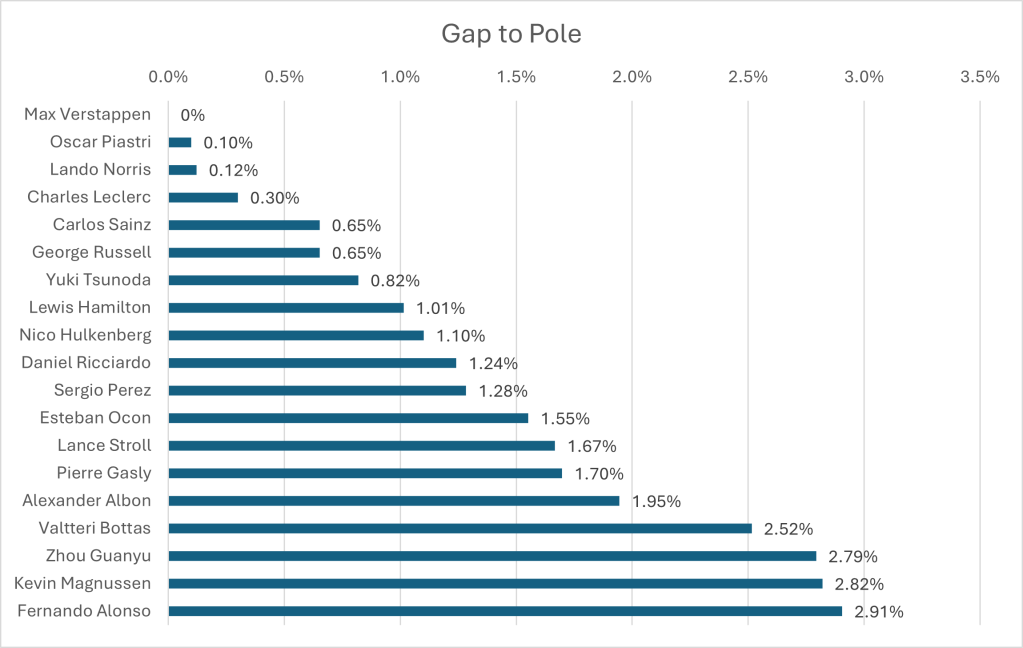
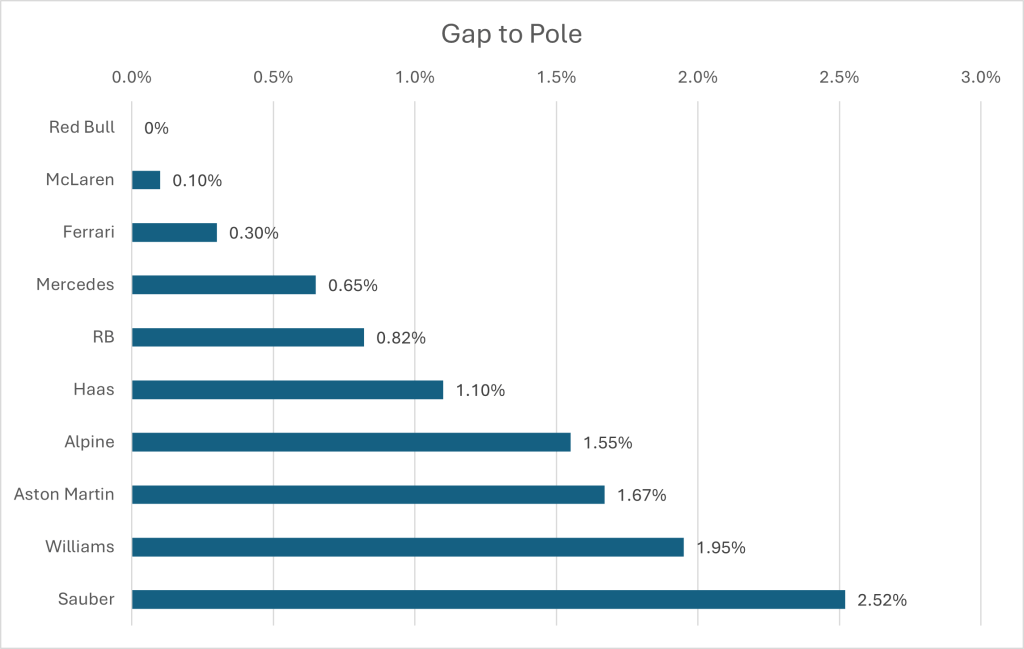
I have collated the fastest laps by each driver in qualifying, to show the average gap to the fastest driver. Whilst this extends the gap between drivers who made it to the top ten and those below, I’ve ruled using the overall fastest times a better grounding point for the true limit of the top cars, as the cars most likely to compete for points are my primary focus in these analyses.
Qualifying Pace-
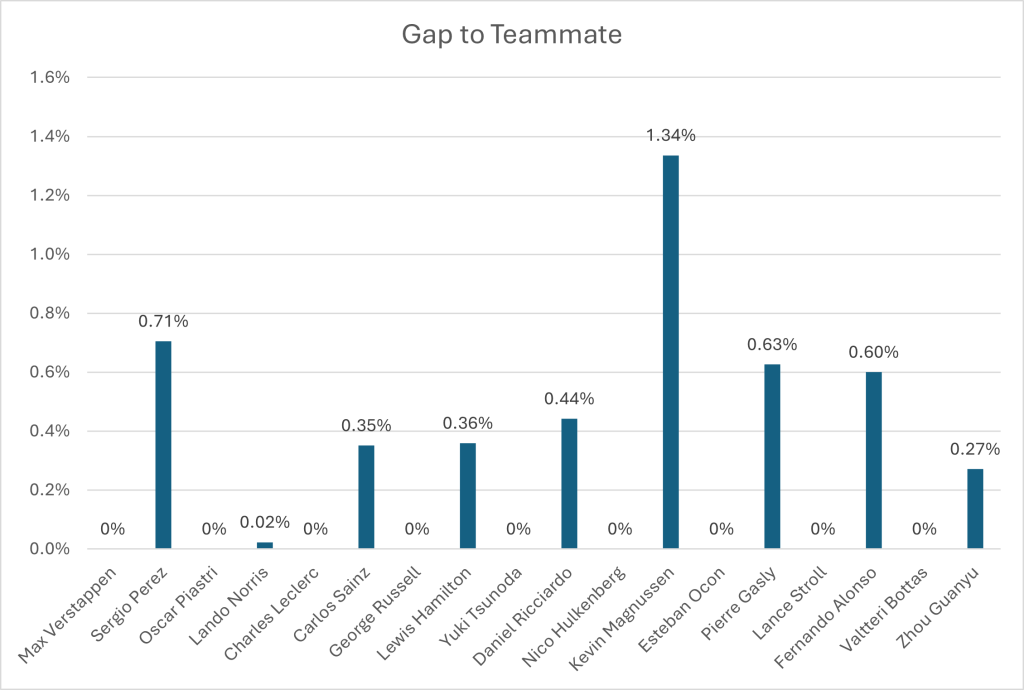
Additionally, I have collected the data for the gaps between teammates. I did this by using their lap times set in the same qualifying session. I generally compare the last session both drivers competed in, however if the fastest driver their fastest time in earlier sessions, I count these instead.
Race Pace-
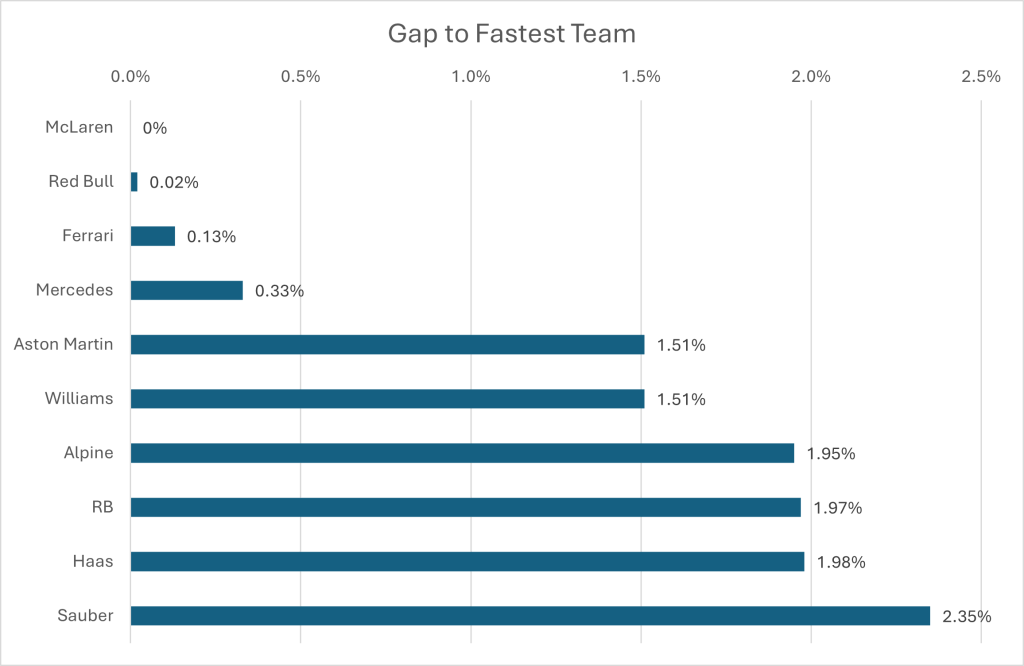
I have calculated the average pace of the drivers, removing the first laps, laps in the pit lane and laps under the safety car as these are all too slow to be representative. Additionally, I removed any laps with major errors I noticed, such as when Perez or Hamilton crossed the gravel trap in Imola. I have only included drivers that completed at least 75% of the laps to not skew the season averages against drivers that never got the chance to run their cars on low fuel.
As different drivers have a varying number of race stints, this skews the overall pace. Generally, if a driver makes more stops, their pace will be faster on average. This will be considered in my final thoughts and analysis. Additionally, the average pace per stint and number of stints are recorded at the bottom of this article, for those interested in viewing more precise estimates of pace relative to other drivers on the same stint.[1]
Analysis:
Pace was generally quite similar between the top three drivers, who all were fastest at some point in the race. Whilst the track did not suit Ferrari, their upgrades appear to have put them in the fight with Red Bull, as well as McLaren’s upgrades nearly delivering another win to Lando Norris.
Aston’s upgrades have not appeared to correlate very well and at present, their pace is similar to the lower midfield. This could be a very bad sign for their season, as upgrades not correlating was the cause of their downfall last season. If they don’t get a handle on their development, they may start to be regularly beaten by the likes of RB and Haas.
Several teams ran terrible strategies, stopping their drivers onto hard tyres incredibly early, failing to account for high tyre degradation. These drivers tended to deliver slower second stints than their initial stints, a rarity in the post-refuelling era.
Haas in particular, made a mistake when they reacted to Tsunoda’s early stop with Hulkenberg. If Hulkenberg had copied Magnussen’s strategy and stopped later he could have banked a ninth place, as he would have been able to overtake Tsunoda on newer tyres and would have covered off Stroll’s ability to overtake him. Magnussen finished less than two seconds behind Hulkenberg on this strategy, when he started in eighteenth.
Albon’s pace seems to have been bolstered by his retirement, due to the suboptimal strategies of other drivers, as usually if a driver retires, their pace is relatively worse.
Further Resources-
Qualifying Pace:
Driver
Fastest Qualifying Time
Max Verstappen
74.746 (0%)
Oscar Piastri
74.82 (+0.099%)
Lando Norris
74.837 (+0.122%)
Charles Leclerc
74.97 (+0.300%)
Carlos Sainz
75.233 (+0.652%)
George Russell
75.234 (+0.653%)
Yuki Tsunoda
75.358 (+0.819%)
Lewis Hamilton
75.504 (+1.014%)
Nico Hulkenberg
75.569 (+1.101%)
Daniel Ricciardo
75.674 (+1.242%)
Sergio Perez
75.706 (+1.284%)
Esteban Ocon
75.906 (+1.552%)
Lance Stroll
75.992 (+1.667%)
Pierre Gasly
76.015 (+1.698%)
Alexander Albon
76.2 (+1.945%)
Valtteri Bottas
76.626 (+2.515%)
Zhou Guanyu
76.834 (+2.793%)
Kevin Magnussen
76.854 (+2.820%)
Fernando Alonso
76.917 (+2.905%)
Average Race Pace:
Driver
Pace
Lando Norris
80.857 (0%)
Max Verstappen
80.876 (+0.024%)
Charles Leclerc
80.959 (+0.127%)
Oscar Piastri
81.07 (+0.263%)
George Russell
81.121 (+0.326%)
Carlos Sainz
81.199 (+0.423%)
Lewis Hamilton
81.31 (+0.560%)
Sergio Perez
81.578 (+0.891%)
Lance Stroll
82.078 (+1.510%)
Alexander Albon
82.078 (+1.510%)
Fernando Alonso
82.289 (+1.771%)
Pierre Gasly
82.434 (+1.950%)
Yuki Tsunoda
82.449 (+1.969%)
Kevin Magnussen
82.46 (+1.982%)
Nico Hulkenberg
82.55 (+2.094%)
Daniel Ricciardo
82.571 (+2.120%)
Zhou Guanyu
82.759 (+2.353%)
Logan Sargeant
82.81 (+2.416%)
Esteban Ocon
82.81 (+2.416%)
Valtteri Bottas
82.987 (+2.634%)
All Stints:
Best Stints
Pace
Russell 3rd (10L/UM)
79.934
Perez 2nd (25L/NM)
80.49
Norris 2nd (40L/UH)
80.612
Leclerc 2nd (37L/NH)
80.659
Verstappen 2nd (38L/NH)
80.723
Piastri 2nd (39L/UH)
80.779
Sainz 2nd (35L/NH)
80.91
Hamilton 2nd (35L/NH)
80.992
Verstappen 1st (22L/NM)
81.14
Russell 2nd (28L/NH)
81.156
Stroll 2nd (25L/UH)
81.276
Norris 1st (20L/NM)
81.348
Leclerc 1st (23L/NM)
81.412
Alonso 3rd (17L/UM)
81.492
Sainz 1st (25L/NM)
81.604
Piastri 1st (21L/NM)
81.609
Russell 1st (19L/NM)
81.692
Magnussen 2nd (24L/NH)
81.727
Hamilton 1st (24L/NM)
81.774
Albon 5th (21L/UM)
81.788
Albon 3rd (12L/NH)
82.007
Hulkenberg 1st (11L/NM)
82.256
Tsunoda 1st (10L/NM)
82.259
Gasly 2nd (20L/NH)
82.331
Sargeant 2nd (30L/NM)
82.35
Perez 1st (34L/NH)
82.378
Ricciardo 1st (9L/NM)
82.386
Zhou 2nd (28L/NM)
82.415
Gasly 3rd (31L/NM)
82.455
Tsunoda 2nd (49L/NH)
82.488
Ricciardo 2nd (50L/NH)
82.604
Albon 1st (8L/NM)
82.612
Hulkenberg 2nd (48L/NH)
82.617
Alonso 2nd (31L/UH)
82.626
Stroll 1st (35L/UM)
82.651
Gasly 1st (6L/NS)
82.666
Ocon 2nd (36L/NH)
82.745
Bottas 1st (6L/NM)
82.825
Ocon 1st (23L/NM)
82.912
Magnussen 1st (35L/NM)
82.962
Bottas 2nd (53L/NH)
83.005
Zhou 1st (31L/NH)
83.071
Alonso 1st (5L/NS)
83.145
Sargeant 1st (29L/NH)
83.286
Key: 1L= One Lap, 2L= Two Laps, NH= New Hards, UM= Used Mediums, NM= New Mediums, NS= New Softs
[1] I only include stints in the stint table if a driver has completed five or more representative laps, in an attempt to avoid fastest lap attempts. This has led to exclusions from the chart of Alonso’s fourth stint and Albon’s second and fourth stints.
This may be one of Max Verstappen’s greatest wins. In a weekend in which he did not have the fastest car, he made the difference, through a sublime qualifying lap and held on despite massive pressure from Norris towards the end of the race to take his 59th win.
2. Lando Norris-
Whilst slightly underperforming in qualifying, Lando made up for it with superb tyre management throughout the race. To only finish 0.7 seconds towards Verstappen, a sight we’ve barely seen during the last couple of years, shows that his win in Miami was not a one-off, but a sign of a McLaren resurgence.
3. Yuki Tsunoda-
Yuki continues to impress this year. Once again outqualifying Ricciardo, at times this weekend he looked like challenging the top teams. Whilst the overall race pace of the RB has yet to escape the midfield, Yuki still held on to score a valuable point at home. With every impressive performance, it is really starting to seem like he may actually get that Red Bull seat one day.
4. Lance Stroll-
Stroll had a quietly impressive performance this weekend. On a track that was difficult to overtake on and a weekend where his teammate was nowhere, Stroll improved from his starting position to drag his underperforming Aston Martin into the points. Whilst I’m not the biggest Lance Stroll fan, I have to give credit where it’s due.
5. Kevin Magnussen-
Kevin’s performance is going to go under looked this weekend. He was comprehensively outqualified by his teammate, yet was making move after move in a track that is difficult to overtake on, to recover to twelfth, only a few seconds behind the sister car. In a better car, he delivered a points worthy performance.
Until the last ten laps, I thought I was going to be the only person on the planet defending Imola. Imola is the recipient of valid and understandable complaints from fans. It’s difficult to overtake on, is unnecessary when there is already a fan-favourite Italian track on the calendar and seldom throws up classic races unless it rains. However, I don’t think that how easy a track is to overtake on is necessarily a count against it. Whilst incredibly difficult, it requires precision to make a move, with the last two corners proving especially challenging for drivers to nail. The track punishes mistakes with trips to the grass or gravel and requires drivers to exercise 100% concentration. It is an incredibly fun track to drive on which is vital to keep drivers bored of generic street tracks to stay in the sport. Whilst this old school track doesn’t necessarily lead to non-stop action, I find it relaxing to watch Formula One cars hustle around here.
That’s not to say nothing this weekend disappointed me. Ferrari’s upgrade package was anticipated for two weeks, with Fred Vasseur anticipating that Ferrari would be competing for a victory.[1] Friday looked promising as well, with Red Bull struggling, Ferrari appeared to be the fastest car. Yet, when it came down to qualifying and the race, Ferrari was slower than McLaren and not quick enough compared to Red Bull to challenge the excellency of Max Verstappen. The track did not suit Ferrari, which should have been more clearly communicated to fans earlier in the week. Monaco may also be a relatively painful weekend, unfortunately, with the true impact of Ferrari’s upgrades to become apparent when we return to faster tracks.
In contrast to Ferrari’s upgrades, McLaren’s are continuing to impress. Whilst in the middle of the race, it looked like Lando Norris was struggling for the pace, it instead appeared that he managed his tyres to perfection. This allowed him to charge at Max Verstappen towards the end of the race. Verstappen had to dig deep to stop Lando from getting into DRS range and attempting a move during the final laps and only won by 0.7 seconds. The last ten laps had vibes of Imola 2005, an example of how an F1 race’s quality is not always determined by the number of overtakes. Whilst Lando was not the driver I wanted to see hunting Max Verstappen down, this race showed that Red Bull is not invulnerable this season. The damp squib of a performance from Perez also emphasized this point.
In conclusion, I enjoy Imola. I understand why many don’t, but I’m never not going to have fun watching F1 drivers struggle to master a challenging, old-school circuit. I also am excited at the prospect of a season where three teams fight for wins, it’s been too long since F1 had one of those.

 Ryan's Lil' F1 Blog