I have little to say about the Singapore Grand Prix. The race at Singapore is only usually interesting if a safety car grants some strategic variety, as happened last year. However, as is becoming typical in 2024, there were no safety cars in Singapore, making the race quite boring. My personal frustration was only compounded by both Ferrari drivers screwing up qualifying and only recovering to fifth and seventh in the race, so I couldn’t even enjoy the result. However, there were a couple of topics throughout the weekend that I feel are worth giving my (belated) opinions on.
The first of these is the way in which Daniel Ricciardo has been treated. It’s not a secret that I haven’t been particularly impressed with Daniel’s performances this year. Whilst an improvement on his dreadful stint at McLaren, Daniel has been humbled by Yuki Tsunoda and it’s apparent that he is not the driver he used to be. However, he is a seven-time GP winner for the Red Bull team, so deserved a gracious farewell. Dropping him from the RB team with six races left to go in the season is not very respectful to his legacy. Not even telling anyone and leaving him in a position where he had no farewell, instead being resorted to being close to tears in interviews during the weekend, was completely abominable. In a year in which Red Bull has had its reputation thoroughly damaged, this was the worst possible look and made me, far from Ricciardo’s biggest fan, just want to give the man a big hug.
The second topic I’d like to discuss is the ridiculous swearing saga. Mohammed Ben Sulayem, the President of the FIA, recently requested that drivers swear less over the radio to make the sport more family friendly. This is already quite silly, as there is no requirement for the producers to play radio messages with swear words in, but they do because it sells. Rather than regulating F1’s producers, Ben Sulayem thinks that it should be incumbent on the people driving some of the fastest cars in the world not to swear if something goes wrong. Max Verstappen then proceeded to swear in the press conference, which resulted in the stewards ruling that he needed to complete community service. Almost all the drivers found this ridiculous, with Lewis encouraging Max to boycott this service. Max also implied that decisions like these will lead to him leaving the sport sooner. Why F1 feels it’s a good idea to alienate one of their biggest stars is beyond me. And it being all for something as trivial as swearing defines the Ben Sulayem leadership, one characterized by making unnecessary and unpopular decisions whilst proceeding to not make those fans are clamoring for.
The double header at Iowa was an unmitigated disaster. From the track, to the hybrids, to the safety, everything that could go wrong did. We were witness to 500 laps of boredom over two races and however much the commentary team tried to gloss it over, it was clear that a great track had been utterly ruined. One hopes that improvements are made for next year, because I am aghast at what I watched.
Problems with the hybrids were apparent during qualifying. Because some drivers did not have access to the hybrid system IndyCar had to offer them the ability to redo their qualifying runs, including the first race’s polesitter Colton Herta. Unfortunately, it seemed to affect Jack Harvey the most. It was already questionable whether Harvey should have been allowed to compete, as he was affected with serious back and neck spasms. After his first run, it was revealed that Harvey did not have access to the hybrid system, leading to him having to go out a second time. After this Jack was in visible agony and could barely get out of the car. So evidently, his hybrid system hadn’t worked again and he was forced to qualify for a third time. At this point, the IndyCar medical team did not want Harvey to run in the race, due to the apparent agony he was in. However, the officials declared that if he withdrew or was replaced by a substitute driver, the car would not be able to receive full points. This forced Harvey into the race for a brief period, until he came into the pits and withdrew due to his pain having become unbearable. Whilst he probably should never have been cleared to compete in the first place, not adjusting the rules when your medical team is suggesting you should to is shameful from IndyCar.
Problems were not limited to qualifying, as the track had been completely ruined. Iowa had always been a fun track that encouraged overtakes and had high tyre degradation. Unfortunately, the track has been partially resurfaced. Not fully, partially. Half the track consisted of a brand-new tarmac that offered high grip and no tyre degradation, whilst the outside line was abrasive and offered little grip. Thus, it was almost impossible to overtake outside of the few laps after a race restart when the track had been cleaned up. It was obvious that the surface was going to offer a challenge to race on when I saw the track and realized that it looked more like a half-finished B&Q car park than a functioning race course. The result of this foolish decision was to completely destroy the race. Drivers that had pace throughout the races, like Will Power, Felix Rosenqvist and Santino Ferrucci couldn’t make overtakes when in years past, there would have been fights throughout the field. This turned the race into one that was won on pit road, rather than on the track. A race that should have been fun and full of action morphed into a procession. As a result, both races were boring. I love oval racing, so when I’m bored, I don’t know how I’m supposed to recommend the sport to anyone.
Another consequence of the inability to overtake was that races were won and lost due to luck. Luck during the pit sequences has always been an issue in Iowa. As the track is so short, when drivers pit, they are consequently lapped. Thus, if a caution comes out during this sequence, the drivers that pit early are severely punished. However, since Iowa was easy to overtake at and had many pit stops a balance was provided, as positions could easily be regained with clever driving. When there are only two pit stops due to a lack of tyre degradation and it is almost impossible to overtake, what used to be a major setback turned into a fatal one. The major casualty of this in race one was Colton Herta. Colton had taken a fantastic pole position despite not having access to the hybrid system and was running in second, having lost the lead during the first pit stop sequence to race one winner Scott McLaughlin. However Palou, who was mired in the midfield due to experiencing a hybrid related stall during his first pit stop, uncharacteristically crashed and bought out a caution on the lap after Colton had pitted. This ruined Colton’s race, sending him to the back of the field and turning an almost guaranteed spot on the podium into an eleventh place.
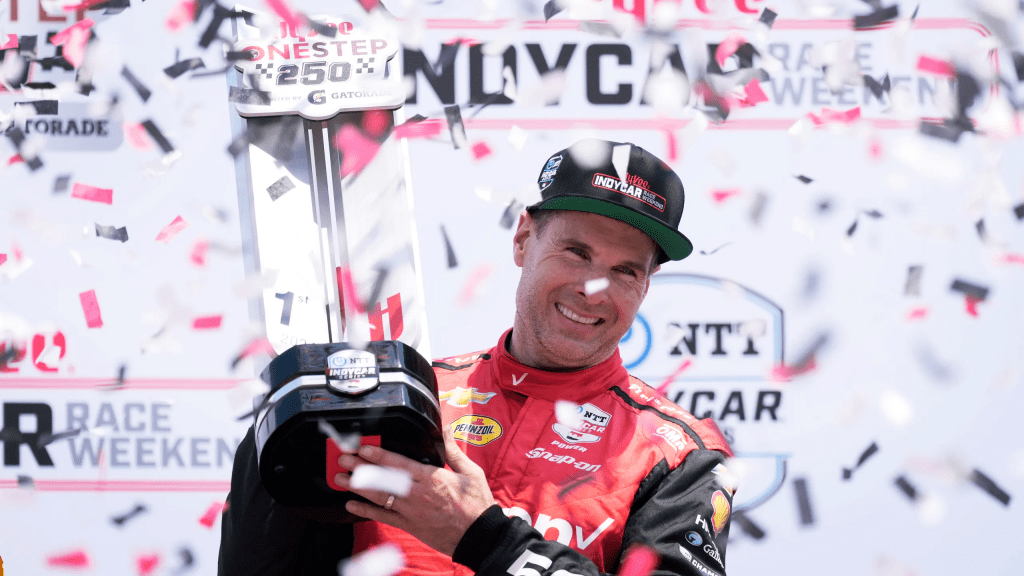
The major winner from a lucky caution was Will Power in race two. Power had hit the wall during his second qualifying lap, thus started race two in twenty-second. He managed to make it to nineteenth at the start, but went into fuel save mode afterwards. Thus, when a caution came out and only Power and Palou had to pit, Power found himself jumping from nineteenth to second. A successful overcut during the second pit stop sequence turned the second place into a victory for Power, achieved entirely by making no overtakes, at an oval. The worst part of this was that Power had a lot of pace which was evident when he was chasing Palou during the middle of the race. Yet, due to the resurfacing, Power didn’t take a win due to a tremendous performance aided by luck, he instead took one entirely through luck.
Just to cap off the weekend, the second race ended in a horrific accident. McLaren hadn’t fueled Alexander Rossi’s car correctly, so he suddenly slowed down on the last lap. This led to Sting Ray Robb crashing into him, with Sting Ray’s car rolling over in a dramatic fashion. This also led to Ed Carpenter and Kyle Kirkwood crashing in an attempt to avoid the rolling car. The safety standards of IndyCar have greatly improved in recent years; if it weren’t for the aero screens on the car, Sting Ray and Kyle would likely be dead. So, it was a relief to be reminded that, even in an awful weekend for the sport, safety standards overall have improved by a country mile since the horrific accidents of decades past. This near miss proved the only relief in this weekend defined by boredom though. Whilst there were some good performances across the field, the changes to the track and the introduction of the hybrid systems combined to make one of IndyCar’s worst weekends in a long time. This season is proving to be heavily disappointing and I’m severely hoping for a good weekend in Toronto.
IndyCar’s Mid-Ohio race saw the debut of the hybrid system. Introducing a new technology mid-season is quite the risk for IndyCar to take. On one hand, I do admire the confidence it shows in the technology. On the other, it may derail the season if things go wrong. Mid-Ohio was not a complete disaster for the hybrids but was also not the unmitigated success that the commentary team tried to spin it as either. Whilst there were not a flurry of hybrid related retirements, one happened on the warm up lap. And it was Scott Dixon who was the victim of this bad luck, who to this point has been one of the contenders for the championship. His chances were already fading before this race and his luck may have put the nail into the coffin. This is the primary concern people have with the hybrids, that they’ll mess up the championship fight. To see that fear realized before the race even started was concerning.
The race itself was a relatively dull affair with not many on track battles. Alex Palou once again started on pole and took an early lead, that reached around six seconds over Pato O’Ward by the first stops. The star of the weekend was David Malukas. Having been dropped by McLaren earlier in the year after breaking his wrists during the pre-season, Malukas was bought back into the sport by Meyer Shank Racing. Despite still suffering the effects of his broken wrists, Malukas was able to qualify in third place in only his second race back. A podium was on the cards, and he ran in third during the first stint. However, another persistent problem with the hybrids affected Malukas, his car stalling after his pit stop. This lost Malukas a lot of time that he was not able to recover, finishing the race in twelfth. At this point I was evidently quite angry, as two of my favorite drivers had their races ruined by the new technology. Whilst it will obviously affect different drivers in future races, if the hybrids’ aim was to instantly alienate me, they succeeded.
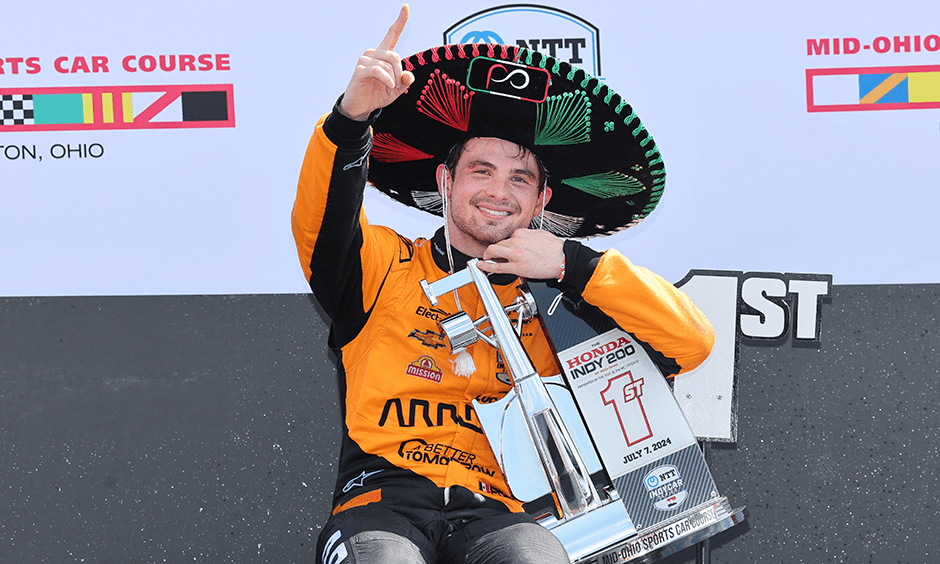
Due to the lack of action across the field, most of the coverage was focused on the battle for the win between Palou and O’Ward, which in fairness, did remain tense for the race’s distance. Whilst Palou had built up a healthy lead by the first stops, on the softer red tyres O’Ward proved the better driver. Throughout the second stint he slowly closed up to Palou, to be within a second by the time they made their second stops. O’Ward stopped first and successfully undercut Palou, who himself lost around a second with a mini stall leaving the pits. Whilst Palou was quicker on the harder black tyres, he was unable to find a way past O’Ward, even when they were in traffic. Therefore, O’Ward took his second win of the season and his first on-track victory in nearly two years, as his St. Petersburg win was awarded due to Josef Newgarden’s disqualification. It was a deserved win and reminded fans that O’Ward has what it takes to win races and fight for championships if his consistency improves.
Other than the battle at the front, there was little excitement in the field. The only other thing worth saying about the hybrid system is that the on-screen graphics need to be changed. Red and green lights were appearing on the timing screen beside every driver’s name when they were using or recharging their highlights. This was distracting enough for me; it would be a nightmare for fans with sensory issues. The graphics team needs to fix that immediately, as the sport should be accessible for all fans. Thankfully, this problem was not evident in the double header at Iowa, though it proved the least of that weekend’s problems.
The race at Laguna Seca this year was good, if not overly exciting. With strategic twists proving the highlight around the corkscrew, as Alex Palou delivered one of his dominant drives that we’ve become used to seeing over the past few years. He had to work hard to get this win, but superior pace combined with superior strategy led to a superior performance.
After achieving pole on Saturday, I was confident that Palou was going to take an easy win. The start placed some doubt into this inevitability, as Kyle Kirkwood made a fantastic move on the outside of the first couple of corners to take the lead. Whilst this made Palou’s job harder, it was quite clear during the first stint that Palou had better pace than Kirkwood. He was able to keep within a second of Kirkwood during the entire stint, in a track notoriously hard to follow at due to its twists and turns. It appeared that Palou would be able to pull off an overcut when Kirkwood pit to change his degrading tyres, but Alexander Rossi added an extra complication, by undercutting Kirkwood. Palou was forced to stop the next lap to prevent any further undercuts, but in doing so was passed by Kyle Kirkwood and Colton Herta on warmer tyres, placing him fourth at the beginning of the second stint. Without a strategic offset, it looked at this point like Palou’s chances of winning were fading. But a strategic offset was what he received.
During the the second stint a caution came out when Luca Ghiotto crashed. The leading trio of Alexander Rossi, Colton Hera and Kyle Kirkwood decided to pit, with Alex Palou electing to stay out. Herta jumped Rossi in the pits and was seen at this point by the commentary team as the favorite to win, as he would only need to make one more pit stop to Palou’s two. This confidence in Herta’s strategy was reinforced when Nolan Seigel bought out a second caution in his McLaren, no doubt filling Zak Brown with confidence that he’d made the right decision in firing Theo Pourchaire. For Palou to win the race, he would have to show vastly superior pace to the rest of the field, which the commentators did not expect to happen. However, the commentators forgot one thing, they were discussing Alex Palou.
When Palou made his second stop, he came out in third, behind Rossi and Herta. It became clear from this point that he’d taken the preferred strategy, as the drivers ahead of him were in a heavy state of fuel saving. Palou was able to dispatch with Rossi with relative ease and as the commentators were talking about how he did not have to instantly overtake Colton Herta to win, he went and overtook Herta regardless. From this point onwards, the only thing that kept the others in the game were the large number of cautions leaving Palou to manage multiple restarts. However, in Palou’s typical style, he did so with ease. The only major effect that the cautions had was preventing Romain Grosjean’s charge to the podium. Grosjean had followed Palou’s strategy and was looking set to take the first podium for his team. That this shock result was on the table showed the benefit of the three-stopper, it allowed drivers to push forwards rather than forcing them to look in their mirrors.
So, it was a fun, if not thrilling race at Laguna Seca. Palou put the pride themed livery into a deserved win and reminded everyone why he is already a two-time IndyCar champion. With every race, it’s looking more and more like Palou’s championship to lose.
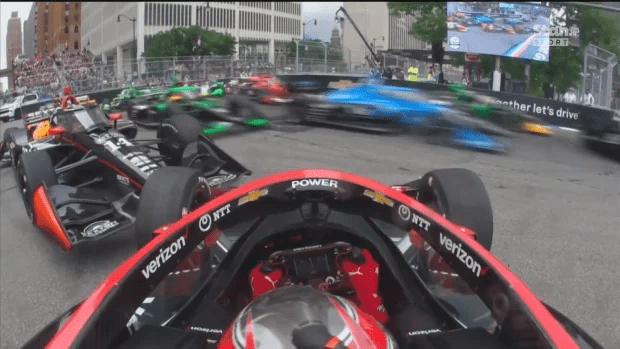
Whoever’s idea it was to follow up the excitement of the Indy500 with a race at a terrible street track in downtown Detroit needs to reflect on what they’ve done. Anyone who had watched the 500 and wanted to see what else IndyCar has to offer may not watch another race. With a track that is essentially a worse version of Baku, itself one of F1’s worst tracks, I expected the race to either be boring or chaotic to the point of frustration. Having now seen the second option play out, I really wish that this race was boring.
It’s unfortunate how the race unfolded, because the opening stint left some hope that it had some potential. This was because the teams mistakenly presumed that the softer green tyres would be preferrable. When Alex Palou, who had started the race in second on the greens, had to pit after dropping through the field like a boulder, it became apparent the harder black tyres were better. Realizing this, many teams prepared to adapt their strategies for a race that could have developed into an interesting tyre war. Instead, it began to rain.
Under a caution period, the track began to resemble a duck pond. At this point, many drivers, including the leading Colton Herta, pit for wet weather tyres. Then it stopped raining, whilst the safety car was still out. As the track dried up, every driver who had pitted regretted their choice, realizing they had handed a valuable win to Scott Dixon. Dixon managing to pull off one of his famous fuel saving strategies to take the win was the only saving grace from here on out. And even then, a Dixon master class is less impressive when nearly half the race was run under caution periods, due to events spiralling into some sort of demolition derby.
The aforementioned derby was not entertaining. Nearly every driver forgot what a braking point was and slammed into the sides of their competitors. Colton Herta was the only exception to this, preferring to miss his braking point so much that he slammed directly into the tyres at the end of the escape road. After having dominated the early stages of the race, Colton made another unforced error when he found himself lower down the field. His move was both emblematic of his championship challenge collapsing and a general lack of adherence to expected driving standards. It was not a great showing for the sensibilities of IndyCar’s drivers and destroyed whatever entertainment could have been salvaged out of the weekend.
Whilst personally dissatisfied at some of the racing standards on display, one thing from the Detroit weekend’s aftermath stuck out. You do not, under any circumstances, send abuse and death threats to anyone, for any reason, ever. This has been the warrant of a subsection of Augustin Canapino fans, who act like football ultras to anyone who crosses Augustin’s path. Theo Pourchaire was the target of abuse this time around, all for contact that was relatively minor compared to some of the incidents that took place during the race.[1] The abuse itself is already problematic, but Canapino’s response beggared belief, as he focused on how his fans were not responsible and questioned if Theo received death threats due to not having personally seen them.[2] This led to Augustin not racing at Road America and his team’s partnership with McLaren being terminated. Yet, Augustin’s response was not even the worst element of the whole debacle. That came from the team owner, Ricardo Juncos, who was heard calling Theo a ‘son of 1,000 wh***s.[3]’ It would be one thing for a driver, in the heat of the moment, to use inappropriate language towards a competitor. When the team owner is doing it, that speaks to a broader workplace cultural problem. And not only did Ricardo Juncos use inappropriate language, he used deeply misogynistic language, language that would not even come into my head to describe my worst enemy. All this, for minor contact. Juncos Hollinger need to do better.
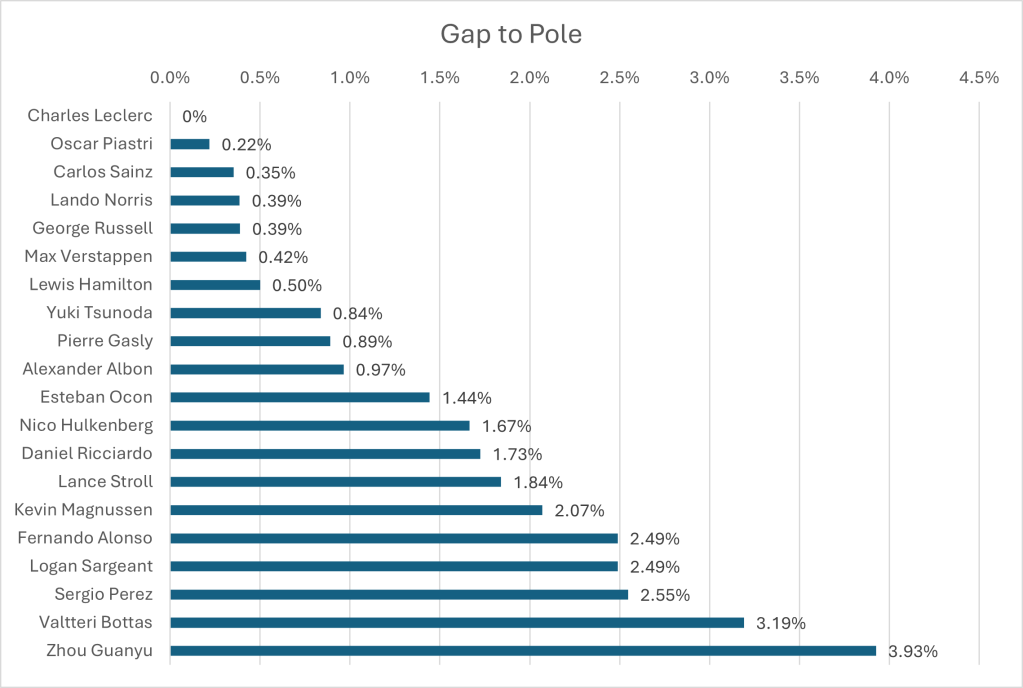
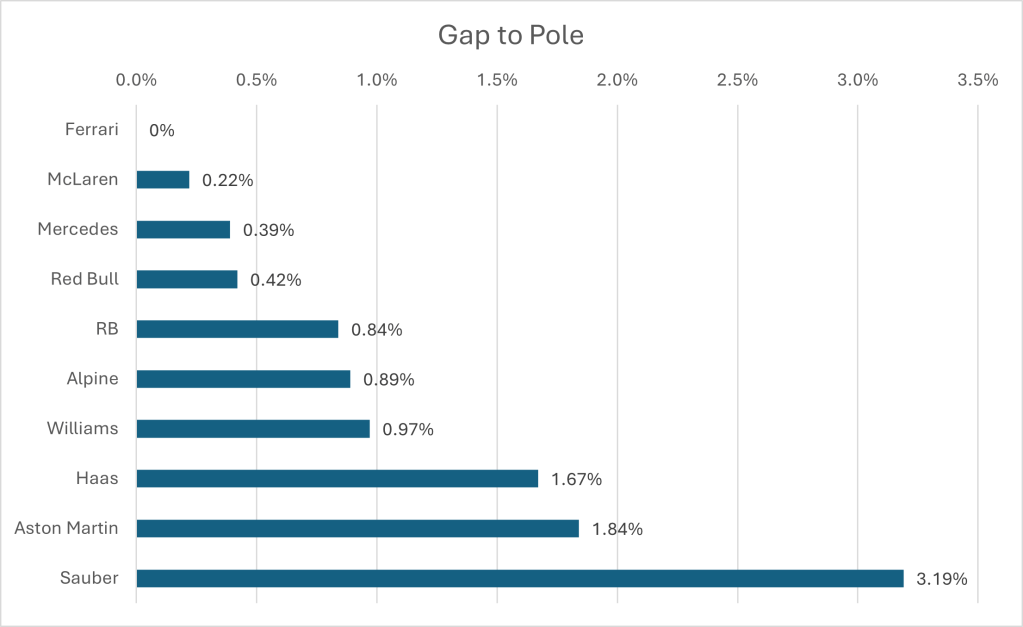
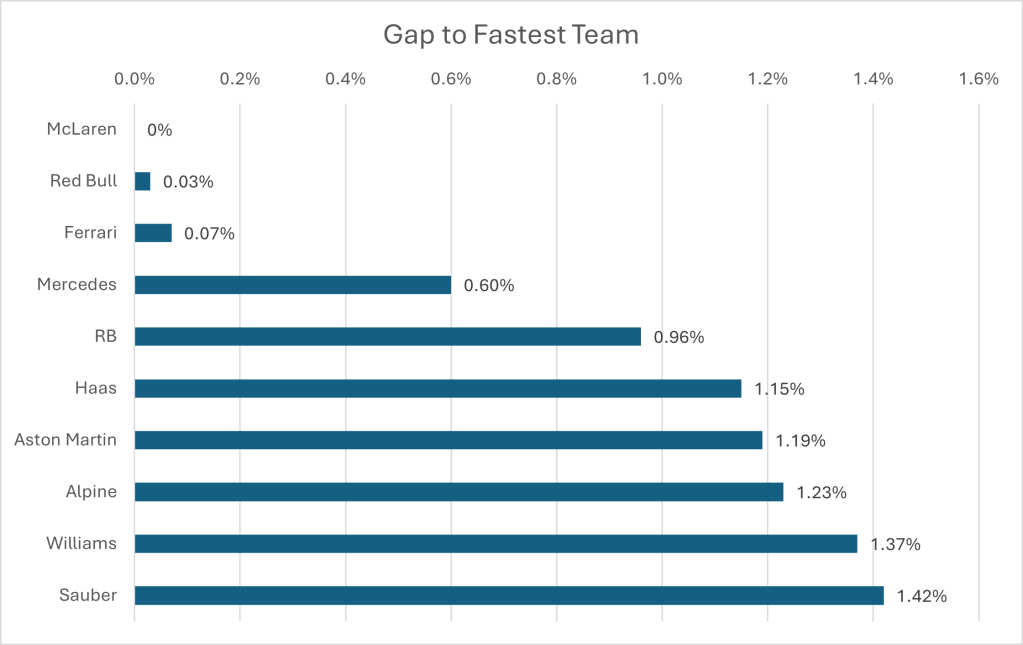
I have collated the fastest laps by each driver in qualifying, to show the average gap to the fastest driver. Whilst this extends the gap between drivers who made it to the top ten and those below, I’ve ruled using the overall fastest times a better grounding point for the true limit of the top cars, as the cars most likely to compete for points are my primary focus in these analyses.
Qualifying Pace-
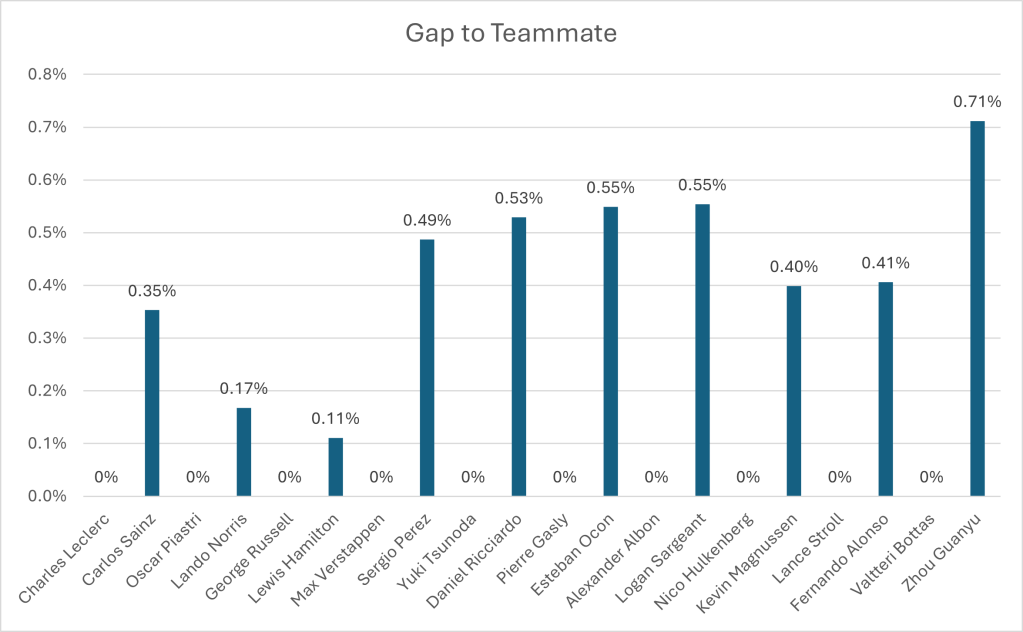
Additionally, I have collected the data for the gaps between teammates. I did this by using their lap times set in the same qualifying session. I generally compare the last session both drivers competed in, however if the fastest driver drove their fastest time in an earlier session, I count these times instead.
Race Pace-
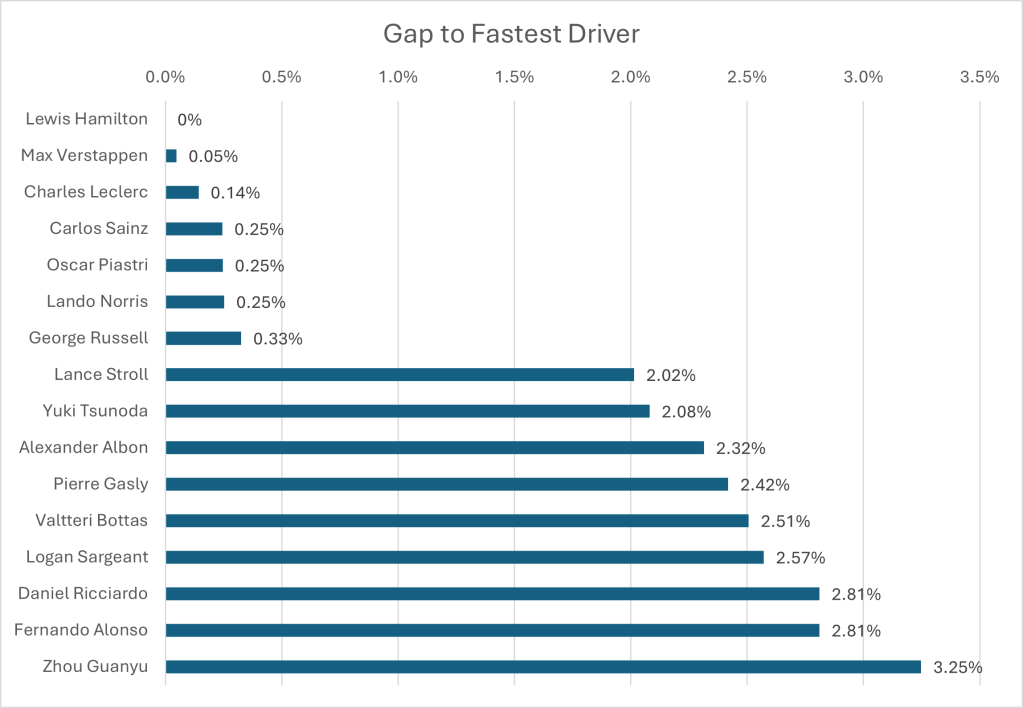
I have calculated the average pace of the drivers, removing race starts, laps in the pit lane and extra formation laps as these are all too slow to be representative. I have only included drivers that completed at least 75% of the laps to not skew the season averages against drivers that never got the chance to run their cars on low fuel, which excludes Esteban Ocon, Sergio Perez and both Haas drivers in Monaco.
As different drivers have a varying number of race stints, this skews the overall pace. Generally, if a driver makes more stops, their pace will be faster on average. This will be considered in my final thoughts and analysis. Additionally, the average pace per stint and number of stints are recorded at the bottom of this article, for those interested in viewing more precise estimates of pace relative to other drivers on the same stint.[1]
Analysis:
This race is not particularly representative of the pace of each team, as every driver was driving as slowly as possible for most of the race, to save their tyres on a track where overtaking is almost impossible.
Consequently, the Haas team benefited in the season long average by being out of the race after the first lap. As there are only 22 races, this should have little effect on the season long average, but is worth noting.
As they were the only drivers at the front to make a pit stop, Hamilton and Verstappen set the fastest average pace during the race. However, this does not represent the general pace the cars showed on similar stints, where the Ferrari and McLaren cars were faster.
There were a number of laps where I could not tell if cars had strategically reduced their pace or were being lapped. As I could not tell, I did not remove these laps.
Further Resources-
Qualifying Pace:
Driver
Fastest Qualifying Time
Charles Leclerc
70.27 (0%)
Oscar Piastri
70.424 (+0.219%)
Carlos Sainz
70.518 (+0.353%)
Lando Norris
70.542 (+0.387%)
George Russell
70.543 (+0.389%)
Max Verstappen
70.567 (+0.423%)
Lewis Hamilton
70.621 (+0.500%)
Yuki Tsunoda
70.858 (+0.837%)
Pierre Gasly
70.896 (+0.891%)
Alexander Albon
70.948 (+0.965%)
Esteban Ocon
71.285 (+1.444%)
Nico Hulkenberg
71.44 (+1.665%)
Daniel Ricciardo
71.482 (+1.725%)
Lance Stroll
71.563 (+1.840%)
Kevin Magnussen
71.725 (+2.071%)
Fernando Alonso
72.019 (+2.489%)
Logan Sargeant
72.02 (+2.490%)
Sergio Perez
72.06 (+2.547%)
Valtteri Bottas
72.512 (+3.191%)
Zhou Guanyu
73.028 (+3.925%)
Average Race Pace:
Driver
Pace
Lewis Hamilton
78.245 (0%)
Max Verstappen
78.283 (+0.048%)
Charles Leclerc
78.357 (+0.143%)
Carlos Sainz
78.437 (+0.245%)
Oscar Piastri
78.438 (+0.247%)
Lando Norris
78.443 (+0.253%)
George Russell
78.5 (+0.326%)
Lance Stroll
79.821 (+2.015%)
Yuki Tsunoda
79.873 (+2.081%)
Alexander Albon
80.056 (+2.315%)
Pierre Gasly
80.138 (+2.419%)
Valtteri Bottas
80.206 (+2.507%)
Logan Sargeant
80.257 (+2.572%)
Daniel Ricciardo
80.444 (+2.811%)
Fernando Alonso
80.445 (+2.811%)
Zhou Guanyu
80.786 (+3.248%)
All Stints:
Best Stints
Pace
Hamilton 3rd (26L/UH)
75.673
Verstappen 3rd (25L/UH)
75.681
Sargeant 3rd (18L/UH)
77.127
Zhou 3rd (5L/NS)
77.636
Leclerc 2nd (75L/NH)
78.357
Sainz 2nd (75L/NH)
78.437
Piastri 2nd (75L/UH)
78.438
Norris 2nd (75L/UH)
78.443
Stroll 4th (27L/NS)
78.458
Russell 2nd (75L/NM)
78.5
Verstappen 2nd (48L/NM)
79.638
Hamilton 2nd (47L/NM)
79.668
Bottas 3rd (60L/UH)
79.84
Tsunoda 2nd (74L/UH)
79.873
Albon 2nd (74L/NH)
80.056
Gasly 2nd (74L/NM)
80.138
Ricciardo 2nd (73L/UH)
80.444
Alonso 2nd (73L/UM)
80.445
Stroll 2nd (38L/UM)
80.937
Zhou 2nd (66L/NH)
81.025
Sargeant 2nd (53L/NM)
81.32
Bottas 2nd (11L/NM)
82.206
Key: 1L= One Lap, 2L= Two Laps, NH= New Hards, UM= Used Mediums, NM= New Mediums, NS= New Softs
[1] I only include stints in the stint table if a driver has completed five or more representative laps, in an attempt to avoid fastest lap attempts. This has led to exclusions from the chart of everyone’s first stint and Stroll’s third stint.
Last week’s Indy 500 was predictably fantastic. 200 laps of the greatest racing you’ll ever see, I can’t do the whole race justice. If you didn’t watch it, you were incredibly unlucky. Nothing beats the 2.5-mile oval in the heart of Indianapolis, it is exhilarating from start to finish.
A week before the race, came the two days of qualifying. Like the race itself, this is an amazing watch. Seeing laps around this speedway, it’s like watching someone drive a rollercoaster. And the narrative qualifying set in place for the race was fascinating. Team Penske delivered an amazing qualifying car, locking out all three spots on the front row, an achievement mirroring 1988. Quite fittingly, the pole sitter, Scott McLaughlin, was driving a tribute livery to the car that had won that year, the Yellow Submarine. He also set a new world record, a four-lap average of 234.22mph. The question on everyone’s mind for the next week was, would Team Penske translate their success into a race win, or would any of the challengers come good on race day?
So, race day came and……… there was a delay. A long delay. This was due to a lightning storm, definitely not the best conditions to race 200mph around an oval. So, I waited, for hours, though thankfully doing things more exciting than rewatching the Monaco Grand Prix.[1] But the race finally came, though the delay appeared to affect the drivers more than me. Because everyone was absolutely sending it, the midfield was chaos and there were more cautions than I could count. The first of these came when the rookie Tom Blomqvist put his wheels into the grass, spun and took out Marcus Erriccson in the process, to cap off a disappointing May for the former winner. These cautions bred cautions, which consequently made fuel saving less necessary than in the last few 500s, leading to the drivers racing each other even harder, breeding yet more cautions. Praise needs to go to the safety team, for how quickly they react to problems on track. They were always at the scene within ten seconds of an accident. Comparing the Indy safety team to F1’s, where it sometimes takes over half a lap for race control to call a safety car, it’s clear which sport values safety the most.
However, not all of the cautions were caused by accidents and collisions. Others were caused by Hondas. Whilst the Chevrolet engines were in danger during qualifying, come race day, it was the Hondas blowing up. Honda’s reliability woes made me worry for Colton Herta, one of the favourites to win the race. I like Colton, he’s funny, talented and attractive. If Dixon isn’t winning the race, I’d like it to be Colton. Yet, I didn’t have to worry about Colton’s engine taking him out of the race, as Colton was willing to do that on his own. Whilst Colton felt like a brand-new person this year, he made the same old mistakes, taking himself out of 2nd place and a possible win. Whilst a win would have bolstered Herta’s championship challenge, a 23rd place has done the exact opposite, to the disappointment of many an American racing fan.
Towards the middle of the race, a frantic battle erupted between Alexander Rossi, Scott McLaughlin, Alex Palou, Josef Newgarden and Santino Ferrucci for the effective lead. Every driver knew that it was vital to gain necessary track position at this point, put themselves towards the head of that train, as it would give them the best chance of battling for the win at the end of the race. Rossi and Newgarden were most successful in these struggles, but up the road, Scott Dixon and Pato O’Ward were leading, on alternative pit stop strategies. Whilst they needed to fuel save, they had a really good chance of being in the fight for the lead come the end of the race. And then came the last thirty laps.
The last thirty laps of this year’s Indy 500 was some of the greatest action I’ve seen in any motorsports race. There was a four-way battle, as Rossi, O’Ward, Dixon and Newgarden all took times leading and there were moves on nearly every lap. Initially, Dixon seemed like he might have the driver’s seat. Whilst the most successful driver currently in the series, Dixon has only won the 500 once, in 2008. As he’s the driver I support, to see him win it from his lowest starting position ever, would have been cathartic after witnessing so many near misses. Alas, his starting position did represent one truth, Dixon’s Chip Ganassi car did not have the ultimate race pace of the Penskes and the McLarens, thus he faded as the stint continued. However, a last lap move on Rossi guaranteed a place on the podium, a consultation to wrap up an otherwise difficult month of May.
As the final stint continued, the race became a two-car battle between O’Ward and Newgarden. They swapped the lead, again and again, but at the beginning of the final lap, Pato made a decisive move on the main straight. It looked like, after many heartbreaking near misses, Pato might finally achieve his dream. He put in so much work into getting to this moment and earlier in the race, had managed to save himself from two snaps of understeer, that would have, and did, put many other drivers into the wall. This was about to be his moment; Mexico was about to celebrate its first Indy 500 win. But last year’s winner had something to say about that. Josef Newgarden, the two-time champion, having waited twelve years to win his first Indy 500, made an amazing move around the outside of O’Ward on turn three, at the last possible opportunity, to win two in a row. It was heartbreaking for O’Ward, who was visibly distraught after the race, but elation for Team Penske and Newgarden, who once again celebrated in the crowd. The emotions in this race are part of what makes it the greatest, as throughout the entire month, everyone tries so hard to win. And everyone takes the emotions seriously, no failed stand-up comedy like you get from F1’s commentators, instead you get pure hype and emotion. Even viewing from home, I can feel the gravitas of this event, so I can’t imagine what it’s like in that crowd, knowing that you’re viewing the greatest spectacle in racing and then celebrating with the winner.
Thus, the Indy 500. Whilst I’ve been able to talk about my favourite moments, there’s still so much I missed. From Sting Ray Robb (yes, that is his name) leading the 3rd most laps, to Dixon’s controversial contact with Ryan Hunter Ray, to Will Power’s disappointing afternoon, going from a pre-race favourite to the wall, this race had everything. I reiterate, if you didn’t watch it, you missed out. So, remember to put May 25th in your calendar next year, avoid missing out again.
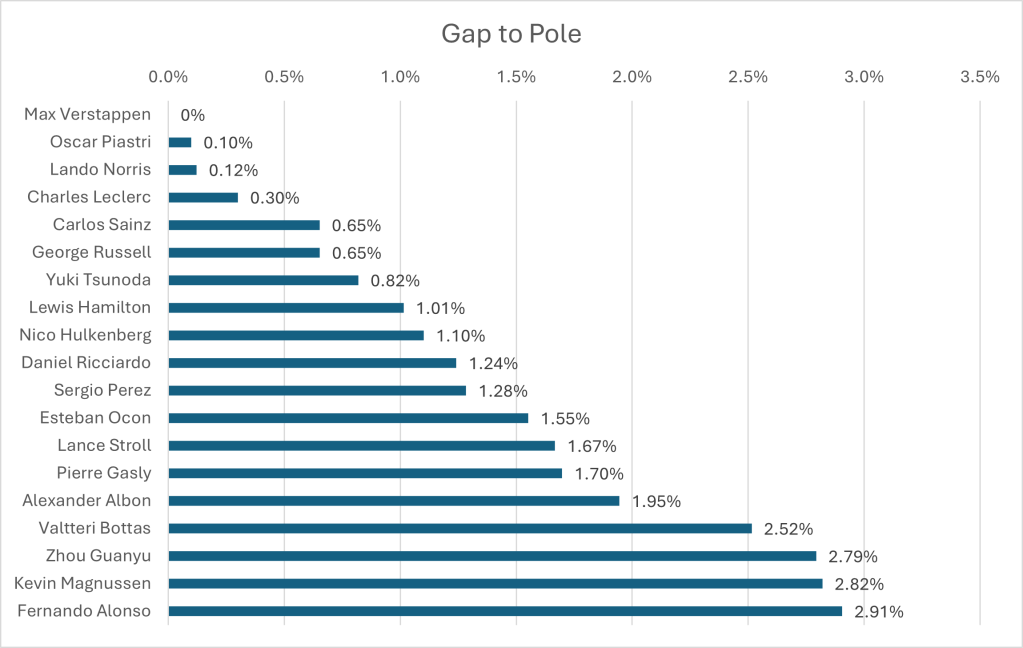
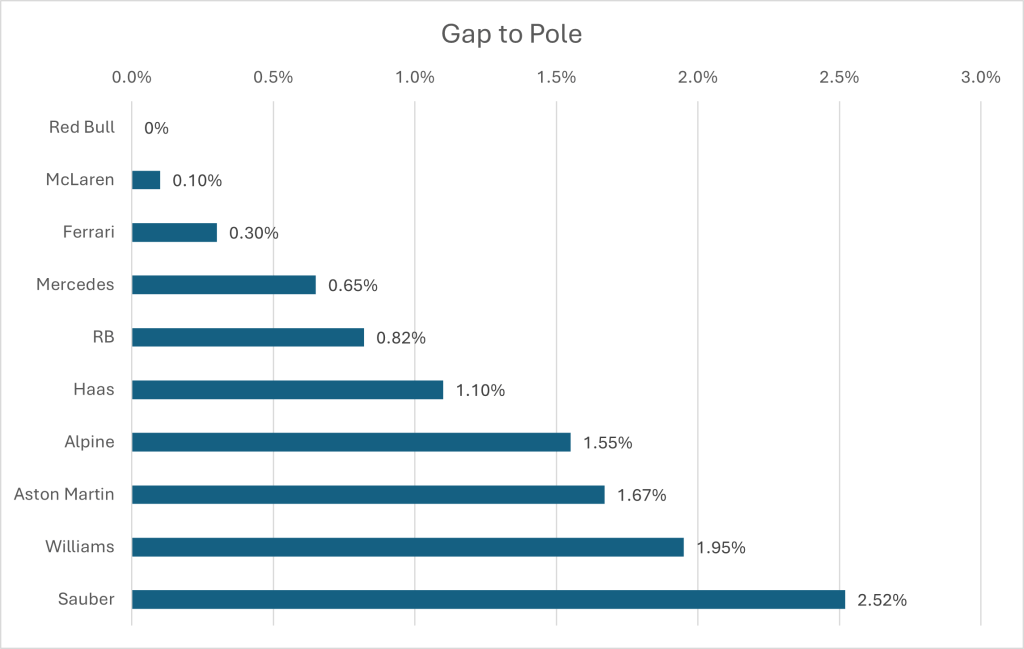
I have collated the fastest laps by each driver in qualifying, to show the average gap to the fastest driver. Whilst this extends the gap between drivers who made it to the top ten and those below, I’ve ruled using the overall fastest times a better grounding point for the true limit of the top cars, as the cars most likely to compete for points are my primary focus in these analyses.
Qualifying Pace-
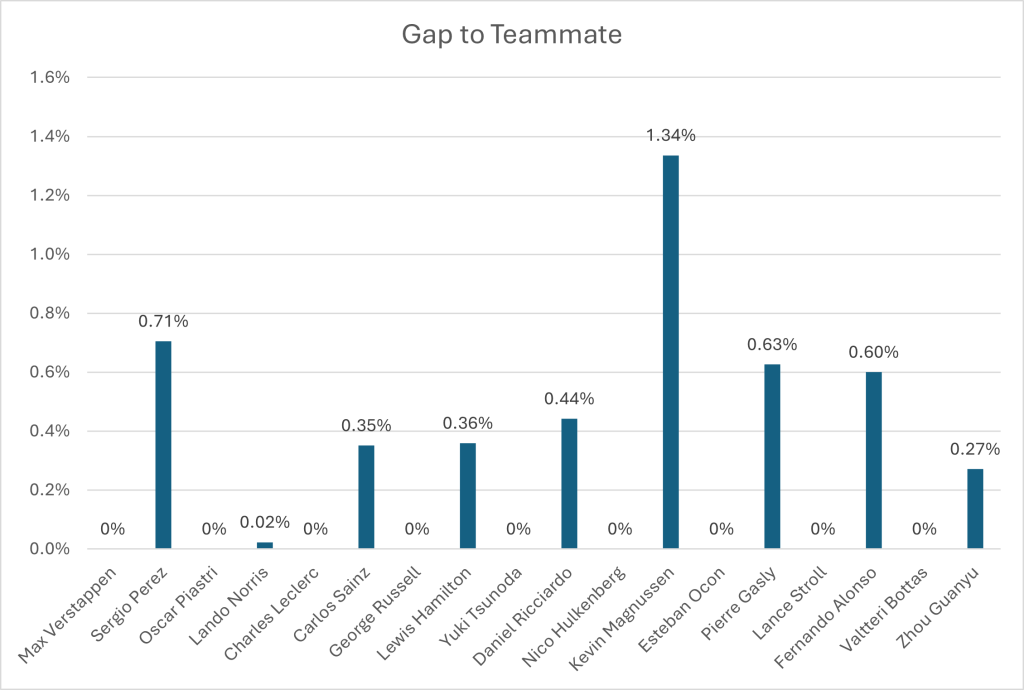
Additionally, I have collected the data for the gaps between teammates. I did this by using their lap times set in the same qualifying session. I generally compare the last session both drivers competed in, however if the fastest driver their fastest time in earlier sessions, I count these instead.
Race Pace-
I have calculated the average pace of the drivers, removing the first laps, laps in the pit lane and laps under the safety car as these are all too slow to be representative. Additionally, I removed any laps with major errors I noticed, such as when Perez or Hamilton crossed the gravel trap in Imola. I have only included drivers that completed at least 75% of the laps to not skew the season averages against drivers that never got the chance to run their cars on low fuel.
As different drivers have a varying number of race stints, this skews the overall pace. Generally, if a driver makes more stops, their pace will be faster on average. This will be considered in my final thoughts and analysis. Additionally, the average pace per stint and number of stints are recorded at the bottom of this article, for those interested in viewing more precise estimates of pace relative to other drivers on the same stint.[1]
Analysis:
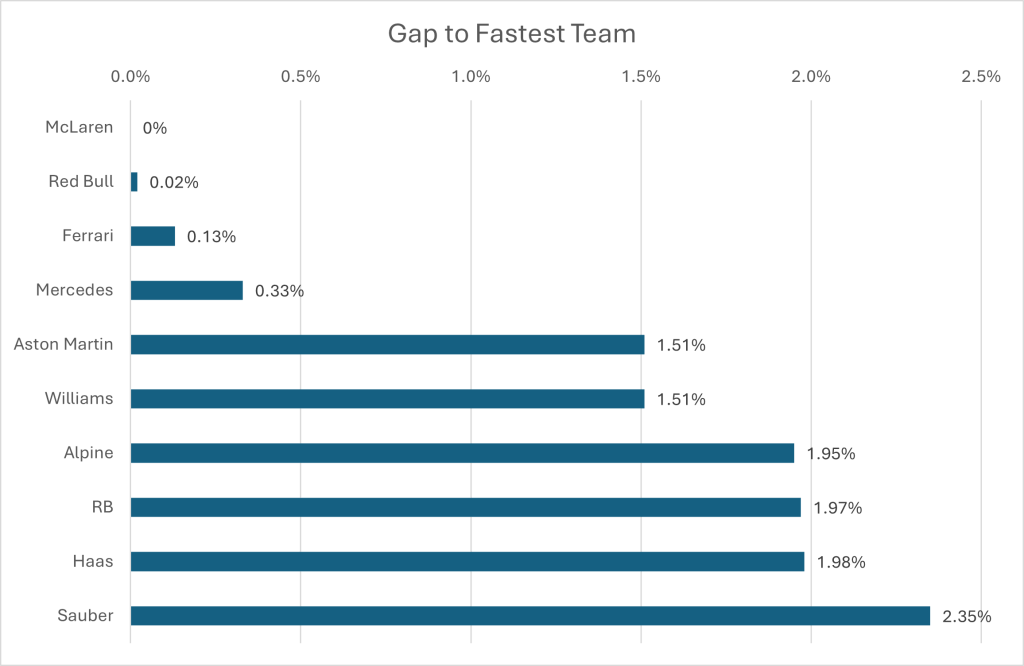
Pace was generally quite similar between the top three drivers, who all were fastest at some point in the race. Whilst the track did not suit Ferrari, their upgrades appear to have put them in the fight with Red Bull, as well as McLaren’s upgrades nearly delivering another win to Lando Norris.
Aston’s upgrades have not appeared to correlate very well and at present, their pace is similar to the lower midfield. This could be a very bad sign for their season, as upgrades not correlating was the cause of their downfall last season. If they don’t get a handle on their development, they may start to be regularly beaten by the likes of RB and Haas.
Several teams ran terrible strategies, stopping their drivers onto hard tyres incredibly early, failing to account for high tyre degradation. These drivers tended to deliver slower second stints than their initial stints, a rarity in the post-refuelling era.
Haas in particular, made a mistake when they reacted to Tsunoda’s early stop with Hulkenberg. If Hulkenberg had copied Magnussen’s strategy and stopped later he could have banked a ninth place, as he would have been able to overtake Tsunoda on newer tyres and would have covered off Stroll’s ability to overtake him. Magnussen finished less than two seconds behind Hulkenberg on this strategy, when he started in eighteenth.
Albon’s pace seems to have been bolstered by his retirement, due to the suboptimal strategies of other drivers, as usually if a driver retires, their pace is relatively worse.
Further Resources-
Qualifying Pace:
Driver
Fastest Qualifying Time
Max Verstappen
74.746 (0%)
Oscar Piastri
74.82 (+0.099%)
Lando Norris
74.837 (+0.122%)
Charles Leclerc
74.97 (+0.300%)
Carlos Sainz
75.233 (+0.652%)
George Russell
75.234 (+0.653%)
Yuki Tsunoda
75.358 (+0.819%)
Lewis Hamilton
75.504 (+1.014%)
Nico Hulkenberg
75.569 (+1.101%)
Daniel Ricciardo
75.674 (+1.242%)
Sergio Perez
75.706 (+1.284%)
Esteban Ocon
75.906 (+1.552%)
Lance Stroll
75.992 (+1.667%)
Pierre Gasly
76.015 (+1.698%)
Alexander Albon
76.2 (+1.945%)
Valtteri Bottas
76.626 (+2.515%)
Zhou Guanyu
76.834 (+2.793%)
Kevin Magnussen
76.854 (+2.820%)
Fernando Alonso
76.917 (+2.905%)
Average Race Pace:
Driver
Pace
Lando Norris
80.857 (0%)
Max Verstappen
80.876 (+0.024%)
Charles Leclerc
80.959 (+0.127%)
Oscar Piastri
81.07 (+0.263%)
George Russell
81.121 (+0.326%)
Carlos Sainz
81.199 (+0.423%)
Lewis Hamilton
81.31 (+0.560%)
Sergio Perez
81.578 (+0.891%)
Lance Stroll
82.078 (+1.510%)
Alexander Albon
82.078 (+1.510%)
Fernando Alonso
82.289 (+1.771%)
Pierre Gasly
82.434 (+1.950%)
Yuki Tsunoda
82.449 (+1.969%)
Kevin Magnussen
82.46 (+1.982%)
Nico Hulkenberg
82.55 (+2.094%)
Daniel Ricciardo
82.571 (+2.120%)
Zhou Guanyu
82.759 (+2.353%)
Logan Sargeant
82.81 (+2.416%)
Esteban Ocon
82.81 (+2.416%)
Valtteri Bottas
82.987 (+2.634%)
All Stints:
Best Stints
Pace
Russell 3rd (10L/UM)
79.934
Perez 2nd (25L/NM)
80.49
Norris 2nd (40L/UH)
80.612
Leclerc 2nd (37L/NH)
80.659
Verstappen 2nd (38L/NH)
80.723
Piastri 2nd (39L/UH)
80.779
Sainz 2nd (35L/NH)
80.91
Hamilton 2nd (35L/NH)
80.992
Verstappen 1st (22L/NM)
81.14
Russell 2nd (28L/NH)
81.156
Stroll 2nd (25L/UH)
81.276
Norris 1st (20L/NM)
81.348
Leclerc 1st (23L/NM)
81.412
Alonso 3rd (17L/UM)
81.492
Sainz 1st (25L/NM)
81.604
Piastri 1st (21L/NM)
81.609
Russell 1st (19L/NM)
81.692
Magnussen 2nd (24L/NH)
81.727
Hamilton 1st (24L/NM)
81.774
Albon 5th (21L/UM)
81.788
Albon 3rd (12L/NH)
82.007
Hulkenberg 1st (11L/NM)
82.256
Tsunoda 1st (10L/NM)
82.259
Gasly 2nd (20L/NH)
82.331
Sargeant 2nd (30L/NM)
82.35
Perez 1st (34L/NH)
82.378
Ricciardo 1st (9L/NM)
82.386
Zhou 2nd (28L/NM)
82.415
Gasly 3rd (31L/NM)
82.455
Tsunoda 2nd (49L/NH)
82.488
Ricciardo 2nd (50L/NH)
82.604
Albon 1st (8L/NM)
82.612
Hulkenberg 2nd (48L/NH)
82.617
Alonso 2nd (31L/UH)
82.626
Stroll 1st (35L/UM)
82.651
Gasly 1st (6L/NS)
82.666
Ocon 2nd (36L/NH)
82.745
Bottas 1st (6L/NM)
82.825
Ocon 1st (23L/NM)
82.912
Magnussen 1st (35L/NM)
82.962
Bottas 2nd (53L/NH)
83.005
Zhou 1st (31L/NH)
83.071
Alonso 1st (5L/NS)
83.145
Sargeant 1st (29L/NH)
83.286
Key: 1L= One Lap, 2L= Two Laps, NH= New Hards, UM= Used Mediums, NM= New Mediums, NS= New Softs
[1] I only include stints in the stint table if a driver has completed five or more representative laps, in an attempt to avoid fastest lap attempts. This has led to exclusions from the chart of Alonso’s fourth stint and Albon’s second and fourth stints.
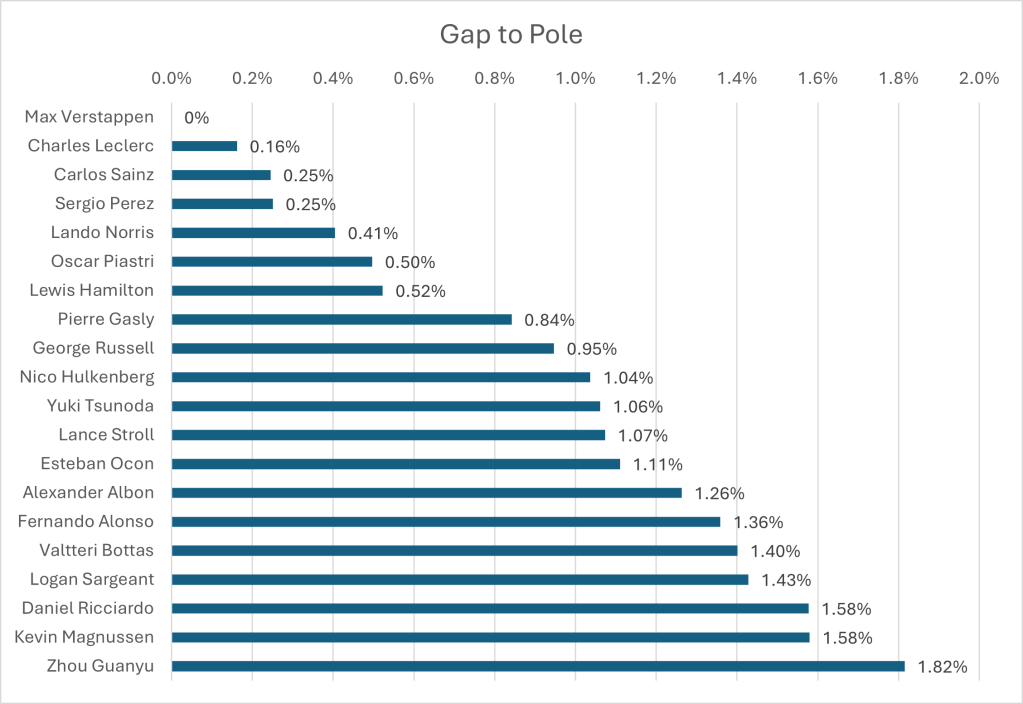
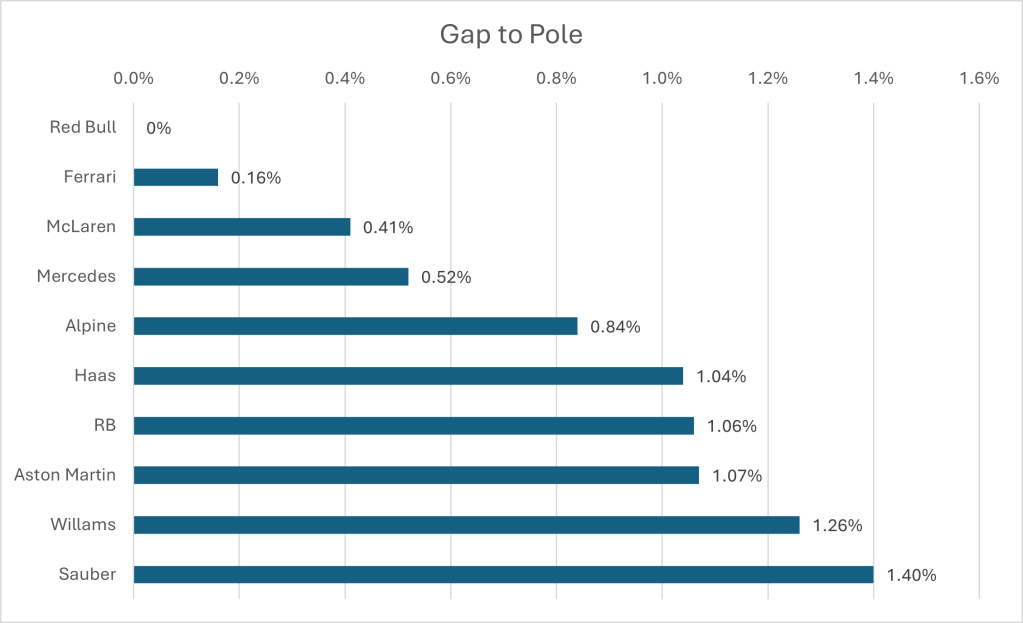
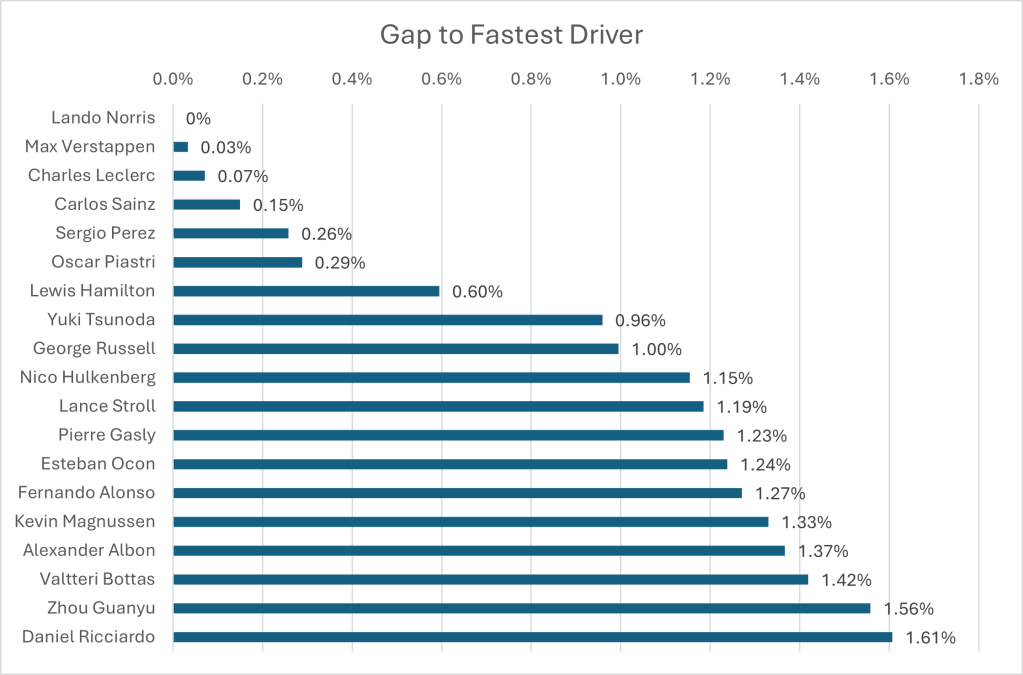
I have collated the fastest laps by each driver in qualifying, to show the average gap to the fastest driver. Whilst this extends the gap between drivers who made it to the top ten and those below, I’ve ruled using the overall fastest times a better grounding point for the true limit of the top cars, as the cars most likely to compete for points are my primary focus in these analyses.
Qualifying Pace-
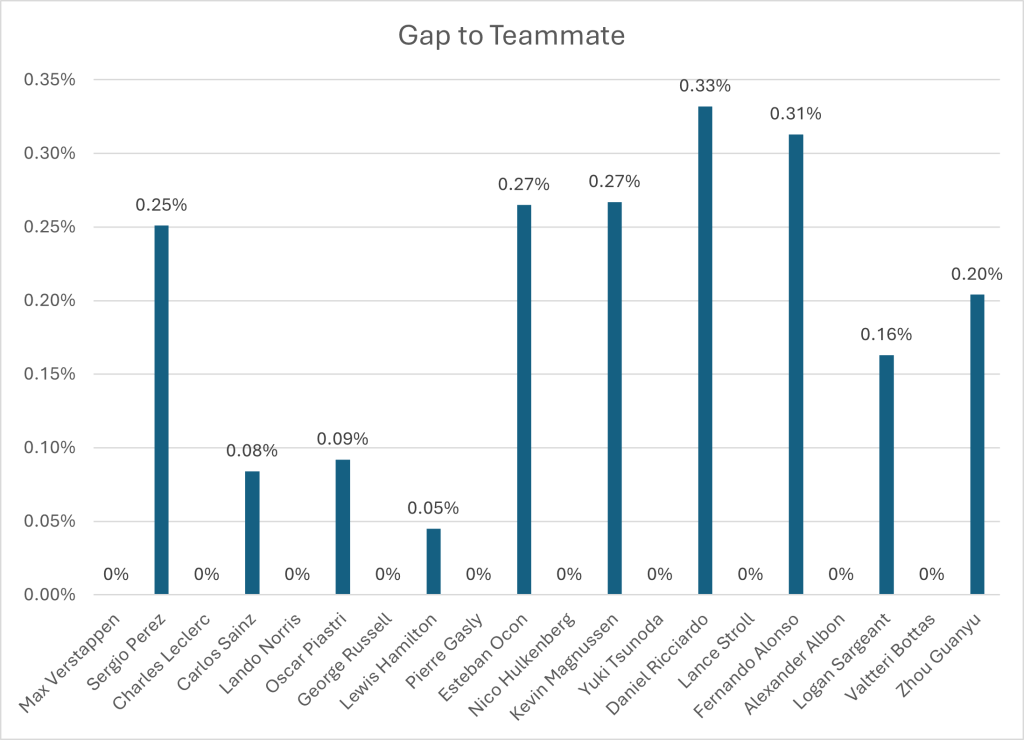
Additionally, I have collected the data for the gaps between teammates. I did this by using their lap times set in the same qualifying session. I generally compare the last session both drivers competed in, however if both set their fastest times in earlier, I count these instead.
Race Pace-
I have calculated the average pace of the drivers, removing the first laps, laps in the pit lane and laps under the safety car as these are all too slow to be representative. Additionally, I removed any laps with major errors I noticed, for example spinning in the lap. In previous races, I excluded the laps after a safety car restart, as these tended to resemble the first laps, yet I counted them for China, as the long straights on the track seem to have negated the loss from cars being bunched up in the lap’s corners. I have only included drivers that completed at least 75% of the laps to not skew the season averages against drivers that never got the chance to run their cars on low fuel.[1]
As different drivers have a varying number of race stints, this skews the overall pace. Generally, if a driver makes more stops, their pace will be faster on average. This will be considered in my final thoughts and analysis. Additionally, the average pace per stint and number of stints are recorded at the bottom of this article, for those interested in viewing more precise estimates of pace relative to other drivers on the same stint.[2]
Analysis:
The McLaren was quite evidently the quickest car in clean air in Miami, as Piastri’s first stint and Norris’ second stint were both quicker than Verstappen’s respective stints.
The Aston Martin, especially from Alonso, was particularly slow in Miami. The team needs upgrades to improve their pace or they’re at risk of falling behind RB and maybe even Haas. Last year, Aston’s upgrades were very weak, some even making the team fall backwards, so if this trend repeats itself, Aston could be in real trouble.
Alpine is continuing to make a slow rise up the midfield. They were quicker than Williams and Sauber throughout the whole weekend. With Williams’ long-term plan being to sacrifice this year and Sauber’s never-ending incompetency, Alpine appear to be in the fight for points at least now. How far they’ll move up the midfield will be seen, but they probably expect to be with RB and Aston Martin by the end of the season.
Mercedes showed relatively solid pace in the race, particularly from Hamilton. Whilst not challenging the top three, I expect them to hold onto fourth place, when taking into account Aston’s struggles this weekend.
Further Resources-
Qualifying Pace:
Driver
Fastest Qualifying Time
Max Verstappen
87.241 (0%)
Charles Leclerc
87.382 (+0.162%)
Carlos Sainz
87.455 (+0.245%)
Sergio Perez
87.46 (+0.251%)
Lando Norris
87.594 (+0.405%)
Oscar Piastri
87.675 (+0.497%)
Lewis Hamilton
87.697 (+0.523%)
Pierre Gasly
87.976 (+0.842%)
George Russell
88.067 (+0.947%)
Nico Hulkenberg
88.146 (+1.037%)
Yuki Tsunoda
88.167 (+1.061%)
Lance Stroll
88.177 (+1.073%)
Esteban Ocon
88.209 (+1.110%)
Alexander Albon
88.343 (+1.263%)
Fernando Alonso
88.427 (+1.359%)
Valtteri Bottas
88.463 (+1.401%)
Logan Sargeant
88.487 (+1.428%)
Daniel Ricciardo
88.617 (+1.577%)
Kevin Magnussen
88.619 (+1.580%)
Zhou Guanyu
88.824 (+1.815%)
Average Race Pace:
Driver
Pace
Lando Norris
92.168 (0%)
Max Verstappen
92.198 (+0.033%)
Charles Leclerc
92.233 (+0.071%)
Carlos Sainz
92.305 (+0.150%)
Sergio Perez
92.405 (+0.258%)
Oscar Piastri
92.433 (+0.288%)
Lewis Hamilton
92.716 (+0.595%)
Yuki Tsunoda
93.051 (+0.959%)
George Russell
93.085 (+0.995%)
Nico Hulkenberg
93.231 (+1.154%)
Lance Stroll
93.26 (+1.185%)
Pierre Gasly
93.301 (+1.230%)
Esteban Ocon
93.309 (+1.238%)
Fernando Alonso
93.339 (+1.271%)
Kevin Magnussen
93.393 (+1.330%)
Alexander Albon
93.428 (+1.367%)
Valtteri Bottas
93.475 (+1.419%)
Zhou Guanyu
93.604 (+1.558%)
Daniel Ricciardo
93.649 (+1.607%)
All Stints:
Best Stints
Pace
Norris 2nd (24L/NH)
91.205
Sainz 2nd (24L/NH)
91.545
Verstappen 2nd (27L/NH)
91.576
Perez 3rd (24L/UM)
91.657
Hamilton 2nd (24L/UM)
91.68
Leclerc 2nd (30L/NH)
91.686
Piastri 3rd (16L/UM)
91.832
Piastri 2nd (6L/NH)
92.007
Tsunoda 2nd (24L/NH)
92.09
Russell 2nd (26L/NH)
92.406
Magnussen 3rd (25L/NM)
92.432
Hulkenberg 3rd (24L/NM)
92.512
Alonso 2nd (28L/UM)
92.587
Stroll 3rd (24L/UM)
92.667
Ocon 2nd (28L/NH)
92.677
Perez 2nd (8L/NH)
92.707
Bottas 3rd (24L/NM)
92.88
Ricciardo 2nd (24L/UM)
92.896
Zhou 2nd (24L/NS)
92.936
Piastri 1st (24L/NM)
92.94
Verstappen 1st (21L/NM)
92.999
Gasly 2nd (36L/NH)
93.047
Norris 1st (26L/NM)
93.057
Sainz 1st (24L/NM)
93.066
Leclerc 1st (17L/NM)
93.198
Albon 2nd (33L/NH)
93.405
Perez 1st (15L/NM)
93.442
Stroll 2nd (13L/UH)
93.712
Sargeant 2nd (13L/NH)
93.738
Bottas 2nd (13L/NH)
93.786
Hulkenberg 2nd (12L/NH)
93.786
Hamilton 1st (23L/NH)
93.797
Russell 1st (21L/UM)
93.926
Tsunoda 1st (25L/NM)
93.974
Stroll 1st (9L/UM)
94.187
Ocon 1st (20L/NM)
94.194
Gasly 1st (10L/NM)
94.216
Zhou 1st (24L/NM)
94.272
Albon 1st (8L/NM)
94.283
Hulkenberg 1st (10L/NM)
94.292
Alonso 1st (20L/UH)
94.392
Ricciardo 1st (24L/NH)
94.401
Sargeant 1st (9L/NM)
94.51
Magnussen 1st (20L/NH)
94.569
Bottas 1st (9L/NS)
94.612
Key: 1L= One Lap, 2L= Two Laps, NH= New Hards, UM= Used Mediums, NM= New Mediums, NS= New Softs
[2] I only include stints in the stint table if a driver has completed five or more representative laps, in an attempt to avoid fastest lap attempts. This has led to exclusions from the chart of Magnussen’s second stint and Albon’s third stint.
IndyCar provided spectators with another entertaining race at Barber Motorsports Park. Scott McLaughlin made it two wins in a row at this track. Whilst having to endure cautions, mannequins and his teammate, McLaughlin ensured that his superior pace was bolstered by solid race craft. After a week in which Team Penske faced controversy, having been disqualified for cheating during the opening race, McLaughlin delivered a much-needed result for the team, catapulting himself up the standings in the process.
Pato O’Ward had a less solid time. Whilst being one of IndyCar’s young talents, Pato seems to have a propensity to make mistakes under pressure. That was true at Long Beach and was repeated at Barber. Pato ruined his race on the second lap, through missing his braking point, locking up and going through a gravel trap. Shortly after this, he took Pietro Fittipaldi out of the race, receiving a drive-through penalty for his efforts. Due to the Penske disqualifications, Pato received a lifeline, with a belated victory in the opening race of the season. To see him throw this lifeline away with mistakes and collisions was incredibly disappointing.
Pato was not the only McLaren disasterclass of the day. The pit crew failed to attach Alexander Rossi’s tyre on properly, leading to it falling off. This led to a caution being called, which became the fulcrum of the event. At this point, McLaughlin and Power, who had been running 1st and 2nd, found themselves in the middle of the pack. Will Power briefly overtook Scott McLaughlin in the chaos, which could have provided him with the opportunity to win the race. However, McLaughlin showed his tenacity, overtaking Power with a fantastic move, before proceeding to cut through the pack. Another caution ensured that McLaughlin was in the hot seat to lead again, but before that caution, there was a unique occurrence.
Before Sting Ray Robb crashed, a slightly risqué mannequin fell from a bridge, onto the side of the track, before its hand was run over by an IndyCar. This was one of the most bizarre moments I’ve ever seen on live TV. Thankfully, it didn’t appear that anyone was convinced that they had run over an actual person, but I can imagine it was incredibly frightening for all involved. During the 3rd caution, Georgina (the mannequin) was removed from the side of the track, no doubt saving her from the fright of her life.
Overall, I had fun with this one. Whilst not being as memorable as the previous race, McLaughlin was a well-deserved winner and the race was complemented by a number of entertaining incidents, battling and mannequins.


 Ryan's Lil' F1 Blog